Monthly Archives: August 2010

Castle Stuart Passes Latest Test

A reader from “Lake Wobegon” — a transparent alias for Lake Michigan, which provided the backdrop and fog for last week’s PGA Championship at Whistling Straits, No. 18 — asks for my definition of the word overrated. “If I can figure out what dictionary you’re using,” he writes, “I can maybe understand your omission of Pine Valley, Pinehurst No. 2, Medinah No. 3, Cherry Hills, The Country Club, Riviera, Inverness, Oakland Hills, Firestone South, Winged Foot, Congressional and Baltusrol from your ridiculous rankings.”

Simply by perusing Wobegon’s list of “slighted” courses I can tell a lot about the man. (There can be no doubt he is a man.) He lives on the far side of fifty, plays to a single-digit handicap, drives a Cadillac Escalade, walks about with a sweater around his neck, drinks Johnny Walker Black, has a home library with more than 200 golf books and a wing chair, votes Republican, has a trophy wife, and files an amended tax return two years out of five. He is, in other words, a man very much like myself.*

*I drive a Honda Insight hybrid, never touch alcohol and vote Democratic, but I roughly conform to the stereotype.

So I can understand Wobegon’s reluctance to accept that Time has passed him — and his beloved Canon of Great Golf Courses — by. (“It strikes! one, two,”  declaims Ben Jonson. “Three, four, five, six. Enough, enough, dear watch, Thy pulse hath beat enough.” ) All the courses he names have resided for a while in the Top 50, only to flow down and off the list like water going over a falls. As for my definition of overrated, I go with American Heritage: “to rate or appraise too highly.”

Which brings me back to the Castle Stuart Golf Links of Inverness, Scotland. Castle Stuart, open only a few months when it debuted last year at No. 10, has since risen to ninth, raising suspicions that insiders with personal agendas might have influenced the rating.*

*Specifically, critics have pointed to my middle name, which happens to be Stuart, and to my most recent book, Ancestral Links: A Golf Obsession Spanning Generations, which has three chapters on the golfing history of the Royal Stuart family, ending with a thwarted visit to the Castle Stuart construction site in the autumn of 2007. My critics, of course, are complete asses.
Castle Stuart

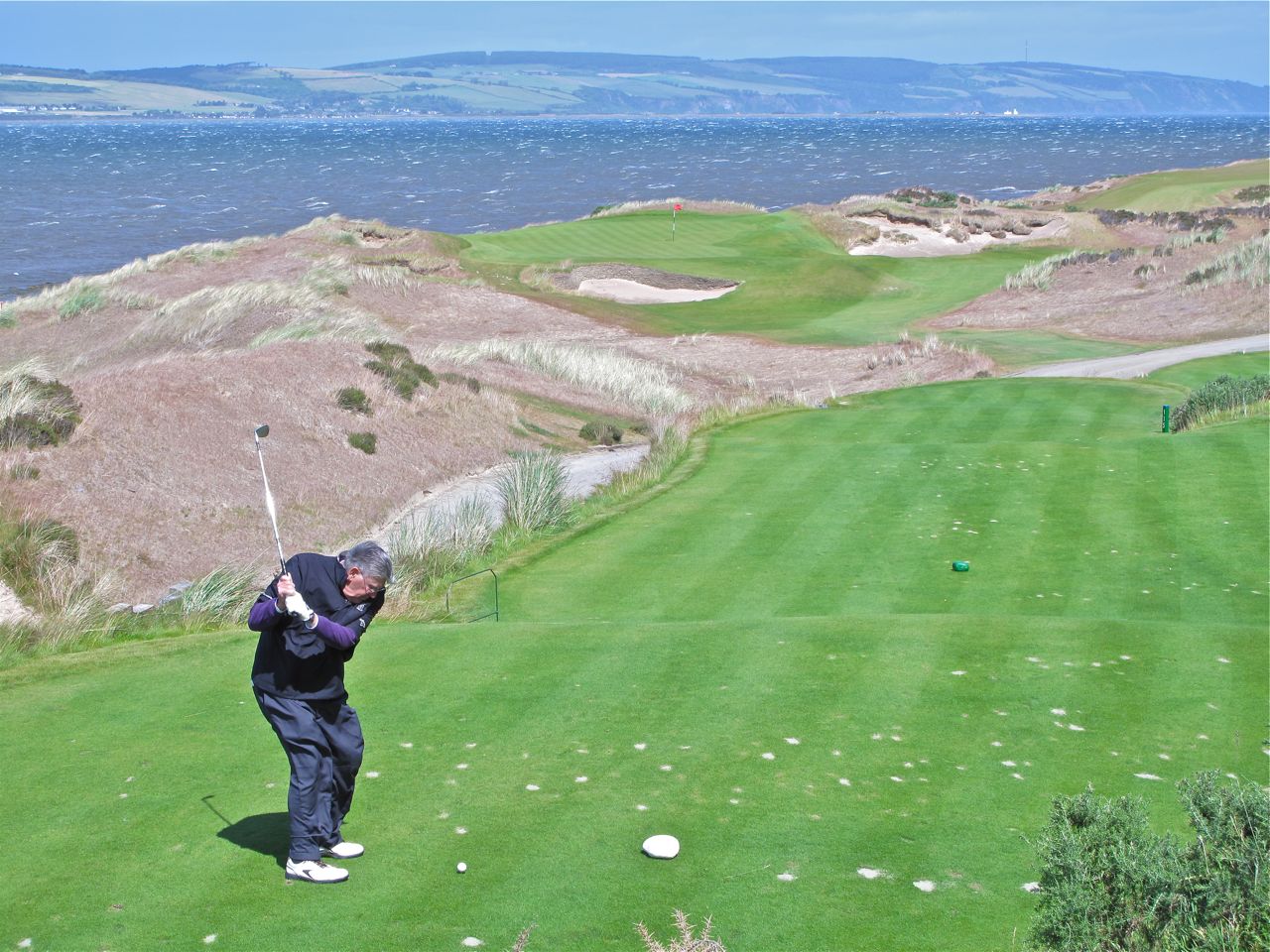
Whitecaps on the Firth? The 11th at Castle Stuart (John Garrity)

As mentioned in an earlier post, Dave Henson and I played only five holes at Castle Stuart on the Fourth of July, due to winds of up to 70 mph and precipitation in the form of horizontal rain, sleet, snow, hail and frozen desserts. Returning three days later at mid-morning, we were happy to see the sky cleared of clouds and the sun spreading its warmth; the only hangup was the wind, which was inexplicably stronger, gusting to 75. Dave was dubious about playing, but I assured him that Mark Parsinen and Gil Hanse had taken wind into account when they designed Castle Stuart. “Just remember to keep one foot on your trolley when you’re hitting a shot,” I told him. “And don’t hit your driver into the wind.”

Dave, whose former post in the Labor Department had him giving advice rather than taking it, apparently thought I was joking. He spent most of the round picking up his  toppled bag, chasing his trolley as it rolled toward cliffs, and watching his drives get swatted down by the gale. I, on the other hand, played most of my shots with a hybrid-4,  employing a hinge-and-hold technique that produced a steady tattoo of 130- to 150-yard wormburners. “It’s golf as it was meant to be played,” I told my frazzled friend, mentally pocketing skin after skin.

Despite the extreme conditions, Castle Stuart was playable. The ball rolled on its own accord on just one green, the twelfth, which clings to a promontory above the beach. The broad fairways, meanwhile, were receptive to smartly-struck drives, and the green complexes tended to collect and contain wayward shots rather than repel them. Aesthetically, Castle Stuart most resembles Top 50 evergreens Pebble Beach and Whistling Straits. The first three holes on each side run low along the water but in opposite directions, bringing the wind into play in contrary fashion. Subsequent holes ride the higher ground, and it’s only when you walk over to cliff’s edge that you see the holes below. The views, needless to say, are spectacular, and there are so many memorable holes that it’s hard to pick out a favorite. The postcard hole is probably the par-3 11th, played from a cliff-wall tee to a hanging-over-the-water green guarded by a nasty pot bunker.

Anyway, having played the course twice now — once last summer in a modest breeze and more recently in wind-tunnel conditions — I can confidently say that Castle Stuart, at No. 9, is not overrated. If anything, it is underrated. (“To rate or evaluate too low; underestimate.”) Personally, I put it right up there with Askernish Old and Carne, my two favorite courses.

Top 50 Alert: Erin Hills Golf Course of Erin, Wisc., recently picked to host the 2017 U.S. Open, debuts at No. 23, the highest first-time ranking for a course since Castle Stuart debuted at No. 10.  Built on farmland outside Milwaukee, Erin Hills echoes the trend toward rural courses with links-style characteristics, a la Prairie Dunes, Sand Hills, Whistling Straits and Medicine Hole. In fact, the bag drop/caddyshack at Erin Hills is an actual barn. (Note to USGA: Provide paved parking for Escalades.)

2 Comments

Filed under golf

Rain Man Tackles Nairn Golf Club

The second stop on our tour of suspected-of-being-overrated Scottish links courses was Nairn, a bustling village just up the road from Castle Stuart, outside Inverness. The Nairn Golf Club will host the 2012 Curtis Cup, so Dave Henson and I were not surprised to find a course groomed to tournament standards. The greens were suspiciously smooth, providing none of the mystifying bumps and bobbles that make small-town golf satisfying, but several of my putts found the hole, leaving me in a forgiving mood. There were a few too many steep-faced bunkers to suit Dave, and I could have done without the 20-inch fescue roughs, but difficulty does not disqualify a course from mention in the Top 50.

My colleague and I did have a piffling disagreement over what constitutes a links course. Midway through our late-afternoon round the holes turned away from the shore and climbed a tree-lined hill, putting us on farmable soil that scarcely resembled the thumpable, sandy underpinning of a true links. The closing holes presented a similar confusion: out-in-the-open, linksy greens requiring long, backward hikes into the woods to new tees that might have been transplanted from Alabama. I argued for a surgical trimming of trees to restore the openness of the closing holes, while Dave — pointing out that it was raining buckets and he was practically coughing up blood, due to his bronchitis — simply shook his head and walked off the course.

That left me to play the last three holes in total isolation, the club members having fled at the first sight of a dark cloud. (So much for the myth of Scottish golfers braving the elements!) As I holed my last putt in a drizzle on the 18th green, Dave came out to greet me, knocking ashes from his pipe, while perhaps a dozen diners cast me admiring glances from the glassed-in warmth of the club dining room.

“So how would you rate Nairn?” Dave asked on the drive back to Inverness.

“Fifty,” I said. “Maybe higher, if they chop down the trees.”

Next Up: Our Fourth of July round having been disrupted by seventy-mile-an-hour winds, we return to Castle Stuart to play a make-up round in seventy-five-mile-an-hour winds.

Whistling Straits Golf Course

Whistling Straits: Are 1,000 bunkers enough? (John Garrity)

Top 50 on TV: The PGA Championship, the fourth and final major of the season, is being played at Whistling Straits in Kohler, Wisc., currently ranked No. 18. (The course, not the state.) Already famous for his island greens and railroad-tie bulkheads, architect Pete Dye gave developer Herb Kohler something no other golf course has: a thousand sand bunkers. Other ideas for Whistling Straits, considered but ultimately rejected, included reversible greens, asphalt tee boxes and torch-lined fairways for night golf.

Leave a comment

Filed under golf

First Stop on Links Tour: Royal Dornoch

As I explained last time, fears that the Top 50 ratings might be flawed led me to cross the Atlantic for three weeks of club-in-hand research on some of our most highly-rated links courses. To get started, I met my longtime friend and America’s Worst Golf Courses researcher Dave Henson at the Glasgow airport, loaded his sleepy carcass and his golf clubs into the rental car, and then drove north along the shores of Lochs Lomond and Inverness to the banks of the Moray Firth, where the staff at Castle Stuart Golf Links rolled out the red carpet for us.

What they should have done was roll the red carpet over us — to keep us from blowing away. “We’re clocking steady winds of 45 to 50 miles per hour with gusts of 70,” said the young man behind the counter in the golf shop. “If your schedule allows, we’d recommend you come back in a couple of days, when you can better appreciate the course.”

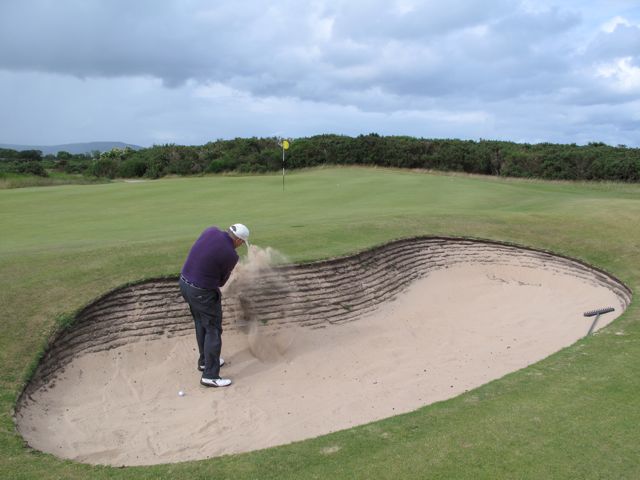
Bunker Shot at Royal Dornoch

Top 50 Staffer Dave Henson tests the sand at Royal Dornoch. (John Garrity)

Dave, who was nursing a case of bronchitis, thought that was a great idea, and since I was already familiar with Castle Stuart, having played it last July, when it opened, I concurred. “But let’s play just a few holes,” I suggested, “to loosen up after the drive and your flight.” To that end, the club’s general manager, Stuart McColm, offered to drive us out to the fourth tee in his SUV, so we wouldn’t have to play the first three holes along the water into the gale.

So we were on the tee of the par-3 fourth when the next squall swept down behind us, blowing over our golf bags, puffing out our rain suits and pelting our necks with stinging sleet. “This should wake you up!” I shouted over the wind, drawing a withering glance from my old friend, who woud prefer to puff on his pipe by a cozy fire whenever the barometer needle dips a fraction. Anyway, we played holes four through nine in varying inclemencies and then drove back into Inverness to check into the Craigside Lodge B&B and change into dry clothes for dinner.

Day Two. A cold, windy, dreary morning followed by a cool, breezy, but clearing afternoon. Dave kept looking at the clouds as if he expected anvils to fall out of them. However, the promise of a round at Royal Dornoch improved his mood. It took us less than an hour to cross the big bridge and motor up past lochs, farms and forest to Dornoch, which is pretty much the northern outpost of the old British Empire, golf division. The great Donald Ross, I didn’t have to remind Dave, was head professional and greenkeeper at Dornoch before emigrating to the United States and establishing himself as the preeminent course designer of his time.

“You didn’t have to remind me,” Dave said.

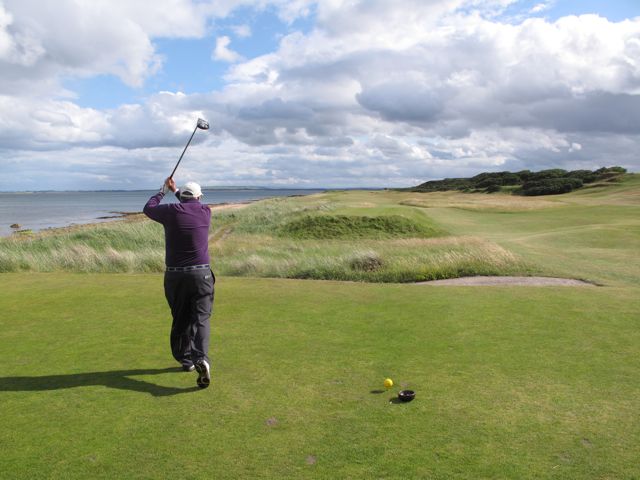
Golfer teeing off at Royal Dornoch

Royal Dornoch: Well worth the drive. (John Garrity)

It was blowing 25 or 30 knots when we teed off at Dornoch, making the national and club flags snap and crackle atop their poles. But it was a helping wind, not the in-your-face variety we had encountered at Castle Stuart.

Not that Royal Dornoch needed any help. Checking my notebook after the round, I found that it was filled with pithy praise: “A classic links …. lovely gorse-covered banks … delightful changes of elevation … unpretentious, a small-town feel … beautiful green complexes … sod-faced bunkers to be avoided at all costs … great sea views! … a perfect distillation of traditional course design with contemporary shot values …” Those are not scientific judgements, to be sure, but the point of our visit was to see if Dornoch’s Top 50 rating stood up to soft-spikes-on-the-ground scrutiny.

It did. In fact, I drove out of town at dusk convinced that Royal Dornoch deserves to be ranked in the top twenty of any reputable course-rating system. And that’s without factoring in the wonderful dinners we enjoyed in the club’s upstairs lounge, which looks down on the first tee and beyond to that long stretch of sand and sea.

I was reassured by Dornoch, but it was just one of many links courses in the Top 50. “Tomorrow,” I told Dave back at the Craigside Lodge, “we’ll check out Nairn.”

So, tomorrow, we’ll check out Nairn.

1 Comment

Filed under golf

Top 50 CEO Comes Clean on Golf Trip

First, a confession. I have been telling friends (and foes) that my recent trek through Scotland and Ireland was a golf holiday. “Fourteen rounds in three weeks!” I say with a self-satisfied smirk, trying to leave the impression that I have nothing better to do with my post-retirement days than chase old-man Bogey up and down a Celtic shore.

Truth is, I was working. And although I would like to ratify that old saw about “my worst day on the golf course being better than my best day at the office” — I can’t. (I work at home, so my best days at the office consist of a lot of napping, snacking, piano playing and careful monitoring of Rumpole of the Bailey and Rockford Files DVDs.)

Next, an apology. To the dedicated staffers here at Catch Basin and to the equally-dedicated Cal Sci mathematicians who manage the Top 50 Algorithm, I publicly announce: “I am sorry.” Sorry for doubting you. Sorry for challenging the raw data. Sorry for sprinkling talcum powder in your pay envelopes.*

*The Company pledges to honor all legitimate claims for emergency room services, doctor visits and treatments for PTSD up to the state-mandated cap of fifty dollars per household.

Third, an explanation. Reader mail, in the past year or so, has consistently challenged the Top 50’s claim to be “the only truly authoritative and scientific course-rating system” by pointing out seeming anomalies. “Pine Valley is not on your list!” complained one correspondent, while another grumbled that “the Augusta National practice range [No. 47] is not even a golf course.” I brushed off most of these criticisms as the product of parochial minds clouded by the puffery of local chambers of commerce and golf-tour operators. But I found it hard to dismiss the charge by a few dozen golf-industry insiders — some of them with college degrees — that my list was top-heavy with links courses in the British Isles. “Five or six Celtic courses is believable,” wrote a Moroccan travel agent. “But 38 of the top fifty? Highly implausible.”

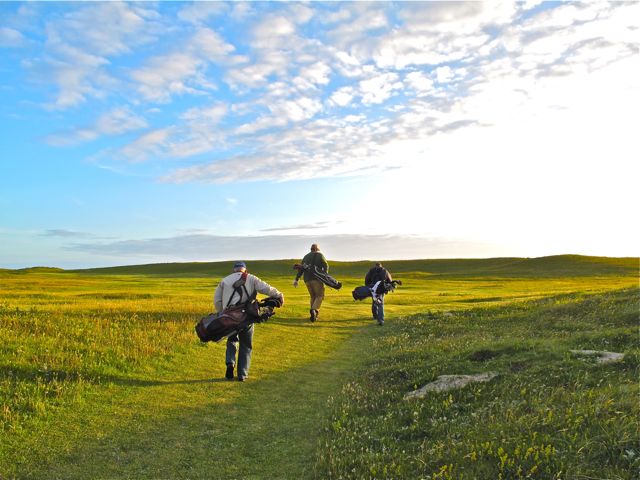
Sunset Golf at Askernish

Links courses: Overrated? Underrated? Properly rated? (John Garrity)

The Moroccan’s claim of 38 was pure hyperbole, but a quick glance at the current Top 50 [see sidebar] reveals no fewer than 16 courses of the British links variety. What’s more, ten of the remaining layouts either have the word “links” in their name or boast of links-style features in their designs — e.g., Pebble Beach, Fancourt, Sand Hills, and Medicine Hole. I have long argued that traditional links courses get the highest marks for one simple reason: They are better golf courses.

Because they are.

But even I began to have doubts last year when Castle Stuart, a brand-new course on the banks of Scotland’s Moray Firth, debuted at No. 10. That was followed by another improbable leap (Kingsbarns to No. 40, pushing the Irish parkland gem, Druids Glen, into the second fifty) and a weird oscillation at No. 50, where Scotland’s Nairn and Ireland’s Donegal have been alternating every hour or so like one of those ballpark banner ads behind home plate.

Was there a flaw in the Top 50 algorithm? Had a mole infiltrated our Catch Basin headquarters? Does Charlie Daniels play a mean fiddle?

I had to find out. And the only way to test the integrity of the Top 50 ranking, as I explained to my wife, was by traveling to the British isles and playing the disputed links courses. Which I did. (Note to IRS: I will not be claiming non-golf expenses as deductions.)

Finally, my report. But that will have to wait a day.*

* Negotiations with Ryan Lawn and Tree have taken longer than expected, due to their lead agronomist’s insistence that sod cannot be laid over the hardwood floor in our TV room.

2 Comments

Filed under golf