Monthly Archives: October 2010

Whose Mystique Was Greater: Hogan’s or Merion’s?

Miracle at Merion Cover Art

Barrett's new book gets to the roots of Merion bluegrass. (John Garrity)

“Are your rankings influenced by reputation?” asks a reader from Berkeley, Calif. “Do courses get points because they’ve been written about in magazines or photographed for book jackets?”

The answer, as usual, is yes and no. The Cal Sci algorithm is rigorously scientific, so it can’t be “influenced” — if by influence you mean subtle bias in favor of a region, a certain architect or an old college friend who has snapshots of you in a compromising position with donuts. On the other hand, the algorithm recognizes “media exposure over time” as a critical variable in measuring course quality. The par-3 sixteenth hole at Cypress Point has appeared on hundreds of book and magazine covers, while the par-3 ninth at Ft. Meade (Fla.) City Mobile Home Park Golf Course has appeared on none. Maybe that reflects an unavoidable social-class bias, but I still infer from the lopsided coverage that the California course is by far the better track. That’s one reason, but not the only reason, why exclusive Cypress Point is currently our 13th-ranked course.

Similarly, our placement of the equally-private Merion East at No. 36 is supported by David Barrett’s new book, Miracle at Merion: The Inspiring Story of Ben Hogan’s Amazing Comeback and Victory at the 1950 U.S. Open. Most of Barrett’s compelling prose is dedicated to Hogan and his dogged opponents, but the book is nevertheless a must for golf-design nuts or, for that matter, anyone who owns both a wing chair and a persimmon driver.

“Merion has to be in my top three in the world, although I’m not sure I’m good at articulating why” David told me over the phone last week. “I’ve played it only once, and that was in 1981. But Merion West was our home course when I played for Haverford College, so every day during golf season we drove right past the East to get to the West. It was kind of frustrating, to be honest, although the West is a wonderful course in its own right.”

David praised the East course for its “great charm” and heaped the usual encomia on the since-modified Hugh Wilson design, calling the layout “challenging,” “varied,” and “fun. And then you’ve got the quarry holes. Those three great and tough finishing holes really elevate the course.”*

*Merion’s altitude, according to The Rolex World’s Top 1000 Golf Courses, is a mere 351 feet. But David may have been speaking figuratively.

“Among the great courses of the world,” he added, “the East is unusual in that there is a road, Ardmore Avenue, that goes right through it. You may not be able to play Merion, but anybody can drive through it and take a look.”

Ben Hogan, who in the summer of ’50 was still recovering from his near-fatal crash into a Greyhound bus, would have been happy to view the East Course from the road, like a tourist. “The trouble with Merion is that it always has you on the defensive,” he told reporters at his hotel on the morning of the U.S. Open playoff.* “There’s no way you can take the offensive against it.”

*Hogan’s Sunday playoff with George Fazio and Lloyd Mangrum didn’t start until 2 p.m. because of Pennsylvania’s blue laws.

“After the playoff,” David told me, “Hogan said that he only went at the flag one time in 90 holes — and he hit that one into a bunker. As with many Hogan quotes, you have to take that with a grain of salt — he did have some short birdie putts along the way — but the U.S. Open set-up definitely had everybody playing defensively. Seven-over 287 made the playoff.”

Miracle at Merion, from Skyhorse Publishing, is $24.95 at bookstores. Ticket prices for the 2013 U.S. Open at Merion East have not been announced by the USGA, there being no way to predict if there will be another miracle.

Top 50 on TV: Nothing this week, but a tip of the ball cap to Jonathan Byrd for his winning ace on the fourth extra hole of the Justin Timberlake Shriners Hospitals for Children Open in Las Vegas, Nev. (It was right across town, come to think of it, that Chip Beck shot the second-ever Tour 59 in the third round of the 1991 Las Vegas Invitational. Maybe they should change their advertising from “loosest slots” to “loosest greens.”)

Leave a comment

Filed under golf

True Enough: It’s CordeValle’s Week

“If you work for the Top 50, shouldn’t you be able to count to 50?”

That snipe, from a cowled friar in Hayward, Calif., points out that the Top 50 on TV addendum to my last post reads “Nothing this week” — when, in fact, the Frys.com Open is being held at the CordeValle Resort Golf CLub, No. 49.

“Furthermore,” the monk mutters, “some nimrod hasn’t been taught how to use the SHIFT key on his Remington. Not to get on his case, but ‘upper’ is for the first letter of proper nouns, and ‘lower’ is for the alphabetical rug rats that follow.”

CordeValle Golf

CordeValle: Top-10 resort, Top-50 golf course. (John Garrity)

I could pen an extended rebuttal to Monastery Man’s snide, albeit artfully-phrased, “gotcha.” But that’s not how we do things at the Top 50. CordeValle is, indeed, No. 49. That’s a rung above the 50th-ranking the northern-California resort achieved back in June, when SI senior writer Gary Van Sickle and I played it on our way to flights from San Jose International Airport.

By the end of a three-birdie round at CordeValle, I was a confirmed 49er. The turfed expanse of the RTJ Jr. tournament track wanders through a valley dominated by  exquisite, oak-dappled foothills, providing a golden backdrop for this week’s Golf Channel cameras. The clubhouse and hotel are shaded by ancient sycamores and swathed in trellised roses. If wine-country ambiance is your cup of tea, CordeValle can’t be beat. Or rather, it can be beat by only seven other golf resorts. (CordeValle is No. 8 on my World Golf Resorts list, which will appear here in November.*)

*Contingent upon completion of certain infrastructure projects at our Kansas City headquarters.

As for the charge by our Thomas Merton wannabe that we can’t type, I will patiently explain that CordeValle — pronounced “COR-de-vol” — is spelled with a capital V. (See my privately-published monograph, “What’s with the E in FedEx?”) The documentation for the L in “CLub” seems to have been misplaced, but I’ve got someone looking into it.

There is no listing for Hayward, by the way, in Michelin’s Guide to North American Monasteries.

Leave a comment

Filed under golf

Engh Reaches Top Rung with Awarii Dunes

“We’re efficient with our construction budgets,” award-winning course designer Jim Engh said yesterday, after giving me a guided tour of his new Awarii Dunes course in Kearney, Neb. “That has to be my niche. I didn’t win a Masters. I have to put out high-class golf courses for modest budgets.”

Jim Engh

Colorado architect has two courses in Top 50. (John Garrity)

The fact checkers at our Catch Basin headquarters tell me that Jim was truthful. He didn’t win a Masters.*

*The course-designers-with-green-jackets club has eight living members, using an arbitrary definition of “course architect.” They are Jack Nicklaus, Tom Watson, Gary Player, Arnold Palmer, Nick Faldo, Ben Crenshaw, Raymond Floyd and Tiger Woods. (Tiger’s membership is contingent on one of his designs actually opening for play.)

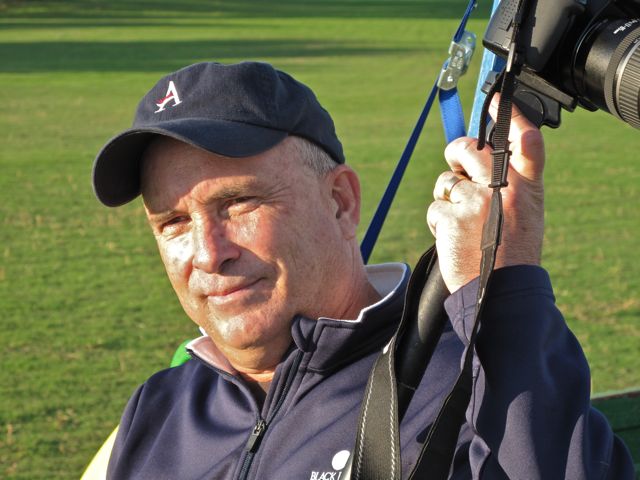
The “modest budgets” claim Jim had already backed up by pressing me into service as his driver, flag planter and photographer’s assistant. For a couple of hours on Monday afternoon, I followed him around as he engaged in a duel of wits with the setting sun, trying to capture shadow-rich photographs of his new course for his home page and promotional brochures. Like the professional course photographers who charge five figures for their product, Jim had lashed a stepladder to the bed of a utility cart. But it was a used stepladder, to save money.

“I see Awarii Dunes as a template for what golf will be in the U.S. when we start building courses again,” Jim said during a break in the inaction. “Maintenance expenditures have to come down. That means less precise irrigation, so you don’t get that trimmed-out look. That means sand-and-gravel cart paths instead of concrete.” As for the fairways and greens, “hard and firm and fast and brown is great.”

Jim Engh at Awarii Dunes

Engh photographs a par-3 at Awarii Dunes. (John Garrity)

With that buildup, I half expected Awarii Dunes to resemble the battlefield at Agincourt before it rained. Instead, the newly-planted fairways and greens are a deep green framed by fescue-covered dunes, golden fields of wheat and elegant cottonwood trees. When it opens for play next spring, Awarii Dunes will provide a closer-to-I-80-and-more-affordable alternative to Crenshaw-Coore’s acclaimed Sand Hills Golf Club, No. 19.

The price tag for Awarii Dunes, according to Jim, was “a million and a half,” mostly for irrigation. “The sand was here, we didn’t have to move a lot of dirt.”

The only obvious corner-cutting is on the greens, which do not have actual holes or flagsticks. (“We’ll take care of that before we open,” Jim said dryly.) For his photography, Jim carried a flagstick with a sharpened point, which he plunged into various greens with the ferocity of an explorer claiming new lands.

I got to get me one of them.

Top 50 on TV: Nothing this week, but last week’s Alfred Dunhill Links Championship featured a final-round 66 on the 16th-ranked Old Course at St. Andrews by the hottest player in golf, Martin Kaymer. Kingsbarns, No. 40, and Carnoustie, No. 203, were the other venues for the European Tour’s annual pro-am/frostbite festival, which features actor Hugh Grant and various knighted athletes and news presenters in wooly sweaters and oven mitts, with knit caps pulled over their ears and eyes to hide their identities.

Leave a comment

Filed under golf