Monthly Archives: August 2013

Hudson Tops International Field at Askernish Open

It is a sign of the times that neither Golf World, Golfweek nor Golf Channel covered last week’s Askernish Open. I, of course, covered it for Sports Illustrated and Golf.com, having left the Solheim Cup in Colorado as soon as the European ladies’ victory there was certain.* I even took the extraordinary step of imbedding myself in Saturday’s stroke-play competition at top-ranked Askernish Old, a tactic which gained me a top-100 finish and an automatic exemption for 2014. Unfortunately, I forgot to tell my editors that I was going to Scotland, so there was no room in the magazine or on the Web for my game story, which was, in any case, accidentally deleted when I mistook my iPhone for the Bomar Brain.
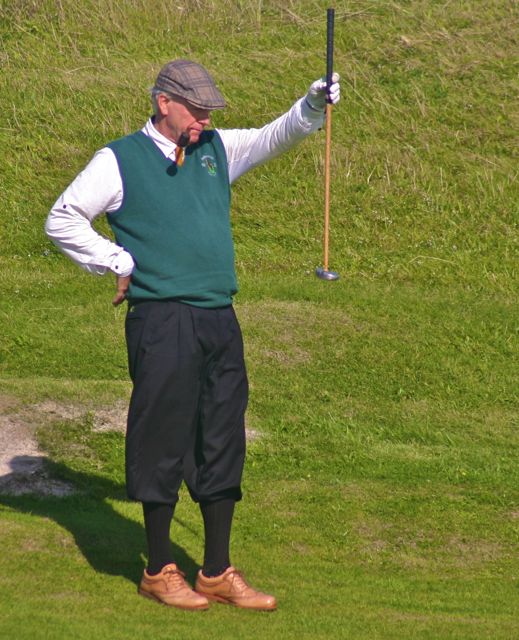
Deal Hudson

Hudson was the “real Deal” at Askernish, right down to his hickory-shafted putter. (John Garrity)

*For me, that moment came on Saturday afternoon when America’s Michelle Wie celebrated like it was VJ day upon making a putt and then ran uphill to the next tee before Sweden’s Caroline Hedwall could answer with a putt of her own to halve the hole. 

Fortunately, Europe’s golf writers know how to find the Western Isles. Here’s a taste of John Gillies’s coverage from the August 29 Stornoway Gazette:

Once again, last weekend, a truly international field of close to 150 golfers contested the Askernish Open. The sun shone and, naturally, the wind blew and the course lived up to its reputation as a supreme test of skill. Brutal rough punished every wayward shot. The terrifying beauty of the eleventh green, perched on the edge of the ocean framed by the hills of Barra, did little to calm golfers trying to shape a 200-yard tee shot into the wind across a deep gully. But no one who stood there would have wished to be anywhere else. This is no ordinary golf course. For John Garrity, who has reviewed the most famous courses on the planet, “there is no greater golfing experience than what we have here.” The course has consistently topped his list of the world’s greatest golf courses and, as John confirmed at the Open prize-giving, while it may occasionally share the top spot with another challenger, Askernish will never be surpassed.
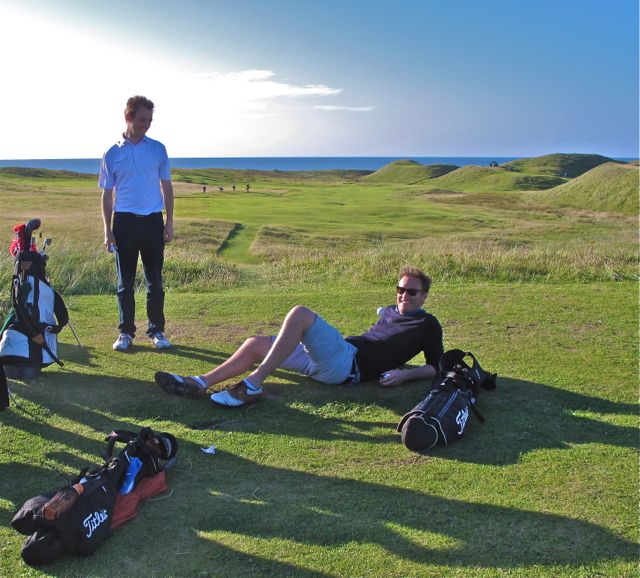
Golfers on Askernish No. 16

Splendid weather turned the 16th, “Old Tom’s Pulpit,” into a tanning station. (John Garrity)

Gillies graciously hinted at the Top 50’s involvement with Old Tom Morris’s renowned “ghost course.” I was, in fact, made “captain for a day” and tasked with opening the Open by striking the ceremonial first shot with a hickory-shafted cleek. This antique club, I hasten to point out, was about as long as a conductor’s baton and had a rusted head no bigger than a commemorative stamp. Ralph Thompson, recently retired as Askernish’s chairman, tried to ice me by saying that “no captain so far has actually botched the shot,” but I took no more than sixty seconds to experiment with various stances and tee heights before smacking a ball that whistled off the elevated first tee and reached a height of ten or twelve feet before landing with a satisfying thud in the first cut of rough, a foot short of the fairway.

Gillies’ description of my cleek shot was apparently cut by his editors, but he appropriately recognised some of the better Hebridean golfers:

David Black took three putts on each of the last two greens to miss out on victory by one stroke. A win would have meant a clean sweep of the championship events in the Western Isles this year but, instead, like many of the prizes at Askernish, the Open Championship title went overseas. There were local winners: Jane Nicolson once again took home the Ladies Championship Trophy with a performance that had her head and shoulders above the competition, and Danny Steele from South Uist won the Handicap Trophy.
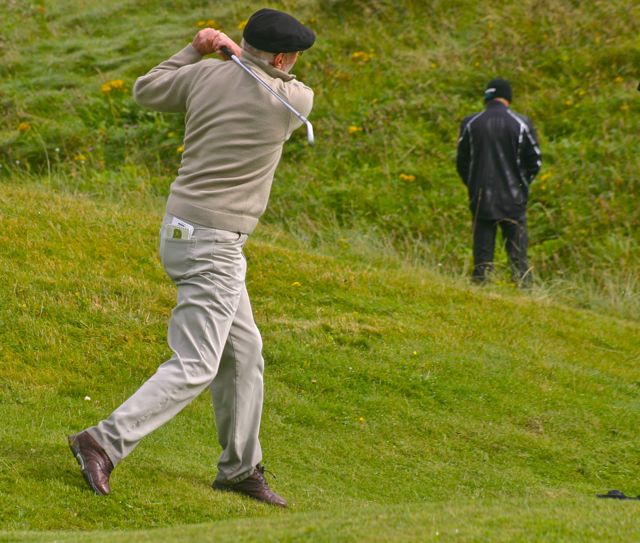
Iron shot at Askernish Open

Beer-fueled golfers were happy to water the roughs at Askernish Old. (John Garrity)

To sum up, the 2013 Askernish Open champion, with a score of 79, was pipe-smoking life member Deal W. Hudson of Fairfax, Va., who played in a dress shirt, tie and plus-fours. Second place, as reported above, went to Stornoway’s David Black, who shot 80. In third, also at 80, was Askernish co-designer Martin Ebert, whose second club is the Royal & Ancient Golf Club of St. Andrews. Fourth prize went to U.S. Army Reserve Major General Wayne Brock, who carded an 81.

Askernish Open scores, by the way, are not the equivalent of conventional scores turned in for handicap purposes. The summer rough at Askernish is so deep and pervasive that virtually any ball hit off the fairway is lost. To keep play moving, a local rule allows golfers to take a penalty stroke and drop a replacement ball in the fairway. This inflates scores, but it boosts the sale of 18-ball zip bags of “American Lake Balls” sold in the Askernish golf shop.

Top 50 on TV: Nothing this week, but the PGA Tour’s FedEx Cup playoffs open with the Deutsche Bank Championship at 128th-ranked TPC of Boston in Norton, Mass. Phil Mickelson opened with a first-round 63, which is equivalent to an Askernish summer score of 69.

1 Comment

Filed under golf

Irish, Scottish Links Contend for No. 1 at Fabled Askernish Open

Ralph Thompson, the recently-retired majordomo at top-ranked Askernish Old, has been busy with preparations for this week’s Askernish Open — but not too busy to complain about the current and unprecedented placement of Ireland’s Carne Golf Links as co-No. 1. “I believe after your visit this week we will regain our rightful and solitary position as No. 1,” he writes from his Hebridean hideout on the isle of South Uist. “If not, then we will bury you in the rough. Even with your long legs you will still not be noticed. Yes, it is that extreme this year.”

Searching for balls

Askernish golfers could find more than lost balls in its world-class rough. (John Garrity)

Putting aside the threatening tone, which I’m used to, Thompson’s words leave me wondering if I’ve packed enough golf balls to get me through three days of competition on the Old Tom Morris-designed ghost course. If the rough is deep enough to conceal an NBA small forward, it will easily consume my meagre stock of Pro V1s.

Not that I care. My real purpose in returning to Askernish is to complete my “This Old Course” series on Askernish, which began a couple of years ago in Sports Illustrated Golf+ and will conclude this fall on Golf.com. To facilitate that coverage, I am traveling with state-of-the-art digital cameras, notepads, a pocket recorder, mosquito netting, quinine pills, a safari jacket and a fully-operational Bomar Brain. All this gear is currently piled on my bed at the Glasgow Marriott, which has long served as my base camp for expeditions to Ayrshire, East Lothian, the Kingdom of Fife and the Scottish Highlands.

This visit, as I patiently explained to Ralph, will have no bearing on the Top 50 rankings, which are issued by our staff at Catch Basin on the basis of scientific calculations far too sophisticated for either of us to comprehend.

Top 50 on TV:  Nothing this week, but an 18-year-old Englishman won the U.S. Amateur last week at The Country Club in Brookline, Mass., currently No. 31 on the Top 50. Coming 100 years after Francis Ouimet’s stunning victory there in the 1913 U.S. Open, Matt Fitzpatrick’s victory avenges the historic humbling of the British greats, Harry Vardon and Ted Ray.

2 Comments

Filed under golf

Ralph Thompson, the recently-retired majordomo at top-ranked Askernish Old, has been busy with preparations for this week’s Askernish Open — but not too busy to complain about the current and unprecedented placement of Ireland’s Carne Golf Links as co-No. 1. “I believe after your visit this week we will regain our rightful and solitary position as No. 1,” he writes from his Hebridean hideout on the isle of South Uist. “If not, then we will bury you in the rough. Even with your long legs you will still not be noticed. Yes, it is that extreme this year.”

Putting aside the threatening tone, which I’m used to, Thompson’s words leave me wondering if I’ve packed enough golf balls to get me through three days of competition on the Old Tom Morris-designed ghost course. If the rough is deep enough to conceal an NBA small forward, it will easily consume my meagre stock of Pro V1s.

Not that I care. My real purpose in returning to Askernish is to complete my “This Old Course” series on Askernish, which began a couple of years ago in Sports Illustrated Golf+ and will conclude this fall on Golf.com. To facilitate that coverage, I am traveling with state-of-the-art digital cameras, notepads, a pocket recorder, mosquito netting, quinine pills, a safari jacket and a fully-operational Bomar Brain. All this gear is currently piled on my bed at the Glasgow Marriott, which has long served as my base camp for expeditions to Ayrshire, East Lothian, the Kingdom of Fife and the Scottish Highlands.

This visit, as I patiently explained to Ralph, will have no bearing on the Top 50 rankings, which are issued by our staff at Catch Basin on the basis of scientific calculations far too sophisticated for either of us to comprehend.

Top 50 on TV:  Nothing this week, but an 18-year-old Englishman won the U.S. Amateur last week at The Country Club in Brookline, Mass., currently No. 31 on the Top 50. Coming 100 years after Francis Ouimet’s stunning victory there in the 1913 U.S. Open, Matt Fitzpatrick’s victory avenges the historic humbling of the British greats, Harry Vardon and Ted Ray.

Leave a comment

August 21, 2013 · 2:19 pm

A Trip to Bountyful: Royal Dublin

“What have you been smoking?” asks a reader from St. Andrews, N.M. “You had Royal Dublin ranked in the mid-80s, and then, like overnight, it’s No. 48. What happened? Did they open a Baskin-Robbins in the halfway house?”

Royal Dublin's 18th

Royal Dublin’s “Garden” eighteenth is a tough row to hoe. (John Garrity)

Actually, Ireland’s second-oldest golf course has continued to move up. Royal Dublin currently resides at No. 36, and it could climb even higher if that Baskin-Robbins rumor checks out. (Instead of cheese peanut butter crackers at the turn, you could have Fudge Fescue on a sugar cone!) On the other hand, it could stall out and drop back into the 40s. The Top 50 is known for its volatility, especially during the summer months, when courses can improve or degrade significantly between supper and sundown.

Even so, I’m at a loss to explain Royal Dublin’s dramatic surge. I played there a couple of weeks ago, and I found the venerable links to be pretty much the same as it was seven years ago, when Martin Hawtree put the finishing touches on a tasteful modernization of H.S. Colt’s original out-and-back routing. The course, if you haven’t had the pleasure of playing it, is situated on an island in Dublin Bay, not far from fabled and 51st-ranked Portmarnock Golf Club, site of the 1991 Walker Cup.* Royal Dublin, like Portmarnock, is a classic links with firm, flat fairways and great plots of tall, golden, fescue rough.

*The island itself is the work of William Bligh, the notorious “Captain Bligh” of Mutiny on the Bounty fame. In an effort to make Dublin Bay safer for 19th-century vessels, Bligh commissioned a two-mile-long sea wall. Over time, sand piled up against the breakwater and spread, creating North Bull Island.

Royal Dublin is a members’ club, but the links is available for public play, in the Irish manner. You can pay as little as $75 (summer twilight or early-weekday-morning rate) or as much as $120 (standard 18-hole rate), or you can play for free as a world-renowned course ranker (my gambit). I emphasize the daily-fee aspect because American golfers, seeing the “Royal” imprimatur, assume that Queen Victoria herself stands at the clubhouse entrance, sorting the aristocratic wheat from the trolley-pulling chaff.

This is not the case. Royal Dublin’s golfers are as hospitable as any in Ireland, and if you’re lucky the loquacious gent buying you a drink might be “Himself” — the club’s resident legend, World Golf Hall of Famer, ten-time Ryder Cupper, ten-time Irish professional champion and former head pro, Christy O’Connor Sr.

Christy O'Connor Sr. and American writers

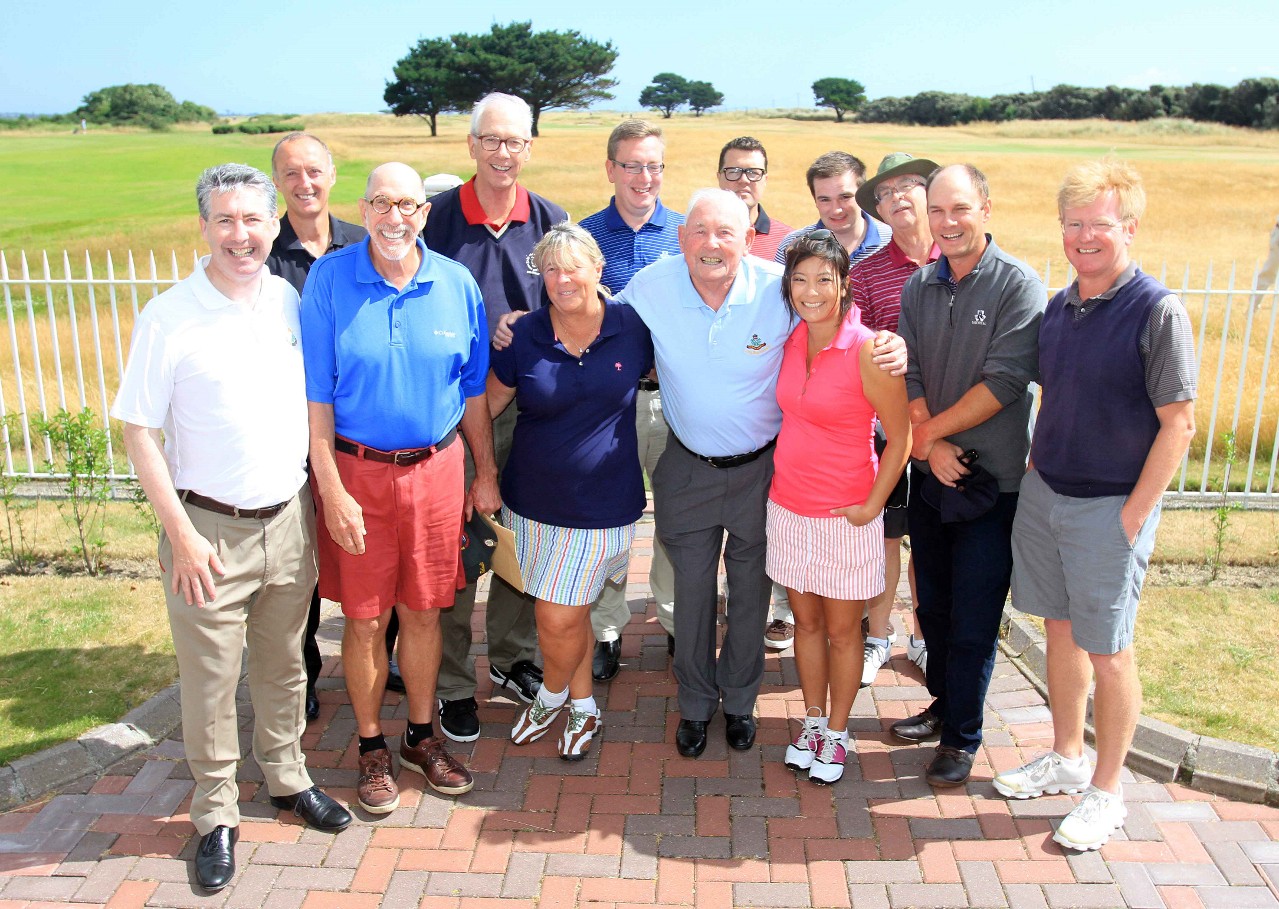
“Himself” at Royal Dublin with captain Paul O’Grady (far left), Top 50 CEO John Garrity (far tallest) and a team of mostly American golf writers. (Photo courtesy of Rory Matthews.)

I was lucky. (See photo, right.)

Returning to the ratings question, I did tack on a point or two for Royal Dublin’s memorable eighteenth hole. Called “Garden” for the adjoining practice range, which plays as O.B., No. 18 is a 480-yard right-angle dogleg right that can be played as a two- or three-shotter; but going for the glory requires a long-iron or fairway-wood approach over a winding burn and a sea of unplayable fescue, usually against a battering wind. I consider it one of the great finishing holes in golf, and I’m sure I’m joined in that opinion by many former winners of the Irish Open at Royal Dublin.

So, doing the math, Royal Dublin picks up — or loses, depending upon how you use the Cal Sci algorithm — roughly .17 points for it’s finishing hole; another .17 points for serendipity (I had the best driving round of my life); .02 points for the post-round showers and big, fluffy towels; .04 points for the Irish-barbecue buffet in the upstairs dining room; and a full two points for O’Connor Sr., who hailed my drive off the first tee with a hearty, “Now there’s a nice bit of rhythm!”* That lifts Royal Dublin to 11.51 on the concentric Perfect-10 scale, just ahead of Michael Bamberger’s Philadelphia Cricket Club Flourtown course.

*I took O’Connor’s remark to be an uncompensated endorsement of Tour Tempo: Golf’s Last Secret Finally Revealed, by John Novosel and John Garrity — hereinafter referred to as “Myself.”

Gold Medal Ribbon, meanwhile, retains the top spot in the Baskin-Robbins Top-31.

Top 50 on TV: Nothing this week, but the PGA Championship returns to 51st-ranked Oak Hill Country Club in Rochester, New York. One of my favorite parkland courses, Oak Hill has been ranked as high as No. 17, but the presence of so many trees has cost it points over time.

2 Comments

Filed under golf

Irish Links Reaches No. 1 with Opening of New Kilmore Nine

For as long as there has been a Top 50 Blog — literally years — Scotland’s Askernish Old has held the No. 1 position. Laid out in 1891 by Old Tom Morris but abandoned by later generations, Askernish vaulted to the top spot upon its Brigadoon-like reappearance on a spring day in 1991. The Hebridean masterpiece maintained its No. 1 ranking despite subsequent vanishings, and in recent years its 18 dramatic holes have been rediscovered and even played by scores of diehard links aficionados.

Kilmore No. 1

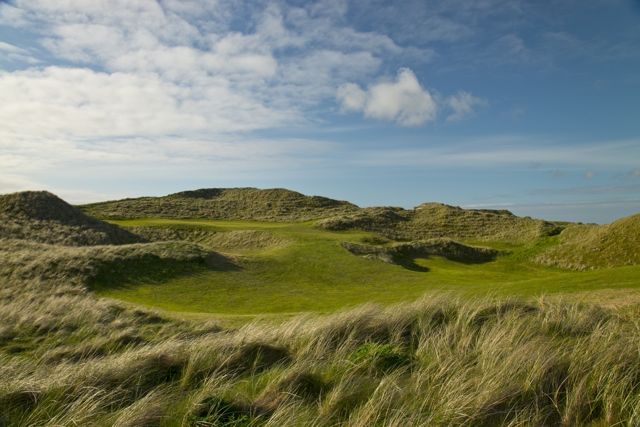
The first hole on Carne’s new Kilmore nine provides a taste of the thrills to follow. (Larry Lambrecht)

Meanwhile, the No. 2 spot has been held just as assiduously by Ireland’s Carne Golf Links, an Eddie Hackett-designed gem on Mayo’s Atlantic coast. Carne’s second-place ranking has long been a puzzle to links lovers, or at least to those who remember that I proclaimed it “the world’s greatest golf course” in a 2003 Sports Illustrated feature. “You must be confused,” wrote a persistent nitpicker with GolfClubAtlas stickers on his steamer trunk — as if confusion were a disqualifying attribute for a course critic.

But now the thinkable has happened. After weeks of stealthy advancement — unnoticed until recently by the wool-gathering analysts at Top 50 headquarters — the Irish course was one good mowing and a couple of tweaks of the Top 50 algorithm from nirvana. This morning, at 9:42 Central Daylight Time, Carne caught Askernish at 10.15/9.85 points on the concentric Perfect-10 scale. For the first time in Top 50 history, two courses share the top ranking.

I, for one, was not caught by surprise. Carne’s rise can be explained by the recent opening of its new Kilmore 9, a spectacular side of golf winding through the Mullet Peninsula’s most breathtaking dunes. Designed tag-team style by American Jim Engh (Sanctuary, The Club at Black Rock, Tullymore GC) and Dublin-based architect Ally McIntosh, the Kilmore 9 was a decade in the making. I monitored its progress from Day 1, and last Tuesday I returned to the Mullet to bang out the ceremonial first drive on behalf of a contingent of American and British golf writers.

Carne’s new holes were worth the wait. Anchored by three dramatic par-3s and a split-fairway par 5 that invites an heroic approach over a gargantuan dune, the Kilmore 9 echoes the grandeur of Hackett’s back nine without copying any of his holes. In fact, I’d argue that no course in the world offers 18 holes of more distinctive character than Carne’s composite links. Kilmore’s par-3 second, for example, starts high on a bank and winds up far below on the lee side of a massive blowout dune, which McIntosh has cleverly tied into a playable bunker.

But that hole is a mini-wow when compared to the WOW of the par-3 seventh, which launches from a sky-scraping dune-top to another dune, 228 yards away, with a wrap-around view of the Atlantic and western Ireland as an unnecessary distraction. “That’s terrifying,” one of my playing partners said at the opening. I thought he was referring to the dizzying drop from the tee to the fifth fairway, until I looked up and saw that he was staring at the distant flag, flapping in a two-club wind.

I realize, of course, that some course-rating systems place greater emphasis on smooth greens. Carne’s new greens won’t be tournament-ready for a few years, and I say, “So what? I can wait.” Neither am I swayed by the $150 million in frills and environmental abuse that Donald Trump lavished upon his Trump International Golf Links in Scotland. Carne’s Kilmore 9 cost €202,000 from start to finish — or roughly what The Donald spent on cocktail shrimp for his grand opening. To which I say: “Sorry, Donald. You can’t crack the Top 50 on the strength of cocktail shrimp.”*

*If you’re talking cash, I might listen.

Anyway, I thought I’d better get this news out before Golf.com finishes its rollout of Golf Magazine’s “Top 100 Courses in the World.”  There might still be time to dump Pine Valley Golf Club from the No. 1 spot and give Askernish and Carne their rightful position in golf’s ever-changing firmament.

Christy O'Connor Sr. plaque

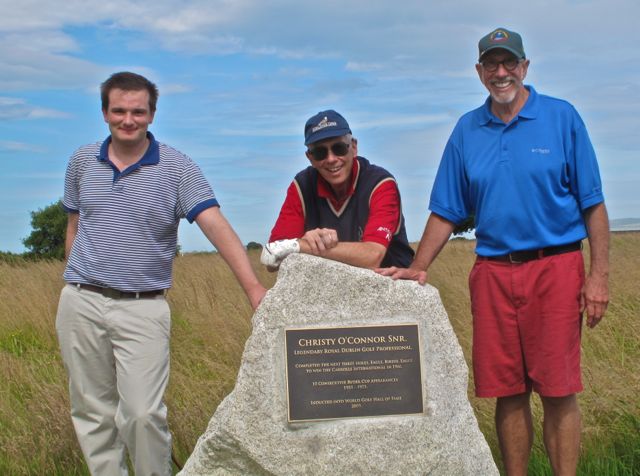
Writers Conor Nagle, John Garrity and John Strawn interrupt their round to visit the Christy O’Connor Sr. plaque at Royal Dublin. (John Garrity)

Top 50 on TV: Inbee Park goes for the “grand slam” of LPGA majors on the 16th-ranked Old Course at St. Andrews, Scotland. Meanwhile, they’re still dancing on Grafton Street in the wake of Ireland’s narrow victory over a crackerjack team of mostly-American golf writers in the biennial Writers Cup at 36th-ranked Royal Dublin Golf Club.

1 Comment

Filed under golf