Post-Lottery Bounce for Augusta National

I fully intended to provide final-round coverage of the Course Designers Championship in Augusta, Ga., won by Phil Mickelson of Dallas-based Phil Mickelson Design. Unfortunately, I learned on Sunday that I was one of 28 winners of the Masters media lottery, my prize being a Monday round at seventh-ranked Augusta National Golf Club. With only 24 hours to prepare for my 11:40 tee time, I had no choice but to race through a column for Golf.com, rearrange my travel schedule, and then scarf down a few calories at T-Bonz with Jim “Bones” Mackay, Mickelson’s caddie.*

*The joint was so crowded that Bones and I had to communicate across several tables using hand signals, but I could tell from the way he mimicked my thumbs-up gesture that he had learned of my good fortune.

It is customary, I know, for writers playing Augusta National for the first time to file self-deprecating accounts of the experience. (If that’s your cup of tea, I highly recommend the breezy, self-flagellating reportage of Chicago Tribune golf writer Teddy Greenstein, who was a member of my foursome.) I, however — mindful of how little space a blog affords the writer — must confine myself to a few highlights. My booming drive on No. 1, for example, which produced whistles of awe from the starters and caddies, carrying far up on the flat. (See my privately-published monograph, “Conquering First Tee Jitters.”) Or my 7-iron on the watery par-3 16th, a tightly-drawn flier that hit the spot I had picked out on the green and funneled down toward the flagstick, stopping two feet from the hole.

Augusta National No. 12

The par-3 12th at Augusta National. (John Garrity)

I was at my best, however, on the par-5 15th, one of the most famous risk-reward holes in golf. Drawing upon my inner Gary Van Sickle, I pounded a long drive up the right side. When I got to my ball, which rested on a relatively flat patch of fairway looking down on Rae’s Creek and a flagstick planted back-right on a wide-but-shallow green, I paused, feigning indecision. Then, with a tight-lipped smile, I turned to my caddie. “Bruce,” I said, “I didn’t come 5,000 miles to lay up.”

Heartened by this display of bravado, Bruce told me I had “195 to the front and 205 to the flag.” Nodding, I pulled the headcover off my hybrid-4 Rescue club, brushed the grass a couple of times with nonchalant practice swings, and then made a Tour Tempo-perfect pass at the ball. The feel at impact was sublime. I watched the shot trace across the distant pines with a feeling of deep contentment — similar, I imagine, to what Mickelson felt on Sunday, when he hit his instantly-legendary 6-iron off the pine straw and twixt the tree trunks on No. 13. My shot was probably struck a little better than Phil’s; it flew precisely 205 yards and landed by the flagstick. Unfortunately, the hole was cut pointlessly close to the back fringe, allowing my ball to skip off the back and run down the tightly-mowed bank. I had to settle for a par.

Was I upset? Not at all. I have studied Alister MacKenzie’s work long enough to know that he labored long and hard to achieve a certain capriciousness in his designs. Sometimes the perfectly struck shot will be punished. That’s how it should be. That’s how you want it to be if you’re a Scotsman fed up with Highlands winters, scratchy kilts and dour neighbors.

Anyway, I found Augusta National to be immaculately groomed and eminently fair from the members‘ tees. I was so impressed, in fact, that I filled out my Top 50 rating sheet in the Champions Locker Room and faxed it off to the Cal Sci number crunchers. A few hours later, they sent me their reply by text: “Augusta National climbs 5 rungs to second! Pebble slides to 7th!”

The Tom Fazio-designed Augusta National Practice Range, meanwhile, holds on to the 47th spot, permanently displacing Oakmont Country Club.

3 Comments

Filed under golf

Tiger, Phil Lead Designers’ Flight

The Course Designers’ flight at the Masters may not get as much attention as it used to, but what a leader board! Tiger Woods and Phil Mickelson share the lead at 6-under par heading into the weekend, and Tom Watson is three back after a second-round 74. Ernie Els survived the 36-hole cut despite a Friday afternoon run-in with Augusta National’s 15th hole; he’s at even-par and T21.

The twist at the Masters, of course, is that the designers are ranked according to their golfing ability, not their design proficiency. That leads to amusing results. Top-ranked designer Ben Crenshaw (Sand Hills Golf Club, No. 19, Kapalua Plantation Course, No. 34) shot rounds of 77-78 and missed the cut by eight strokes. But Woods, who has yet to complete a golf course after three years in the design business, gets to play on the weekend. It may not be fair, but that’s what makes it fun.

Anyway, here are the two-round cumulative results:

Position Player Total Cumulative
T-1 Tiger Woods -6 138
T-1 Phil Mickelson -6 138
3 Tom Watson -3 141
4 Ernie Els E 144
T-5 Bernhard Langer +5 149*
T-5 Mark O’Meara +5 149*
7 Vijay Singh +10 154*
8 Ben Crenshaw +11 155*
9 Ian Woosnam +20 164*
*Missed Cut

Top 50 on TV: The Course Designers’ Tournament is being played at Augusta National, No. 7, but the CBS cameras can’t get enough of the new Tom Fazio-designed Augusta National Practice Facility. The new range, which replaces a foreshortened lawn that ended in a 200-foot vertical net, is more than 400 yards long and lined with azaleas (reminiscent of my back yard). The short-game area, on the golf course side of the range, is roped for spectators and features white-sand bunkers and tournament-ready greens. I’ll review Fazio’s work in more detail in a subsequent post, but for this week only his Augusta National range cracks the Top 50 at No. 47, replacing Oakmont Country Club.

Leave a comment

Filed under golf

Are Artificial Trees in Augusta’s Future?

Every year at the Masters, an old folk song plays in my head: “In the pines, in the pines, where the sun never shines ….” There are better tree songs, I suppose — Hoagy Carmichael’s “A Dogwood Died in Dallas” comes to mind — but Augusta National’s famous 18 meanders through a pine forest. In fact, when founder Bobby Jones gave course designer Alister MacKenzie his first tour of the Fruitland Nursery property, it was to point out that skinny Georgia pines, unlike Britain’s massive hardwoods, could be felled with a few strokes of a hatchet. And if for some reason you wanted more trees, pines were easy to transplant, having root balls about the size of a duffle bag.*

*The portability of pines is demonstrated annually on the National’s eleventh hole, where trees come and go with the nonchalance of guests at a high-end resort hotel.

The downside of the pine is its propensity for shedding pollen in the spring. A single loblolly pine, according an Audubon-knock-off pamphlet I can’t put my hand on, can produce two to three kilograms of yellow powder overnight — enough to cover a fleet of rental cars. Bees carry some of this pollen to flowers, but the rest drifts up against curbs and doorsills or is inhaled by guileless visitors from the north.

“The official Masters color might have to be changed from green to yellow,” Ron Green Jr. wrote in Monday’s Charlotte Observer. “There’s a soft yellow haze in the air and a heavy coating on most static surfaces around the golf course.”

Relief is promised in the form of thunderstorms, which are expected to rumble through Augusta in the next hour or so. Until then, the  Augusta National Golf Club’s No. 7 ranking is suspended (subject to review by the executive committee).

Golf Cart at 2010 Masters

Georgia farmers hail record harvest of sneezables. (John Garrity)

Leave a comment

Filed under golf

Masters Field Too Strong for Tiger?

With Masters week looming, people keep asking what question I’ll spring on Tiger Woods at his Monday press conference. They assume, based upon my background as an investigative, that I will throw him hardballs such as, “Who is Janine, and how did she get your signature on a golf flag?”

Their assumptions are wrong. I’m going to throw the spitter. I’m going to ask Tiger the question that my weak-kneed, pusillanimous colleagues won’t touch with a two-foot pole: “Who is the best course designer in this year’s field?”

I expect Tiger to blush and stammer, because nothing embarrasses him more than his oh-for-three record as a golf architect. Three years after he opened Tiger Woods Design in a blind mail drop outside a mall in Windermere, Fla., Woods has yet to cut a ribbon at a course opening. His Al Ruwaya course in Dubai is stalled, his Cliffs at High Carolina course remains hypothetical, and his Mexican clients have put off construction of their Punta Brava seaside course until they get assurances that they can build it with American labor.

Photo of Cassique Golf Club

The 15th at Tom Watson's Cassique Golf Club, Kiawah Island, S.C. (Tom Watson Design)

Should Tiger dare to answer my question, he’ll have to weigh the design credentials of a couple of dozen tournament players — many of whom have actually visited the courses they are credited with designing. He’ll have to give consideration to two-time Masters champion Bernhard Langer, who has put his stamp on some 17 courses on three continents. But Langer might not prevail in a design playoff with former Masters champs Raymond Floyd (Turnberry Isle Resort and Club, Aventura, Fla.) and Vijay Singh (The Water at Jumeirah Golf Estates, Dubai). And those two worthies would certainly meet their match in three-time Masters champion Tom Watson, whose Independence course at the Reunion Resort in Orlando, Fla., has drawn categorical praise from GOLF Magazine, Golf Digest and Golfweek. Watson showed what he’s made of when he agreed to renovate the marvelous Ballybunion Old in County Kerry, Ireland — a judicious tweaking that saw Ballybunion fall only three places, to No. 5, in the Top 50.

The best designer to tee it up on Thursday, however, will be yet another two-time Masters champion: Ben Crenshaw. With his acclaimed design partner, Bill Coore, Crenshaw is the only active player with two courses in the Top 50: Sand Hills Golf Club, No. 19, and The Plantation Course, No. 34. And that’s not counting the duo’s renovation work on Prairie Dunes Country Club, No. 6.*

*Is there a correlation between Masters titles and design potential? I think there is. Phil Mickelson, a two-time Masters winner, successfully partnered with Gary Stephens on the Lower Course at Whisper Rock Golf Club in Scottsdale, Ariz. The salient fact is that Mickelson finished Whisper Rock in 2001, three years before he donned his first green jacket. (That augurs well for non-Masters winner Ernie Els. The Big Easy has co-designed roughly a dozen courses to date, including the Anahita Golf Course on the isle of Mauritius, chosen “Best Golf Development for Europe and Africa” by CNBC International Property Awards.)

Tiger may not see it my way, but what’s he going to do? Change the subject to his marriage?

Top 50 on TV: The Nabisco Championship, the first major of the LPGA season, returns to the Mission Hills Tournament Course, No. 44. I’m very fond of this course, having sharpened my game on its eucalyptus-lined fairways during countless playing lessons with my West Coast swing guru, Rob Stanger. It lacks, I admit, the symbolic depth of Desmond Muirhead’s later work — such as his par-4 “Guernica” hole at the Segovia Golf Club in Chiyoda, Japan, which commemorates Picasso’s famous painting of a town savagely bombed during the Spanish Civil War. (“A dismembered foot and hand surround the green,” Muirhead wrote in his program notes, “a solitary eye glares at you from behind it. The teeing ground is elevated as a symbol of power for the golfer and to help to see clearly the horse’s head around the lake.”) I also think that Mission Hills, situated as it is in the desert, could use a few more water fountains.

1 Comment

Filed under golf

The Top 50 Hits the Road

It has been a long winter in Kansas City. Last weekend’s ten-inch snow mocked the arrival of “spring” and prevented me from tuning up on the silky fairways of the Heart of America Golf Academy Par-3 (No. 55). “You need a vacation” said my wife, watching in admiration as I practiced full swings in the TV room, leaving perfect, dollar-bill sized scuff marks on the Persian rug. “I bought you a discount ticket on Southwest Airlines. I packed your suitcase. The car service will be here in ten minutes.”

My vacations, of course, are of the working variety. I am typing this in the media center of the La Costa Resort & Spa in Carlsbad, Calif., site of this week’s LPGA Tour event, the KIA Classic.* If I can find time between my course-rating activities and my sideline as a free-lance dowser, I will file a game story to Sports Illustrated Golf Plus on Monday morning.

*La Costa’s theater-style press room, with its digital video screens, multi-media work stations and ergonomically-correct executive chairs, is No. 5 in the most recent World Press Facility Ranking Presented by Frito-Lay.

Word of my presence has spread quickly, judging from the press-room buzz about La Costa’s Dick Wilson/Joe Lee-designed composite course. Rolex points leader Ai Miyazato took a bashful stab at course rating yesterday when she was asked to compare La Costa’s tournament track to the more famous South Course at nearby Torrey Pines. “Well, I would say the grass is different,” she said through an interpreter. “I think over here is more thick so that makes it a little less distance, but the greens are much softer over here, so it’s kind of half and half.”

I carry the Top 50 data base on 42 keychain flash drives, so I was able to compare the Japanese star’s impressions with the reports of my course raters. They were all in agreement: “half and half.”

“But Torrey Pines,” Miyazato continued, “was like almost no wind, and it seems like over here is more windy. So La Costa is more difficult.”

I would have to disagree with Ai on that point. The ocean cliffs of Torrey Pines are far more exposed than the condo canyons of La Costa, and the latter is lined with giant gum trees, to which the wind must inevitably stick. Conclusion: Torrey Pines is more difficult.

More difficult, I shouldn’t have to add, does not mean better.

Top 50 on TV: Dick Wilson’s highly-regarded eighteen at Florida’s Bay Hill Club & Lodge (No. 56) is the site of this week’s Arnold Palmer Invitational, a PGA Tour event. Palmer, a course designer himself, likes to tweak Wilson’s old track from time to time. Most of his changes are inconsequential, such as this year’s lengthening of the already-unplayable par-4 18th by ten yards. But Palmer has shown true genius by moving the tournament tee on the par-4 15th to the other side of heavily-trafficked Bay Hill Boulevard, forcing the pros to smack their drives over a pair of neatly-trimmed hedges. As one who has long argued for the inclusion of steeplechase elements in golf design, I can only say, “Well done, Arnie — and pay no attention to the neighsayers.”

2 Comments

Filed under golf

Kansas Tops Northern Iowa in Poll that Matters

A wave of sadness has swept over our neighborhood upon hearing that the University of Kansas has lost to the University of Northern Iowa in the second round of the NCAA basketball championship.* We live roughly a block-and-a-half east of the state celebrated in What’s the Matter with Kansas?, so we know that our border partner is a full-out Technicolor state, not the drab, tornado-prone territory portrayed in The Wizard of Oz. Or it least it was until yesterday evening, when the No. 1 Jayhawks were swept off the board by UNI’s Fighting Warriors. Or Blue Devils. (We’ll Google that and get back to you.)

*The sadness may not be universal. The neighbor across the street  flies a University of Missouri flag over his portico.

Anyway, to lift the spirits of our depressed neighbors, I have issued a Top 50 press release pointing out that Jayhawk fans retain bragging rights in the area of great golf courses.

“Kansas is home to no fewer than three Top Fifty courses [I’m quoting from the release], which is more than any other state and a lot more than Northern Iowa, which has no courses in the Top Fifty. (Or the Top 500, for that matter.) Topping the list of Kansas gems is 6th-ranked Prairie Dunes Country Club of Hutchinson, the site of numerous national championships …” etc., etc. The release goes on to mention Mission Hills’s Kansas City Country Club (home of 5-time British Open champion Tom Watson) and Leawood’s Hallbrook Country Club (home of Tour Tempo tycoon, John Novosel), Nos. 50 and 42 respectively.

I could have added that Milburn Country Club of Overland Park, Ks., was in the Top Fifty as recently as February, but I don’t want Iowans to think I’m rubbing it in. I’ll just point out that a list of other Kansas courses that are better than anything northern Iowa has to offer would include Flint Hills National, Colbert Hills, Prairie Highlands, Mission Hills, Auburn Hills, Dub’s Dread, Buffalo Dunes, and Sand Creek Station (recently rated No. 2 public-access course in the state by Golfweek).

Feel better Kansans? I hope so.

Oops, have to go. The Mizzou-West Virginia game tips off in a few minutes.

2 Comments

Filed under golf

Fighting Words Over Brookline Ranking

“I have to disagree with Swope Memorial,” Dan B writes. “This is a decent local municipal course, but it does not belong in any national discussion, regardless of who designed it or what tournament it may have hosted.”

Dan’s spirited rebuke is music to my ears! The whole point of the Top 50 is to get students of great golf design to come out of their shells and start squabbling like litigants on Judge Judy. If you were to visit us here at Catch Basin, you’d find Top 50 staffers shouting in hallways, hurling logoed caps at each other and throwing the occasional punch over the most arcane disagreements. Tempers flare because most of these disputes are, at their core, matters of individual taste. Are the greens at North Dakota’s Medicine Hole, No. 38, better than the greens at Augusta National, No. 7? I would say no — particularly during Masters week. But my assistant with the frayed knuckles asks: Better for whom? The average Badlands golfer will take four or five putts on Augusta’s 9th green — which, Omar will argue, is proof of faulty design.

17th at Ballybunion

Ballybunion Old: Better than TPC Scottsdale? (John Garrity)

Similarly, there are those who, like Dan B, wonder how a midwestern muni like Swope Memorial, No. 45, can topple a legendary layout like The Country Club. We are all prey to this “we know who or what is best” attitude. It’s the same conventional wisdom that told us that a 20-year-old American street urchin named Francis Ouimet couldn’t possibly outplay the British golf titans Harry Vardon and Ted Ray for the 1913 U.S. Open title.

The Top 50 algorithm, I’m proud to say, does not look down its nose at underdogs. When you take a closer look at a mutt like Swope Memorial — give it a flea bath, say, and a good brushing — you may find that it has a pedigree to compare with that of any Brookline Pomeranian. Did you know, for instance, that the legendary newsman O.B. Keeler, Bobby Jones’s mentor and Boswell, was a regular at Swope Park during his brief tenure at  the Kansas City Star? Keeler wrote about the parkland gem in its 9-hole, pre-Tillinghast iteration, circa 1910, but you could easily apply his words to today’s 6,274-yard championship layout:

It was as simple and straightforward a golf course as nature could devise, uncomplicated by fancy architectural notions. An intermittent sort of stream with trees guarded the first green, and another stream in a steep-walled valley, with a spread of swamp to the right, had to be crossed on the one-shotter, No. 4. … The fairways were good enough, and the rough wasn’t particularly rough, though the putting surfaces never seemed adequate and we were forever complaining about them. Withal, they were not to be despised as excuses. ‘You know how those greens are,’ you could tell your friends.

That sounds a lot like the Swope Memorial I play on my senior-discount, weekdays-and-weekend-afternoons annual pass — particularly that passage about a “steep-walled valley with a spread of swamp,” a spot I seem to find with some regularity. The greens, of course, have improved greatly since Keeler’s time, though they may not be as “sophisticated” as those at The Country Club.

As I recall it [Keeler continues], the original public course at Swope Park ought to have been about as easy a nine holes as the most gingerly neophyte could have asked on which to start cutting down his medal average of 7 strokes to the hole. Yet the shameful confession may as well be made, that not only did I fail to achieve the average of 4 that originally was established as my Ultima Thule*, but also that I cannot recall ever playing a single round of nine holes at an average of 5 — certainly not the full round of 18 holes — in the three years I fought, bled and courted apoplexy about that course.**

*The Latin words Ultima Thule, in medieval geographies, denoted any distant place beyond the boundaries of the known world. The term was later appropriated by the Swedish Viking-rock band, Ultima Thule, which sold one certified platinum and three gold albums in the 1990s.

**From O.B. Keeler’s The Autobiography of an Average Golfer, Greenberg, 1925.

I could go on quoting Keeler to my advantage, but the proof is in the playing, so to speak. I happily invite any Country Club member out to Swope Memorial as my guest, on the understanding that I get a round at The Country Club in return. Who knows? If it impresses me, Brookline might find its way back to the Top 50.*

*Golfweek’s latest course ranking (3-12-10) has The Country Club at No. 20 on its list of so-called Classic Courses. That sounds impressive until you notice that Golfweek excludes all courses built since 1960 — they have a Top 100 of their own! — and totally ignores golf courses outside the U. S. If I were The Country Club, I’d find a second and challenge Golfweek to a duel.

1 Comment

Filed under golf

Oops! Swope In, Brookline Out

No one has found fault, so far, with our recently-updated Top 50. The only quibbles come from the tree-hugging community — effectively dismissed in my last posting — and from an anonymous correspondent who claims he has trouble distinguishing between the late Robert Trent Jones (designer of Valderrama, No. 17, and renovator of Kansas City C.C., No. 50) and his son, Robert Trent Jones Jr. (Poipu Bay, No. 15). Which brings to mind the Joan Rivers acquaintance who didn’t understand the concept of Roman numerals. (“She thought we just fought World War Eleven.”)

Perfect, however, is something we have never claimed to be. Decimal points can be misplaced. Fours can fail to be carried. Checks can — and do — get lost in the mail.* That’s why we constantly re-examine our data, looking for niggling errors, and why we subscribe to a sophisticated “spell-checking program” that makes us look up words that it doesn’t recognize. (See “Valderrama.”) It is Top 50 policy to correct even minor mistakes, there being no better way to preserve confidence in the published ranking.

*Sometimes twice in a row, against all odds.

In that spirit, we submit this clarification of the most recent ranking: No. 45 is Swope Memorial Golf Course, Kansas City, Mo. — not The Country Club of Brookline, Mass., as originally announced.

The elevation of Swope Memorial marks the first time that two A. W. Tillinghast courses from Kansas City have achieved simultaneous rankings. Elegant Kansas City Country Club, the third-oldest country club west of the Mississippi and home course of five-time British Open champion Tom Watson, is better known than its crosstown cousin, but both tracks have pedigrees. KCCC has hosted numerous state, regional and national tournaments, including the inaugural Trans-Mississippi Amateur (1901), won by John Stuart. Hilly Swope Memorial, a municipal course, hosted the 2005 U.S. Women’s Amateur Public Links Championship and was the PGA’s venue for the 1949 Kansas City Open, won by Jim Ferrier.

The adjustment leaves the highly-regarded Country Club, currently ranked 18th in the U.S. by an anonymous Golf Digest panel, with no ranking at all. To mollify its New England supporters, who relentlessly lobby the Top 50 on behalf of their allegedly underrated courses, we have temporarily moved the Donald Ross-designed 9-hole Tatnuck Country Club course of Worcester, Mass., to No. 68, three rungs above its previous station

We regret, but don’t admit to, the error.

13 Comments

Filed under golf

A Gripe from the Branch Office

“I can’t hit a 1-iron, but I’ve proven countless times that I can hit a tree.” — Anon.

“Have you got something against trees?” asks a tree surgeon from Dubai.

The question puzzled me at first, but an hour’s perusal of the new Top 50 enlightened me. Four of the top five courses (and six of the top ten) are as treeless as the polar ice caps. The wind-blown machair at top-ranked Askernish Old supports a stubble of knee-high marram grass, but a South Uist horse thief will never hang there — nothing to hang him on, so to speak. Ditto for the dramatic dunes of Carne (No. 3), which support no vegetation taller than a garden gnome. Even Pittsburgh’s legendary Oakmont Country Club (No. 47), come to think of it, didn’t crack the Top 50 until its members chopped, sawed, toppled, bulldozed and ground up a few million board feet of shade trees in preparation for the 2007 U.S. Open.

But to answer the tree doc’s question, no. We’ve got nothing against trees. Many of the Top 50 courses are extravagantly shaded, and no fewer than seven* are named for nature’s biggest nuisances: Oak Hill (No. 9), Cypress Point (No. 13), Pine Needles (No. 30), Castle Pines (No. 33), Calusa Pines (No. 46), Oakmont (No. 47) and Laurel Valley (No. 49).

* Eight if the “Poipu” in Poipu Bay (No. 15) is Hawaiian for the arthritic, scarlet-blossomed view-hogger that ate my Pro V-1 four years ago.

Carne Golf Links

No bark on Carne's infamous 17th, but it can certainly bite. (John Garrity)

It’s just a fact that links courses are the most highly-regarded golf courses, and a true links has no, or hardly any, trees.* How else to explain Castle Stuart’s debut at No. 10, leapfrogging hundreds of parkland courses? Or St. Andrews Old at No. 16, despite a closing hole that is indistinguishable from the visitors’ parking lot.

*Despite its name, the Pebble Beach Golf Links (No. 2) is not a true links. It is a cliffside course, the distinction being obvious to anyone who has ever sliced his tee shot on Pebble’s sixth hole.

Personally, I’m about as pro-tree as they come. I have trees in my front yard and trees in my back yard, and if you see me discreetly raking my spiky sweet-gum balls under the neighbor’s fence, it’s because I want to share my arboreal bounty.

Top 50 on TV: Nothing this week, but the Honda Classic is being played on the Jack Nicklaus-designed Champion Course at the PGA National Resort & Spa in Palm Beach Gardens, Fla. Nicklaus has two courses in the Top 50, both of which have hosted PGA Tour or Champions Tour events. The first person who can e-mail me the names of those tournaments will be mocked for spending too much time in front of the flat screen. (Or awarded a free copy of my book Ancestral Links: A Golf Obsession Spanning Generations, just out in paperback. It all depends on my mood.)

2 Comments

Filed under golf

Castle Stuart Soars in World Ranking

The surprise of the latest Top 50 ranking (see sidebar) is the new Castle Stuart Golf Links of Inverness, Scotland, which debuts at No. 10.  A collaborative effort by Philadelphia-based architect Gil Hanse and American developer Mark “Kingsbarns” Parsinen, Castle Stuart opened last July to rave reviews from the dead-tree publications: “Destined to become one of the best courses in the world.” (Links Magazine. … “A Masterpiece!” (Bunkered) … “Effortlessly blends the best elements of St. Andrews and Pebble Beach, Ballybunion and Royal County Down.” (Golf World, U.K.)

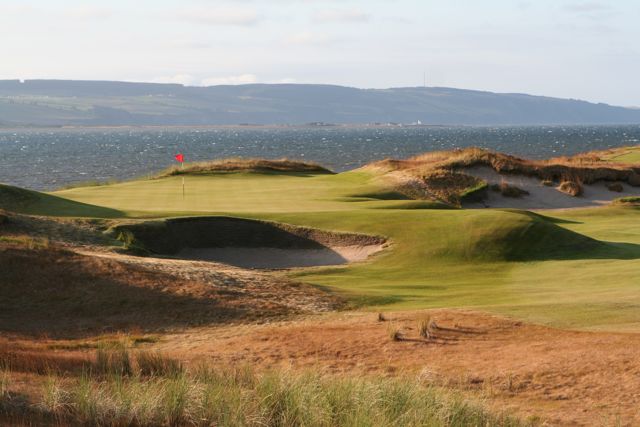
Castle Stuart Golf Links

The 11th green at Castle Stuart, Inverness, Scotland

“Yes, it is that good,” wrote the Links reviewer, prolific author and former GOLF Magazine editor, George Peper. “Succinctly put, Castle Stuart will be the most significant British Isles debut since Loch Lomond in 1993. It should be well on its way to the top echelon of the world rankings.” I’m guessing that Peper was paid by Links to write that, but you can’t argue with his call.  Castle Stuart, at No. 10, is the highest-ranked new course in Top 50 history.

My own first impression*, garnered on a bright, windy afternoon in late July, was as positive as Peper’s. Most of the holes have views of the miles-wide Moray Firth, from the Kessock Bridge to the Chanonry Lighthouse, and an improbable number seem to be right on the water. It’s an illusion. When you play the holes that parallel the Firth on the higher ground, it’s like playing the cliffside holes at second-ranked Pebble Beach Golf Links; you don’t see the beach or the lowland duffers, you see only sparkling water and breaching whales. (Or, in this case, breaching Loch Ness Monsters.)

*I have no financial, professional or prurient interest in the Castle Stuart development, but my middle name is Stuart and I claim, by royal birthright, to be the rightful monarch of both Scotland and England via my great-great-great-great-etc.-cousin, Mary Stuart — a.k.a. Mary, Queen of Scots — and the other golfing Stuarts, including James IV of Scotland — “the first golfer known to history” — and James I of England, who is best remembered for appointing the first royal club maker.  For more on the Stuart golfers, see the just-released paperback edition of my book, Ancestral Links: A Golf Obsession Spanning Generations.

I’ll discuss the course layout in later postings, but there’s no reason to withhold the fact that Castle Stuart dominated our “top lavatory view in golf” category, displacing Newport Country Club of Newport, R.I. The shower stalls and urinals on the third floor of Castle Stuart’s art-deco clubhouse provide panoramic views of the course and the shoreline through eye-level, wraparound windows. Dropping to No. 3 is the locker room pissoir at California’s venerable Cypress Point Golf Club (No. 13). “An awning somewhat restricts your view,” reports Sports Illustrated’s Gary Van Sickle, “but you can see a big tree and some of the ocean.”

Equally surprising is the disappearance from the Top 50 of the Jupiter Hills Club of Tequesta, Fla., which held the No. 10 spot now occupied by Castle Stuart. Knowing how computers work, I suspect that the Jupiter Hills listing has somehow been covered up by Castle Stuart, concealing a tenth-place tie.

We’ll get to the bottom of that. In the meantime, Jupiter Hills moves to No. 1 on the Challenged and Disputed List, replacing Liberty National Golf Club of Jersey City, N.J..

4 Comments

Filed under golf