Coastal Par-3 Breaks Into Top 50

Pebble Beach is so over-rated,” grouses a reader from Ft. Meade, Fla., dissing our ninth-ranked course. Another reader insists that sixth-ranked Augusta National is “a lot of fancy grass and prom corsages masquerading as a golf course.”

It would be easy to dismiss these comments as the ravings of unschooled dolts, but the Top 50 doesn’t operate that way. We investigate such claims. We put all our resources to the task. We even make calls.

Gary Van Sickle

Van Sickle ponders Pebble’s ranking while covering the U.S. Open at Olympic. (John Garrity)

To placate the Ft. Meade correspondent, we sent chief course rater Gary Van Sickle to Monterey to see if the iconic California layout had deteriorated since we last played it. Gary immediately wired back that it had not. “PEBBLE BEACH REMAINS THE GREATEST GOLFING EXPERIENCE IN THE WORLD STOP SEND EXPENSE MONEY STOP.”

He filed the rest of his report in the form of a GOLF.com article from which we quote to the full extent of the fair-use provisions of the Copyright Act:

Purists like to rate golf courses based on absolutes like shot values, relation to par and other inside-golf things. I’ve read those who say Pebble has 10 great holes and eight mediocre ones, and that it’s grossly overrated. I wish one of those critics could have been out on the peninsula with my group Sunday afternoon, basking in the early-evening golden light with postcard views in every direction, hearing the crashing of the waves, the squawk of the gulls and smelling the scent of the sea. Race the sun to the finish, like we did (although it was a very slowwww race), and try to play the 18th hole in the dark when you could no longer see the ball at your feet, and tell me Pebble Beach is overrated.

It isn’t. It’s an experience you can’t put a price on. You would pay just to walk this hallowed green and savor the dramatic meeting between land and sea. It’s special.

After playing Pebble, Gary visited the previously unranked Casserly Par-3 Golf Course in Watsonville, just up the coast. Finding it to be “better than a pleasant surprise” at $9 per round, he called our attention to Casserly’s signature hole, the 112-yard seventh, which calls for a carry over a ravine and a 60-foot pine that blocks the green. “I COULDN’T SEE THE PIN BEHIND THE PINE STOP VERY COOL STOP”

Gary’s enthusiasm for Casserly was almost as great as his enthusiasm for Pebble, so we have tentatively installed the Par-3 at No. 49, displacing Robert Trent Jones Jr.’s CordeValle Resort course, site of the PGA Tour’s Frys.com Open.
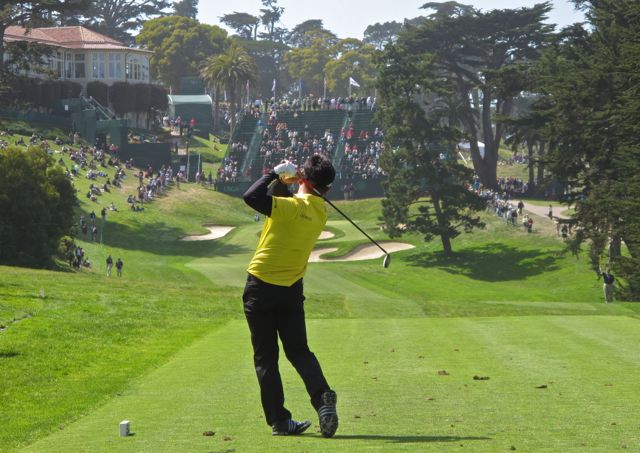
Practice round at Olympic

51st-ranked Olympic Club is tough from the back tees. (John Garrity)

Top 50 on TV: Nothing this week, but the U.S. Open is being played on the famous Lake Course at San Francisco’s Olympic Club, currently ranked No. 51. Further west, in Japan, they’re still agonizing over the abysmal attendance, in late May, at the Diamond Cup at the Country Club of Japan in the Tokyo suburbs. “Miserable results,” writes Duke Ishikawa, our chief Asian correspondent. “The four-day total was 6,839. Same week as Colonial. Thursday was only a thousand.”

There are several reasons for Japan’s attendance slump, but Duke says it’s mostly the fans’ infatuation with young Ryo Ishikawa (no relation), who is playing more American events. “I have suggested in my articles that Ryo play more in the U.S. because it’s the world’s strongest tour,” he writes, “and especially the Memorial, because that’s Jack’s tournament. But Katsuji Ebisawa, our tour’s new chairman, sent an official letter to Ryo entreating ‘please don’t forget the Japanese Tour.’

Duke continues: “The New York Times said ‘One Star Between Two Tours,’ but I don’t think Ryo is a star. He is just an idol, a gallery’s pet. Or a pin-up boy. But he still influences the sports show in Japan. To stay on the U.S. Tour or not, that is Ryo’s question.”

Pressed for another reason why fans might shun the Japanese tournaments, Duke mentions the high prices at concession stands. “At Japan Open my friends paid US $11 for a piece of sausage and a coke.”
1 Comment

Filed under golf

Heartland and Harding Making Moves

A reader from Muskegon, Mich., asks if we change a course’s ranking based upon minor alterations to the design. “Like, say, if they were to chop down the Eisenhower Tree at Augusta National, would that give them a higher or a lower score? Or what if at a certain course in Grand Rapids they fixed a certain tee so that it didn’t point way right when you need to hit it left to stay out of the trees? Would that make a difference?”

Heartland Rebuilding Ross Green

Heartland GC, the only Donald Ross design in Missouri, is restoring the Ross green on its ninth hole. (John Garrity)

I see two points that need correcting in Muskie’s e-mail. The first is the perennial misunderstanding of “higher or lower score” as it pertains to the Top 50 rankings. The Cal Sci algorithm is concentrically weighted around “a perfect 10,” which means that high and low scores are to be avoided, not pursued. Put another way, if Smash star Katharine McPhee scores a 10 on the Carnegie Mellon Feminine Pulchritude Scale (FPS), she’s got no way to go but down. Or up. She can’t do better.

Secondly, it would make no difference if they re-oriented that tee so it pointed straight down the fairway. Muskie would still slice his drive into the trees.

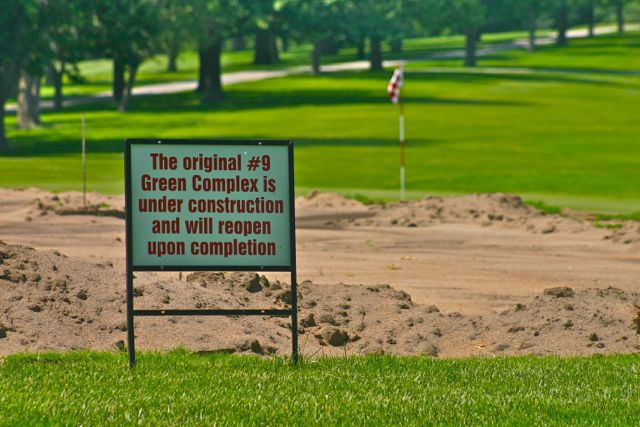
But to the larger point, yes, we take minor alterations of a design into account when we issue our adjusted ratings.* For instance, the 45th-ranked Heartland Golf Club of Kansas City, Mo. (aka Hillcrest Country Club) is restoring Donald Ross’s original ninth green, correcting a 21st-century design blunder. When the green is completed in the fall, Heartland could leap into the Top 40.

* A new Top 50 is posted daily at 2:15 a.m. CDT. We publish hard-copy Mandarin and Portuguese versions on a weekly basis, but only in Africa and the Middle East.

“That’s all well and good,” writes a junior golfer from Sun City, Ariz., “but you can’t possibly know what’s happening at courses around the world. I’ve heard that Pete Dye, just to name one architect, keeps ‘tweaking’ his designs ad infinitum, jumping on a sand pro at the drop of a hat. So your ratings must necessarily be flawed.”

Practice facility, Harding Park

TPC Harding Park’s new short-game practice area will be the perfect place to test the theories in Tour Tempo 2: The Short Game and Beyond. (John Garrity)

Wrong! The Top 50’s vast network of course raters keeps an eye on all the work being done at ranked courses. Last week, for example, workers in San Francisco applied the finishing touches to a new short-game practice area at TPC Harding Park, site of the 2009 Presidents Cup. Positioned between the parking lot and the practice range, the new practice area overlooks beautiful Lake Merced. But it wasn’t overlooked by us! Harding Park jumps three positions to No. 78.*

* If the new grass survives the typically-brutal San Francisco summer, HP will climb even higher.

As for Pete Dye and his constant course-doctoring, give us some credit. We shadow his every movement with unpaid interns.

Top 50 on TV: Nothing this week, but The Memorial Tournament is being played on the immaculate fairways and greens of the 51st-ranked Muirfield Village Golf Club, designed by Jack Nicklaus and the late, great land-form artist, Desmond Muirhead. (Nicklaus is famous for winning 18 major championships. Muirhead is famous for designing golf holes in the shapes of states, stringed instruments and farm animals.)

1 Comment

Filed under golf

Final Shots in Fifth-Major Battle

Bowing to reader demands that Gary Van Sickle’s The Players: NOT the Fifth Major be given an extended run, we’ve held onto his third act until this afternoon. (Actually, Matt Kuchar’s second-round 68 at the HP Byron Nelson Championship reminded me that I had not posted the final installment, as promised. Fortunately, it was one of those “we” promises, not an “I” promise.) Kuchar, you’ll recall, won last week’s edition of THE PLAYERS. It was his fourth PGA Tour victory and his first “fifth major.”

Or not. Gary picks up the thread with some ruminations about another would-be biggie.

Now to the last real contender, the Memorial Tournament. Jack Nicklaus founded it in Dublin, Ohio, and he has said that no, he wasn’t trying to build a major championship. Come on, of course he was! Check out the current Nicklaus.com home page:  “The Memorial Tournament has grown into one of golf’s premier events, often called the fifth major.”

Actually, it isn’t. Maybe for 15 minutes about 30 years ago. The hometown Columbus Dispatch jumped on Jack’s bandwagon early. After Roger Maltbie beat Hale Irwin in an experimental three-hole playoff in the inaugural ’76 Memorial, and Nicklaus himself won the next year, Paul Hornung wrote in the Dispatch, “The first two tournaments have been more than memorable athletic events. In that short time, they have established the Memorial as a candidate for fifth major designation.”

The Memorial was Jack’s ode to Augusta National. Concession tents were dark green. Caddies wore white jump suits. The course was immaculately maintained, and say, that par-3 12th hole over water looks familiar. Tour players were gushing in their praise. From Bob Baptist in the Dispatch before the ’81 Memorial: “When he was asked, What do you think about the Memorial’s chances of one day being a major, Mark Hayes flatly predicted, ‘One day I think it will be bigger than Augusta.’”

That’s right. Bigger than Augusta.

In 1984, Baptist quoted former Memorial champ David Graham in the Dispatch: “Nicklaus is a legend who has surpassed Bobby Jones and probably everyone else. One of these years, he’s going to retire. The only place players and fans will be able to see Jack will be Muirfield Village during the Memorial. Shades of Augusta National. You think that won’t make the Memorial a major?”

Perhaps it might have if the Tournament Players Championship hadn’t barreled right over it. A new era began in 1982 when Jerry Pate won and inaugurated the terrifyingly difficult Stadium Course and its infamous island-green 17th hole. It had a surprise—if choreographed—ending on national television in which Pate pushed tour commissioner Deane Beman and course designer Pete Dye into the lake and dived in after them.

Just that quick, the Memorial fell to second place in the Fifth Major arms race. From Ian O’Connor’s 2008 book, Arnie & Jack: “In fact, the Memorial was battling the tour’s Player Championship at the TPC at Sawgrass for unofficial honors as the game’s fifth major.  ‘Deane came up with a great idea with the Players Championship… but you can’t buy a major championship and that was sort of the effort being made,’ Nicklaus said. ‘The Memorial was his only competition… but everything he could do to put one ahead of the other, he would do and that’s always stuck in my craw.’”

It’s not as if Nicklaus didn’t see it coming. He joked that he won the first TPC event in ’74 “just in case” it became a major later, but despite winning the tour’s new flagship event three times, Nicklaus never treated them as significant wins. For obvious reasons. Just ask Deane Beman, the happily retired PGA Tour commissioner who helped create The Players from scratch, as detailed in Adam Schupak’s tale of the tour’s dramatic rise, Golf’s Driving Force: “’Bobby Jones was Jack’s model,” Beman said. ‘His goal was to win more majors than Bobby Jones. When Jack decided to build his own facility and have his own tournament, that tournament would be to him what the Masters was to Bobby Jones. And of course, our tournament stood in his way.’”

While rain often poured on the Memorial and it’s late-May date, almost the only thing that poured on the Players and its new Stadium Course was more publicity. Dye’s design was controversial. “It was like playing Donkey Kong out there,” Tom Weiskopf said, likening it to a popular video game. There was Pate, his orange ball and menacing camera shots of a trolling alligator. There was even media hype. From Golf’s Driving Force: “Before the first putt has been stroked, the first hot dog sold or the first complaint made about the rough, it has been billed as golf’s Super Bowl,” wrote Golf Digest’s Dwayne Netland. “This is quite a burden for any unborn event, no matter how noble its blood, but if the grandiose plans materialize, the Tournament Players Championship may become the sport’s fifth major event.”

Greg Larson, the golf writer then for the Florida Times-Union in Jacksonville, raised the bar with his report from the 1985 PGA Championship: “Deane Beman was quoted in a New York Times story yesterday as calling for the TPC to be declared a fifth major. If the PGA, which begins today at Cherry Hills, is any measurement, Beman should be screaming for fourth place… After two days of walking around Cherry Hills… nothing jumps out and says, ‘Hey, this is different than the Memorial, the Crosby or the Bay Hill Classic.’”

So here we are three decades later, on the verge of a fifth major… or not.

If there is going to be a fifth major, Dan Jenkins said, it has to be The Players. Lawrence Donegan, the respected golf writer for Scotland’s The Guardian, has a different idea. “America doesn’t need any more majors,” he said, presenting a view widely shared in Europe. “It’s ludicrous that we have four majors and three of them are on one continent. Golf is becoming more global and if Asia is the new frontier, and it is, where better to have another major? The fifth major should be the Australian Open. It’s got the history, the tradition, the courses. But four’s a great number. So forget the PGA Championship—just plug in the Australian Open.”

Larson, who’s still going strong as a Jacksonville-area sports-talk radio personality since leaving his paper in ’89, thinks Pate put The Players on the short list of contenders but… “The tour was always blowing in people’s ears, ‘This is a major,’ and I think they pushed it too hard,” Larson said. “If they’d just left it alone, everybody would consider it a major by now.”

Beman is hopeful but said he never had any illusions that his tournament would get major status quickly. “The last element to become the fifth major, or to replace one of the others, is that the players need to fully understand how important it is to their enterprise and they have to fully embrace it,” he said. “The tour is reluctant to tell them that. Somebody else needs to.”

There is one other possibility, Beman believes, that might accelerate the coronation of The Players—Tiger regaining form and winning more Opens or Masters. “Then Jack may want this to become a major after all,” Beman said with a laugh. “Because he won it three times.”

If The Players is a major, the new score is: Jack 21, Tiger 15.

And Kooch 1. Thanks to Gary for his analysis.

Top 50 on TV:  Nothing this week, but Mike Van Sickle of Wexford, Pa., advanced to U.S. Open sectional qualifying after earning medalist honors with a 67 at Quicksilver Golf Club in Midway, Pa. Van Sickle, who starred at Marquette University, is a prominent blogger.

2 Comments

Filed under golf

Fifth-Major Debate Heats Up

Assuming you’ve all found your way back to your seats, we’re about to dim the lights and present Act Two of Gary Van Sickle’s The Players: NOT the Fifth Major. (For those of you who prefer the Cliff Notes versions of the classics, we recommend Gary’s charticle, “Taking the 5th,” which appeared in the PLAYERS preview edition of SI Golf+.)

Act One ended with Gary lancing the pretensions of the Australian Open. The curtain rises again to the strains of “The Forest Ranger Song” from Little Mary Sunshine.

Like the Aussie Open, the Canadian Open also began in 1904, taking a lengthy break for World War I before resuming. Tommy Armour, the legendary Silver Scot, called the Canadian Open “not the third but the second-greatest championship in the world,” ranking it behind the U.S. Open, possibly because he won it three times (1927, ’30 and ’34). But in the mid-‘30s, what else was there?

Fast forward to 1965 after Gene Littler won the Canadian Open and said, “I never go into any major tournament with the idea that I’m playing well enough to win.”

That’s right, Littler lumped it among the other majors like it was fact. That’s notable. Lee Trevino won the Canadian in 1971, sandwiched between his U.S. Open and British Open titles, a feat promptly christened the Triple Crown. Later, Trevino recalled, “The Canadian Open is one of the world’s oldest championships and I rate it among the top four in the world. The only Open I can’t seem to win is the Mexican Open.”

Ernie Els in Dubai

Ernie Els, a winner of national Opens on both sides of the Atlantic, thinks the British PGA is a big deal. (John Garrity)

Trevino never missed a chance to take a jab at the Masters, a tournament whose course and policies didn’t agree with him, but the Canadian Open did have an impressive run. Its champions included Sam Snead, Byron Nelson, Walter Hagen, Locke, Billy Casper and Palmer. Also, the World Series of Golf was then a four-man event for the winners of the four majors, and if a player won two majors in a year, guess who filled in at the World Series? The Canadian Open champion.

Jack Nicklaus played in the Open every year from 1974 through ’89. He finished second seven times, which helped revive the event. After he built the Glen Abbey course near Toronto and it became the tournament’s permanent home in 1977, the event lost its national championship feel and morphed into just another tour stop. Tiger Woods gave it an adrenaline boost by winning in 2000, but even he didn’t return after 2001. When the FedEx Cup series began, the Open was shoe-horned into an unfavorable date and stuck with a weak field. The glory days are long gone… unless RBC can buy a better date.

“Now,” said Toronto Star columnist Dave Perkins, “virtually every reference to RBC rebuilding the tournament carries a line like ‘attempting to restore the Open to its former glory, when it was widely considered the fifth major.’ I think it’s one of those self-fulfilling media prophecies. We keep repeating it as if it were true, therefore it must have been true.”

Stay tuned for the thrilling conclusion, which we’ll post Sunday afternoon when the final twosome, Kevin Na and Matt Kuchar, step onto the tee of the island-green 17th.

Leave a comment

Filed under golf

THE PLAYERS: Van Sickle’s View

Gary Van Sickle, our chief course rater and principal PGA Tour correspondent, moonlights as a Sports Illustrated senior writer. In that capacity he is, at this very moment, covering THE PLAYERS at the 51st-ranked TPC Sawgrass Stadium Course in Ponte Vedra, Fla. Busy as he is, Gary was kind enough to slide a few thousand words of cogent analysis under our door, asking only that we not identify him as the author. We therefore ask that you, the readers, honor his request.

Phil Mickelson

Mickelson, a former PLAYERS champ, was happy to take the Fifth. (John Garrity)

Gary’s chosen topic, by the way, is “THE PLAYERS: Is It the Fifth Major?”

Repeat after me: There will never be a fifth major championship.

Now repeat after me again: Never say never.

It is no longer a stretch to use the words fifth major in the same sentence as THE PLAYERS. It’s been done. In fact, starting in the pages of Sports Illustrated in 1984 when Dan Jenkins, famous sportswriter and soon to be World Golf Hall of Fame member, wrote about the Tournament Players Championship (a.k.a. The Players). “For two years,”Jenkins wrote, “the pros had been howling louder than a North Florida wind about the horrors of the design of their own course at their own headquarters and the site of their own championship, which has certainly become the ‘fifth major.’”

Ahh, you say, but Jenkins is a comedian and a master of sarcasm. Those aren’t quote marks around fifth major, you say, those are Dan’s dried tears from laughing so hard at his ironic use of “certainly” and “fifth major.”

Fine. Let’s go to Pebble Beach during the West Coast Swing of 2008, where Phil Mickelson was answering a question about where he plays. “What’s difficult from a player’s point of view,” Lefty said, “is scheduling, because if you take the five majors, counting the Players, and the three World Golf Championships, which is eight…”

Five majors. He said it!

Not so fast, you counter. Phil, too, is a comedian and… wait a minute, didn’t Phil win The Players the year before this comment? He’s counting The Players as a major because HE won it!

Gee, you people are so cynical. I don’t even know you anymore.

Let’s agree on two things, at least. One, golf history is fluid. It meanders like the mighty Mississippi. Even the Masters wasn’t always a major. Adding a fifth major championship may seem as unnecessary as dunking an Oreo in hot fudge, but hey, it might happen in this now-now-NOW world where yesterday’s tradition is today’s who cares?

Two, the competition for any future fifth-major status looks a lot like a Soviet election—only one real candidate. The Players is effectively the last man standing.

You’re not so sure? Well, follow along as I weed out the pretenders, who will fall away, one by one, like those sniffling, rose-less Bachelorettes.

Let’s start with the weakest.

A friend, whom I will identify only as a “Mr. Google” in order to protect his true identity, found this in a 1981 Associated Press story: “Tom Watson, who turned back the Masters bids of Jack Nicklaus and Johnny Miller, can expect a challenge from a different quarter this week in golf’s “Fifth Major,” the $300,000 MONY Tournament of Champions.”

Sounds like the new kid at the AP desk swallowed some bad press release for lunch. The T of C was a small-field event for winners only. Not a major. Not even close.

Next, from the bargain bin at Borders, there’s Tales from Q-School: Inside Golf’s Fifth Major, by John Feinstein. Horror stories from the PGA Tour’s qualifying tournament could, indeed, fill a book, but if Q-School is really a major championship, you should be able to name a Q-School winner of the last 30 years.

Can’t do it? Didn’t think so. Case closed.

Next up is AmateurGolf.blogspot.com with the headline, “THE FIFTH MAJOR: THE U.S. AMATEUR.” Yes, it used to be called the National Amateur, and it was once part of the Grand Slam (or the “Impregnable Quadrilateral,” a nickname that somehow didn’t stick), won by Bobby Jones in 1930—the U.S. and British Amateurs, the U.S. and British Opens. That was back when amateur golf mattered and pro golf was viewed as a troupe of unwashed vagabonds. The National Amateur faded in relevance, however, well before the 21st century.

The only thing funnier than last year’s Golf Boys’ video was when the European Tour issued a press release touting its BMW PGA Championship as golf’s “Fifth Major.”  Yes, seven of the top nine players in the world ranking competed, and yes, golf’s pendulum of power has clearly swung toward Europe for the first time since America invented the game. (Just kidding—laugh, Scotland!)

Said England’s Lee Westwood, a delightful and clever chap, “The Players probably used to be regarded as the fifth major, and it felt that way back in the late ‘90s. But since the invention of the World Golf Championships, it’s actually stepped back. So what is it, eighth on the list now?”

Ouch. Added South Africa’s Ernie Els, “This event is definitely taking the place of the TPC. I also feel we’ve got a stronger field here and a classic golf course.”

Naturally, their comments were totally objective. Westwood is a longstanding critic of The Players, notably skipping it, and Els needed to justify his redesign of the Wentworth Club course, which drew loud criticism even though everybody loves Ernie.

Golf’s Fifth Major, the BMW PGA? Please, serious attempts only, gentlemen.

Here’s what a real Fifth Major contender looks like. The Australian Open, the toast of an entire continent, dates to 1904, is played on classic layouts such as Royal Melbourne and Kingston Heath, and its roll call of champions includes Gene Sarazen, Norman von Nida, Arnold Palmer, Tom Watson, Greg Norman and Bobby Locke. Gary Player won it a record seven times. Nicklaus won six.

Even better, Nicklaus called it the fifth major on his many trips Down Under, which is noted in nearly every Aussie Open reference. When the Greatest Golfer of the Twentieth Century speaks, people listen.

But when the Greatest Golfer of the Twentieth Century writes, they don’t read. In his 1969 biography, The Greatest Game of All: My Life in Golf, Jack stated, “In conversations with friends I referred to the Australian Open as a major championship, but they knew and I knew I was kidding myself. Being the national championship of a golf-minded country, the Australian Open was a most estimable tournament to be won but simply wasn’t a major championship except in the eyes of Australians. Of course, the men who won it prized it highly.”

Sorry about that, mates. No Jack endorsement plus few top American players in the last 20 years equals no major.

Gary’s rant will resume shortly. (Our fact checkers need a breather.)


Leave a comment

Filed under golf

Z Boaz Was One of “America’s Worst”

In my last post I promised that “tomorrow” I’d reprint a report on 11,237th-ranked Z Boaz Golf Course from my almost-best-seller of 1994, America’s Worst Golf Courses. By “tomorrow,” of course, I meant “next week.” I’ve spent much of that week searching Catch Basin for my file of Z Boaz photographs. When I find them — and after they’ve been digitally enhanced from the drab colors of the last century to glorious black-and-white — I’ll present them in gallery format. Meanwhile, here’s what America’s Worst Golf Courses had to say about Z Boaz:

“Riding on its reputation.”


That’s what you hear whenever Z Boaz shows up on the latest list of America’s worst courses. And it’s true — this vintage layout has suffered numerous improvements since its debut as a WPA project in 1937. The spindly trees have grown into impressive oaks; ponds and creeks have filled with water; once-faceless sand bunkers now yawn impressively. It’s a far cry from the hardpan heaven that earned Z Boaz the nickname “Goat Hills New.”


Richard Teague, the muni’s current assistant pro, looks out the clubhouse window and shakes his head over the changes. “When I played here, there wasn’t no trees,” he says. “Wasn’t no grass, either, for that matter.”

What Z Boaz has going for it is its legacy. In a memorable article in Sports Illustrated called “The Glory Game at Goat Hills,” writer Dan Jenkins recalled his student days at nearby Texas Christian University, where he and his band of rowdy, bet-happy ne’er-do-wells wasted their afternoons on the parched fairways of the old Worth Hills Golf Course.


Overtaken by development — not to mention good taste — Worth Hills went under the bulldozers some years ago, causing SI  to remark that “it was nice to learn that something could take a divot out of those hard fairways.” Z Boaz carries on the tradition as best it can. Every summer, Jenkins invites a touring pro and a bunch of lesser lights to Z Boaz for a one-day tournament, the Dan Jenkins Partnership & Goat Hills Glory Game Reprise. Although not as bleak as Worth Hills in its prime, Z Boaz still offers a pungent contrast to Fort Worth’s elegant Colonial Country Club, some miles away. No clipped hedges and high-dollar homes here — just a stark rectangle of Texas Hill country bounded by a railroad line and three busy streets.


The din of traffic, in fact, is an inescapable feature of golf at Z Boaz. The neighborhood is rich with furniture showcases and warehouses, most of which provide a pleasing backdrop to the golfer about to play a shot. Batting cages, miniature golf, and a life-size statue of a giraffe enhance the northern boundary, while empty storefronts and a karate school line the seventh fairway on the east side. And where, save for the finishing holes at Cypress Point, will the golfer find two more natural greensites than Z Boaz’s sixteenth (at the foot of the neon “Checks Cashed” sign) and seventeenth (hard against Long John Silver’s Seafood Shop)?


Surely, this is what Robert Louis Stevenson meant when he described Z Boaz as “the most beautiful meeting of land and transmission shops that nature has produced.”

Can such a course really be at death’s door? Will golfers no longer gather on the banks of the Firth of Camp Bowie to ponder its murky depths and weigh the risks of reaching for a muddy ball. Will dog owners and skate boarders defoliate the sacred sward?

Stay tuned for further updates.

Top 50 on TV: Nothing this week, but THE PLAYERS Championship has begun on Pete and Alice Dye’s 51st-ranked TPC Sawgrass Stadium Course in Ponte Vedra, Fla.   Described on a PGA Tour web site as “perhaps the world’s most famous golf course,” it is not. 

Leave a comment

Filed under Uncategorized

Texas Course Threatened by Progress

“John, I’ve got some bad news.”

Dan Jenkins, waiting for his ride outside the Savannah Rapids Pavilion, couldn’t have looked more troubled. Which was surprising, since he had just been honored for being honored at the Golf Writers Association of America’s annual dinner.

The world’s greatest golf writer cut to the chase: “They’re closing Z Boaz.”

Witnesses say that I made some gaspy, guttural sounds and began swaying like a pine in a stout breeze. My Top 50 aide-de-camp clutched my elbow and offered to send someone for a ginger ale.

“No,” I said, regaining my composure. “But I’d like some grapes.”

My flunky hustled inside, leaving me to get the whole story from Dan. The Fort Worth City Council, he told me, had voted by a margin of 6-to-1 to close the scenic and 11,237th-ranked Z Boaz Golf Course in September and replace it with a 138-acre community park. “I hate to be the bearer of bad tidings,” Dan said, “but I know how you feel about Z Boaz.”

A month has passed, and I’m still reeling from the news. Z Boaz featured prominently in my 1994 almost-best-seller, America’s Worst Golf Courses: A Collection of Courses Not Up to Par. While not the worst course I’ve ever seen — that distinction still belongs to Florida’s Ft. Meade City Mobile Home Park Golf Course — Z Boaz is undoubtedly the worst course I’ve played multiple times to increasing levels of satisfaction and fondness. Z Boaz was the venue for the annual Dan Jenkins Partnership & Goat Hills Glory Game Reprise, a two-man scramble tournament for sandbaggers, golf writers, aging celebrities and down-on-their-luck PGA Tour pros from across the country.

“It’s all about the money,” Dan told me at the Masters. “Z Boaz is supposed to generate enough revenue to pay for itself, but usage has decreased from 46,873 golfers in 2000 to 21,844 in 2010. They say Z Boaz lost $234,000 last year.”*

*This may not be an actual quote by Dan, unless he was reading to me from an April 3 article by Bill Hanna in the Fort Worth Star-Telegram.

I’ve done a little research of my own since then, and I’ve found evidence that Z Boaz’s demise is being promoted by well-funded lobbyists for the dog-park and mountain-bike-trail movements. (See the Star-Telegram’s coverage of a public hearing, which states, “Other speakers advocated for a dog park at Z Boaz and the possible addition of mountain bike trails.”) Some park proponents have poisoned the debate by characterizing Z Boaz golfers as “profanity-spouting layabouts with coarse habits, showing minimal regard for taxpayer dollars” — as if that justifies shuttering an operation that has served its community for more than 80 years.

Am I going to take this lying down? Probably. I’ve reached the age where a thrice-daily nap is critical if I’m to operate at peak efficiency.

But I will not take this standing up! I hereby announce that John Garrity’s Top 50 Blog will join Hall of Fame golfer Kathy Whitworth and the ghosts of Byron Nelson and Ben Hogan in pleading for Z Boaz’s life. It’s not too late, Fort Worth City Council! It’s not too late!

(Tomorrow, I’ll reprint the Z Boaz chapter from America’s Worst Golf Courses. In the meantime, I invite my billionaire readers to consider a generous donation to the Save Z Boaz Foundation, if there is such a thing.)

Top 50 on TV: The PGA Tour’s Wells Fargo Championship is being played at 32nd-ranked Quail Hollow Club in Charlotte, N.C. The practice range at Quail Hollow ranks in every pro’s Top 5, as you’ll discover when you read my SI Golf Plus article from 2006, “7 Days on the Range.”


3 Comments

Filed under Uncategorized

Partisan Rancor Over Azalea-Free Masters

The electronic mailbag overflowed in response to my Masters post asserting that man-made climate change has so thoroughly jumbled the seasons that spring golf is no longer possible. “You must have been smoking those cherry blossoms,” suggested a reader from St. Petersburg, Fla. “I just drove through two feet of snow to get to Walmart. Global warming is a proven hoax.” A reader from Peculiar, Mo., sent me a crude pencil drawing of blooming redbuds captioned, “Everything’s NORMAL in Peculiar.”

I certainly didn’t intend to wade into one of our era’s most contentious issues. In fact, I’ve purposely downplayed the subject. Last summer, for instance, I redacted a line in a course review that alluded to “crocodile sightings” at Nebraska’s Awarii Dunes. More recently, I rejected a developer’s ad for “Gulf-view lots on the Arkansas coastline.”

But not all the mail came from so-called “deniers.” Several Irish golfers pointed out that a month or so of the Celtic winter seems to have relocated to June-July, making September the most summery month. That followed an e-mail from Dubai insisting that the desert has swallowed up whole golf courses, including Al Ruwaya, a highly-touted Tiger Woods design.

Listen, folks, you’re barking up the wrong, climatically-distressed tree. The Top 50 blog is a politics-free zone, a refuge for golfers escaping the drudgery of the Drudge Report or the sluttishness of Slate.com. Rest assured, if I spot a hoodie-wearing penguin seeking the services of a cross-dressing abortion provider at a radical mosque in my predominately-white Kansas City neighborhood, I’ll keep it to myself.

That said, this is what 50th-ranked Glen Echo Country Club looked like when I played there last week:

Glen Echo CC

Spring lingered last week at Glen Echo Country Club in Normandie, Mo. (John Garrity)

Top 50 on TV: Nothing this week, but the Valero Texas Open is at the TPC San Antonio, where John Novosel Jr. and I performed a Tour Tempo segment for a not-so-long-ago episode of “Champions Tour Learning Center.” (That’s your cue to break down the door of your favorite e-book store for a copy of Tour Tempo 2: The Short Game and Beyond, by yours truly and John Novosel Sr.)

Leave a comment

Filed under golf

Climate Change Forces Golfers to Adjust to Lesser Hues

AUGUSTA, GA. — You’ve no doubt heard that unseasonably warm weather in the South has forced Masters officials to dump truckloads of ice on their azalea beds to keep the famous shrubs from blooming prematurely. This may or may not be true. I was going to walk out to Amen Corner yesterday to find out, but it was too damn hot.

Masters Week

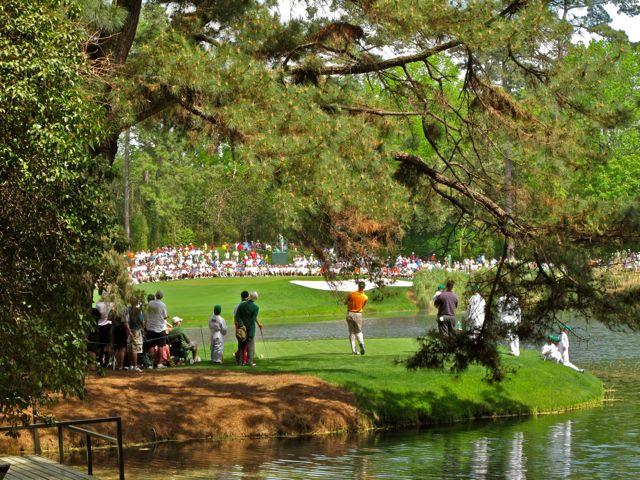
Augusta National's par-3 course, famous for its horticulture, may not be as bright this week. (John Garrity)

The meteorologist at our Kansas City headquarters, meanwhile, reports that spring is a month ahead of schedule. The dogwoods, redbuds and crabapples are already dropping their blossoms, and the Top 50 staff, in my absence, spend their afternoons sipping cabernets at sidewalk cafés on the Country Club Plaza. My imaginary friend Bert, who runs a snow-blower concession, says that sales are flat. “I’m a global-warming denier,” he says, iPhoning from the sixth hole of Donald Ross’s Heartland Club (No. 45). “But I don’t deny that the world is getting hotter.”

Bert is my imaginary friend, but I’m not afraid to tell him that he’s a dope. “The world IS getting hotter,” I tell him, “but you’re confusing weather with climate. The scientifically-measured increase in global surface temperature since 1980 was roughly a half-degree Fahrenheit, and if the most dire predictions of climatologists come true, it could rise another 4 to 10 degrees degrees by 2100. This abrupt warming could have a catastrophic impact on the planet, melting the polar ice cap, flooding highly-rated links courses and diverting the Gulf Stream, which would turn continental Europe into a year-round skating rink. But that’s CLIMATE. You’ll still have unseasonably cool summers and unseasonably warm winters. That’s WEATHER.”

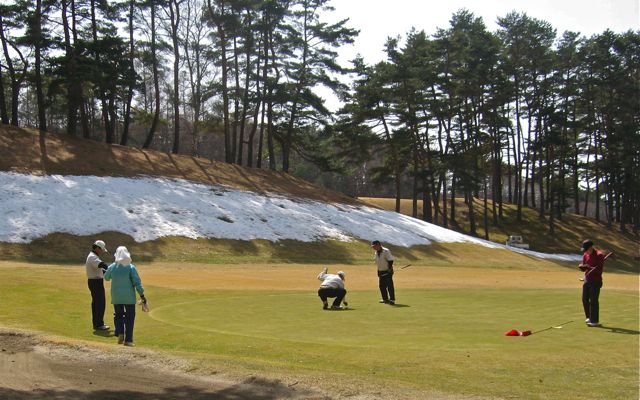
Snow on Japanese golf course

The cherry blossoms have yet to bloom on Japanese courses. (Courtesy of Duke Ishikawa)

As proof I sent Bert the latest dispatch from our chief Asian correspondent, Duke Ishikawa, who reports that Japan’s cherry-blossom season is on hold. “We really had a cold winter this year,” he begins.

Enclosed several pictures from Suwako CC in Nagano Prefecture. One thousand meters above sea level. Many courses still closed, but Suwako opened on April 1. In two weeks, they shoveled almost a foot of snow. These pictures are evidence of it. This is why our professional tour cannot start this season until after the Masters.

Suwako, Duke points out, is near the Karuizawa 72 course, site of the 2014 Eisenhower Trophy competition (barring the onset of an ice age).

This talk of azaleas and cherry blossoms is not peripheral to course ranking. Many of the Top 50 courses are currently swathed in spring colors, from the dogwoods of 42nd-ranked Hallbrook to the wildflowers of second-ranked Carne. Here’s Duke again on the Japanese golf landscape:

We have a gorgeous cherry-blossom season from the end of March to early April (normally). That’s in the Tokyo area. Our island is longer than 2,000 kilometers, so the cherry-blossom season moves from south (Okinawa) to North (Hokkaido) with a front line of rising temperatures. We call it sakura zensen. (Sakura is “cherry,” zensen means “front line.”) The cherry trees usually keep one week of bloom in each area, so it is a very short moment. We made it a symbol for the Samurai who had to commit hara-kiri suicide in front of his boss after making a mistake. (Please don’t laugh.)

Some of our golf courses have one thousand cherry trees. With more cherry trees in the hills around, it makes us all pink. I occasionally send pictures of this to my fairway ladies, Louise Solheim and Barbara, whose husband is Jack.

Again, it is a great time of year. Sincerely, Duke

New Richmond Golf Club

The New Richmond Golf Club rivals Augusta National for spring coloration. (John Garrity)

Several of the Top 50’s course raters are licensed botanists, so I had them compile a spring-colors Top 5 from the current ranking. Here it is:

1) New Richmond Golf Club, New Richmond, Wis. (132.6)

2) Augusta National Golf Club, Augusta, Ga. (128.8)

3) Augusta National Practice Range, Augusta, Ga. (127.1)

4) Askernish Old, South Uist Island, Scotland (124.0)

5) Mid Pines Resort and Golf Club, Southern Pines, N.C. (123.9)

Top 50 on TV: The Masters (CBS).

Leave a comment

Filed under golf

Troon North Benefits from Ying Correction

“Your Top 50 rating of Conestoga Golf Club at 8.09 is ludicrous,” writes Gary Van Sickle of Retrograde, Pa. “I’ve gone over the numbers repeatedly and never gotten more than an 8.05. This is a complete travesty — as opposed to a partial travesty, which no one likes.”

Conestoga Par 3

The par-3 fifth hole at Conestoga Golf Club: Too isolated? Or perfectly isolated? (John Garrity)

I usually dispose of crank e-mails by tapping the garbage-can icon, but something about this particular missive made me hesitate. Then it hit me: Van Sickle is our PGA Tour correspondent and executive director for course rating. So, with a heavy sigh, I re-read his rant and then forwarded it to Y. E. Ying, the Cal Sci “hotshot” who’s been crunching our numbers since Charlie Eppes ran off to Europe with what’s-her-name.

“Will check,” Ying texted me back. Two days later, he texted me again. “Van Sickle is correct. Conestoga GC of Mesquite, Nev., scores at 8.05 and should be ranked 55th. No. 50, at 8.09, is Pinnacle Course at Troon North Golf Club, Scottsdale, Az. Sorry. Please excuse error.”

Sorry? The Top 50 doesn’t publish apologies! The Top 50 publishes authoritative, 100% confirmed empirical data culled from the golf industry’s most comprehensive course-evaluation protocols. I’d have fired Ying on the spot if I didn’t have to run everything past a bankruptcy judge.

Another reader, who calls herself “Anon-a-mouse,” asks if I can tell the difference between closely-ranked courses like Conestoga and Troon North. My honest answer is no. I played Conestoga a few months ago and was blown away by its high-desert beauty. I played Troon North in February (as adjunct faculty at the Tour Tempo VIP School) and was similarly blown away by its high-desert beauty. Conestoga is more rugged and natural, with canyon holes that leave you feeling completely cut off from civilization. Troon’s Pinnacle course is the more difficult to play, with cactus patches that practically gobble up the wandering drive.

Ask me which is better, and I can only shrug. That’s why I employ only scientific criteria to rank the world’s courses from top (Askernish Old) to bottom (Ft. Meade City Mobile Home Park Golf Course). That’s why we confidently claim to be “99.9% accurate.” And that’s why we promptly correct the rare error made by a pocket-protector know-it-all who never returns our calls.

Top 50 on TV: Nothing this week, but congratulations to Top 50 favorite Gil Hanse and LPGA Hall of Famer Amy Alcott for bagging the Brazil Olympics course-design contract. Coincidentally, Hanse’s acclaimed Castle Stuart Golf Links jumps two spots to No. 5. Way to go, Gil!

Leave a comment

Filed under golf