Category Archives: golf

Summer’s Best Hole Used to be a Dud

“What’s your favorite golf hole?” asks a reader from my immediate neighborhood. A child, actually. My grandson, if you’re going to get all fact-checky on me.

Well, Jack, I have many favorites. Readers of my golf memoir, Ancestral Links, know about my obsession with the par-4 seventeenth at second-ranked Carne. But they may not know that my favorite hole at Carne is either the par-4 third, with its rumpled fairway and two-tiered green, or the par-4 ninth, where you drive into a box canyon before playing blind up to a pinnacle green. Wait no, my favorite is probably the quirky twelfth, which requires an approach shot from a switchback fairway to a dunetop green best reached with ropes and crampons. Or if not the twelfth, how about the imposing fifteenth, a par-4 so rugged and natural that I tend to credit meteor impacts, and not Eddie Hackett, for its strong features.

Get my drift? It’s hard to pick my favorite hole on any one course, never mind the thousands of courses that we visit every year to compile the Top 50 ranking. Like most sentient golfers, I love the Road Hole at the Old Course, the lighthouse hole at Turnberry, the eighth and eighteenth holes at Pebble Beach, the par-3 sixteenth at Cypress Point, the majestic tenth at Augusta National, the drive-over-the-beach first at Machrihanish, and the baffling ninth at Ft. Meade’s City Mobile Home Park Golf Course. I’ve currently got a crush on the closing hole at 51st-ranked Caledonia Golf and Fish Club, which calls for two precise shots over scenic marshland to the accompaniment of turtles splashing in an adjoining canal.

Hillcrest No. 5

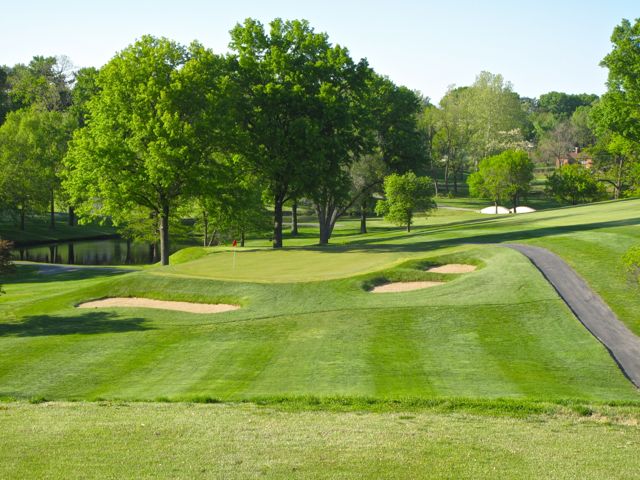
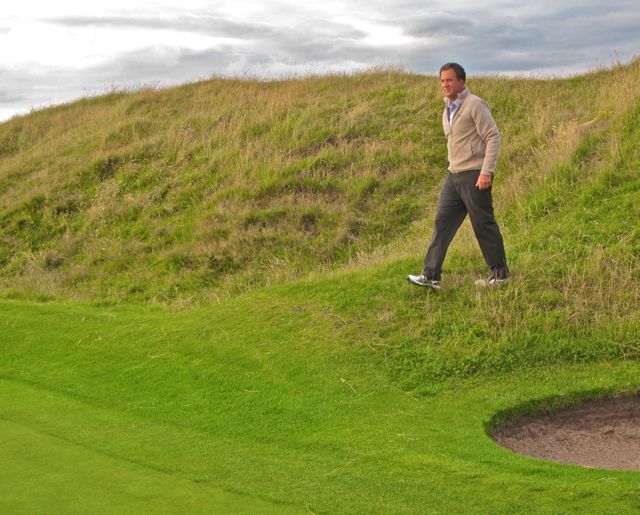
Hillcrest’s fifth hole, like good chili, has improved with age. (John Garrity)

That said, my favorite hole of the Summer of ’12 is the par-4 fifth at 45th-ranked Hillcrest in Kansas City, Mo. It’s a surprising favorite, because the No. 5 was maybe my least favorite hole when I caddied and played at Hillcrest as a boy in the late fifties.    Tree-lined and level from tee to green, it rides a ridge that drops off on either side, most sharply on the left, with the slope starting in the center of the fairway.

This was a serious defect, a half century ago, because Hillcrest had not yet installed fairway sprinklers. The summer fairways were bone-hard and brown. That made the tee shot on No. 5 impossibly difficult. Drives hit straight down the middle kicked left off the ridge and bounded through the trees and down the hill toward the tenth green, forcing a blind recovery shot from a steep lie. A slicing drive, on the other hand, would either wind up in the tree line or fly over the trees into the sixth fairway.

Hillcrest’s fifth hole was so bad, in fact, that I remember members cursing the nincompoop who had designed it: a Carolina pasture-plower by the name of Donald Ross.

Well, that was then. Hillcrest has been irrigated for decades now, and the fairways no longer bake in the summer sun. The fifth hole is now what Ross hoped it would be — a challenging par 4 of classic simplicity. The drive still causes your heart to flutter, but the fairway is much more receptive. If you miss left, bluegrass rough keeps most balls from plunging down the hill. “Tough, but fair” is the consensus of local golfers. That and, “Maybe that Ross guy wasn’t such a slug, after all.”

Having played Hillcrest often this summer, I’ve come to love the fifth. There’s nothing fancy about the hole — no gaudy bunker complexes or faux mounding — but the view from the tee (or from the green back to the tee) is classic. It’s an archetypal hole, a Ross variation that echoes holes from Pine Needles (T51), Mid-Pines (T51), Oak Hill (T51) and Aronimink (T51).

So yeah, Jack, I’d say my current favorite is the fifth at Hillcrest. Now if you limit it to the approach shot, I’d maybe choose the eighth hole at Askernish or the par-5 seventeenth at Royal Birkdale, where Paddy Harrington made his eagle ….

But that’s enough for now. Thanks for asking. And yes, we can play catch after dinner.

Top 50 on TV: Nothing this week, but the pros have taken their season-ending cash grab to 145th-ranked Crooked Stick Golf Club in Carmel, Ind., site of the BMW Championship. That brings back memories of John Daly at the 1991 PGA Championship, which I covered for Sports Illustrated. I recommend Cameron Morfit’s oral history here on Golf.com, or you can check out my contemporaneous coverage from the SI Vault. Either way, you can ignore Henry Ford’s dictum that “history is bunk.”
1 Comment

Filed under golf

Maldives Floats Course Proposal (and Course)

Good news, Aquaman! The Daily Mail reports that a doomed island chain is spending roughly half a billion dollars on a floating golf course.

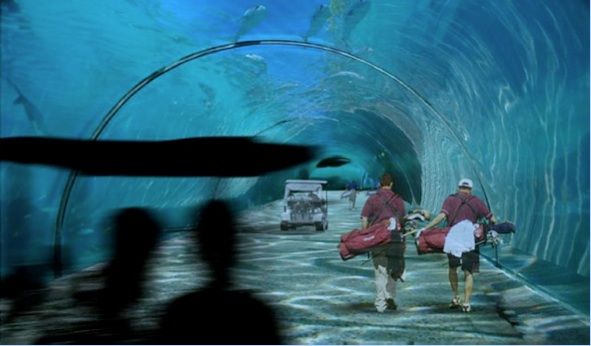
The Maldives has revealed plans for a radical £320 floating course, which players access by an undersea tunnel. The course is part of a massive plan to replace the sinking islands with a network of man made floating islands. With an average elevation of just five feet above sea level, the Maldives, with its 1,192 islands in the Indian Ocean, is the lowest country in the world.

Being five feet above sea level is a fine thing, particularly if you’re asked to carry a bucket of ice and fresh fish into town. On the other hand, if the sea rises a few feet — well, you do the math. The Maldivian government addressed the Atlantis scenario by hiring a Dutch company to build a series of floating islands onto which the populace can step as their homes disappear under the waves.

The islands will also be designed for swimmers, divers and even private submarines to enter them from below, and the Dutch firm designing the scheme has said visitors will be able to rent private submarines that can surface right in the middle of their living rooms.

Image

The new Maldives course promises ocean views from under every hole.

The golf course, very sensibly, will be the first phase of the project. The islands will be constructed off-site and then floated into position, with grass and landscaping to follow. The underwater tunnels will be wide enough to accommodate beverage carts and long enough, one hopes, to reach another island.

According to the developers, the floating course “should be ready for play by the end of 2013 ahead of the full launch in 2015.”

Did they really say “launch”?”

Anyway, keep your eyes on our sidebar list of top Aqua-ranges. Dolce Chantilly’s long reign as No. 1 may soon be over.

Top 50 on TV: Nothing this week, but sixth-ranked Augusta National announced that a prominent business executive and a former U.S. secretary of state will become members this fall. (Same old, same old.) Meanwhile, the FedEx Cup playoffs get under way with The Barclays at 51st-ranked Bethpage Black, a terrestrial course.

2 Comments

Filed under golf

Top 50 Transparency Praised by Founder

A reader from Stone Harbor, N.J., asks if we conduct our course ratings in secrecy. “Do you travel under aliases? Do you inform a course’s staff that you are evaluating their facility and plan to publish an assessment that could be damaging to their reputations and bottom line? Do you go about your business whistling with a smile* while actually twisting your knife in the backs of honest businessmen who are merely trying to provide fun and recreation?”

* This is anatomically impossible, unless you whistle through your teeth; but we do try to project a certain cheeriness.

The e-mail is signed “Diogenes,” so I assume the writer is Greek. And before I address the substance of his letter, I’d just like to say how sorry I am about his country’s sovereign debt crisis and for the shocking deterioration of the 7th-ranked Parthenon and other public buildings. Things look bleak, I know, but a century or so of austerity should square the Greeks’ accounts and get them back out on the golf course.

Anyway, Di asked about “secrecy.” My answer is a flat “No.” We don’t sneak onto golf courses in Zorro masks and capes, and we don’t hide our clipboards and cameras in gym bags. To the contrary, the arrival of a Top 50 rater tends to be a civic happening replete with bunting, ceremony and intemperate drinking. It’s the democratic nature of the Top 50, in fact, that makes it so much fun. What other course-rating system has gallery members draw lots for a chance to evaluate the par-3s? Who but the Top 50 would let the head pro appeal for a better score in return for logoed caps and golf balls?

Besides, if we snuck in and out of venues, would we get so much publicity? Not to be immodest, but my recent rating trip to England got almost as much media attention as the Open Championship at 186th-ranked Royal Lytham & St. Annes. First it was Sports Illustrated’s Alan Shipnuck, who took participatory journalism to a new level by following me around 17th-ranked Royal Birkdale dressed in my clothes. (“If you can learn about someone by walking in their shoes,” he said afterwards, “it has to be even better to walk around in their baggy polo shirts and Dockers.”) Shipnuck’s reverential report can be seen here.

Michael Bamberger

SI’s Michael Bamberger followed our Top 50 rater at St. Annes Old Links. (John Garrity)

Also following me at Birkdale was Michael Bamberger, author of To the Linksland and inventor of the E-Club. In appreciation, I let him rate the 200-yard fourth hole, where each of us missed an ace by a matter of inches. (“Challenging to the extreme,” he concluded, “but brilliant!”) Bamberger then popped up a couple of evenings later as I rated St. Annes Old Links (49). He wrote about it for Golf.com, as did Golf Digest’s Cameron Morfit, whose astute critique of St. Annes can be read here.

To sum up, the Top 50 — far from being secretive — is the most transparent of all the leading course-rating systems. Diogenes may not accept that, but I infer that he’s bitter about some perceived slight or life-destroying tort that he associates with golf course critics. That’s unfortunate, but it has nothing to do with us.

Unless, that is, he is referring to our sister company, America’s Worst Golf Courses (LLC).  Our AWGC raters do conceal their identities, and they usually prevaricate when asked why they are dipping test strips into the ball washers or taking core samples from the greens. “When things get hairy,” I tell them, “it’s best to lie.”

Different company, of course.

Glen Echo's 14th hole

Would Glen Echo’s “Dewdrop” par 3 present a challenge to modern Olympians? (John Garrity)

Top 50 on TV: Nothing this week, but the London Olympics reminds us that golf returns to the Games in Rio de Janeiro, Brazil, in the summer of 2016. That should focus attention on 51st-ranked Glen Echo Country Club of St. Louis, Mo., which was an Olympic venue in conjunction with the 1904 St. Louis World’s Fair. I played Glen Echo some weeks ago and found it to be in tip-top shape and fully capable of hosting the Olympics again, should the Gil Hanse-designed Rio course be thwarted by local politicians. (Glen Echo still has a commuter line running alongside its first hole, so transportation will be a snap.)

2 Comments

Filed under golf

A Open Letter to Trump (from Duke)

“John,” writes our chief Asian correspondent, Duke Ishikawa, “could you give this note to Donald if you have any chance to reach him, please?”

I don’t expect to see “Donald” in the next couple of weeks, so I decided to post Duke’s letter here on the theory that Donald is following the site closely to see if his 51st-ranked Trump International Golf Links can break into the Top 50.

Mr.Donald Trump

Chairman, Trump International

From Duke Ishikawa (Tokyo International News)

Sir, I have two things to explain to you, please?

1. It will be a year and half, this coming September, since the March 11 disaster in Northern Japan. More than two hundred orphans were born from the earthquake and tsunami. They are still having a tough time. So we plan to have a charity skins game with Jumbo Ozaki, Isao Aoki and Tommy Nakajima. They are considered The Big 3 in Japan with more than 200 combined wins. They’ll play at the end of summer because kids’ school starts on Sept. 1

The first 16 holes will be for $500 or $1,000 each, then double for the last two holes. The three pros will donate 30% to 50% of their skins to the orphans for their schooling. We’ll be talking to leading TV stations to dover it, and I’m sure the AP, Reuters, Bloomberg, the New York Times and many U.S. media will cover it to. So my question is, is there a possibility of your sponsorship, please?

2. Tokyo is a candidate for the 2020 Summer Games, and surely golf will be continued as an Olympic event. But we don’t have good-enough courses in the Tokyo area. There are about 2,400 courses in Japan, but more than 90% of them are in mountain areas.That means far from where people live. Gas is a few times higher than US. We then have to pay more yen to the toll road. One bad example is the DIamond Cup, the men’s tournament held in June. They only  had 6,839 admission for all four days. Because the course was too far. No business at all.

So we need a new golf course near Tokyo. But it must be Japan’s first Stadium-Type Course. The new course should be near Tokyo Disneyland, which is not far from Narita Airport. The name should be California Golf Park (CGP).We pick up all eighteen holes from famous ones in California. They should be the 16th of Cypress Point, the 18th and 8th from Pebble Beach. The tenth of Riviera CC. (I took this idea from the Bear’s Best in Las Vegas.) The main entrance should be named Goldrush Road instead of Magnolia Lane. The clubhouse will look like the capitol building in Sacramento, and one of our honorable members will be the former CA governor, Arnold Schwarzenegger.

I’d like the architect to be one from Crenshaw-Coore, Nicklaus himself (not with his sons), Nick Faldo and Jumbo Ozaki.

The first stadium-type course in Japan has a good future of business. We have more than thirty-million populations in the Tokyo metropolitan area, so it should be quite easy to collect 100,000 spectators for a tournament if we can provide enough facility. (The biggest number for a US Open gallery was 387,045 in 2005 at Pinhurst CC. )There are about fifty professional golf tournaments, both men and women, in Japan. Two or three of them could be held at the California Golf Park. Each one would collect more than one hundred thousand people. I would expect quite similar results as the Wentworth Club in London.

The Eisenhower Trophy will be in Japan in 2014. Then, possibly, the 2020 Olympic Game. The Presidents Cup in 2015 will be in Korea, but we have another chance to invite it to Japan, because it is a home and away game.Then not only Japan but also Mr. Finchem will be pleased to see his Presidents Cup return to Asia. That will provide big opportunities for the golf business in Japan and also the CGP itself.

We used spent more than $200 million to $250 million to build one course in Japan. But the costs now are much less. Japan is no longer Number One in costs. So if you build Japan’s first stadium-type course, you will be able to make a giant step for your real estate business in a new territory.

Respectfully, Duke Ishikawa

On second thought, I’m going to try to get Duke’s letter to The Donald. The first part, anyway; the part soliciting a donation for the Japanese orphans. The Tokyo stadium-course proposal I may hold back to show to my accountants at Catch Basin. It would be great to have a Top 50 course that was actually owned by the Top 50.

Morfit and Bamberger

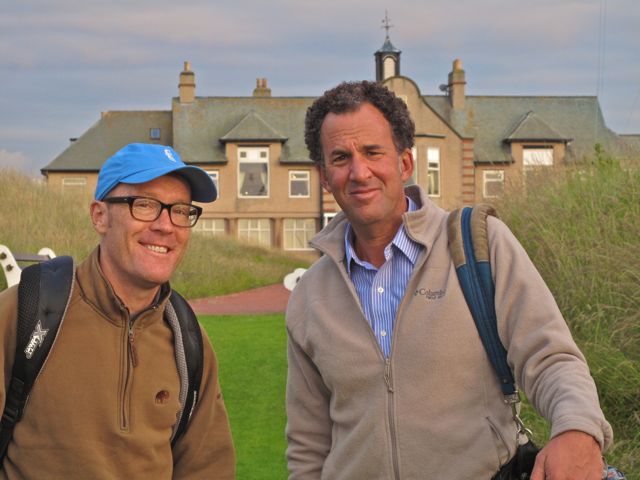
Cameron Morfit (left) and Michael Bamberger were among the notables playing St. Annes Old Links on Friday evening. (John Garrity)

Top 50 on TV: Still nothing this week, but Friday evening I slipped away from the Open Championship at Royal Lytham & St. Annes to inspect the St. Annes Old Links of Lancashire, England. (Joining me were Sports Illustrated senior writer Michael Bamberger and GOLF Magazine senior writer Cameron Morfit.) Situated between the Pleasure Beach roller coaster and the more dignified neighborhoods of St. Annes, the Old Links is a modestly-duned and immaculately-maintained layout. There are bands of deep rough, but the playing corridors are wide enough to minimize ball searching and tame enough to encourage recovery shots. “These conditions are the sine qua non of links golf,” said Bamberger, who is wont to speak Latin or Greek when he’s on his game. “The English probably think of it as a working-man’s links, but if it were in America I’d rate St. Annes in the top one or two hundred.” I’d go even farther. I’d rate it No. 50 in the world.

Leave a comment

Filed under golf

Clearing Up ‘Dwarf Course’ Comment

A reader from Daytona Beach, Fla., gets right to the point: “You don’t know what a ‘dwarf course’ is? What a fool some folks are!”

The reader refers to golf architect Bill Amick’s remark, in my last post, that he was off to West Africa to build a dwarf course at an eco lodge. Or maybe it was an eco course at a dwarf lodge. But the reader, now that I look more closely, is Bill Amick. So I’ll let him explain the term.

I coined that label, dwarf course, because of my mother. She was a wonderful woman and I loved her very much, but she was short. For some reason, she was never fond of me calling her a dwarf. Hey, she should have known that life, like golf, is not always fair. For instance, she could not have become a member of the Augusta National Golf Club. Though that was not because of her limited vertical stature.

Having cleared that up, Bill comments on the rankings:

I was extremely pleased that Ridgewood Golf Club [formerly Chestuee Golf & Country Club] made it into your latest top 20. And I’m proud that, after looking it up, I know it by its current name. It has always been a rule of mine that a golf course architect should at least know the names of the courses he or she has designed. Not knowing would be almost as bad as the over-the-hill touring pro who, having put his signature on a course, had to be pointed in the direction of the first tee for the ceremonial opening round.

And I find Grand Reserve a welcome addition to your aqua-range list. I can’t think of a better use for treated sewer water.

Turning to the new, Bill drops a tidbit or two about his detour through Scotland:

As you know, I made it up to The Trump in Aberdeen [No. 51] to share the ceremonies with my friend Martin Hawtree. And here’s what really burned me. As my taxi was delivering me down the entrance road, The Donald was leaving in his long black limo. He did not wait for me at the clubhouse nor even wave as we passed on the road. I guess some Americans are just rude.

I did get a tour of His course by the Hawtree team, so my visit was not a complete bummer. I was impressed by it all, and in a later message I’ll attach what I write for ByDesign with my impressions of the course.

When I got to Ghana, I’m happy to say, there was no rude American passing me in his long black limo as I entered the property. But I did think of my dear, late mother. Have I ever mentioned that she was not a particularly tall person?

Shipnuck and Bamberger Putting

Shipnuck putts and Bamberger tends the flag on a course not unlike Royal Birkdale. (John Garrity)

Top 50 on TV: Nothing this week, but on Wednesday afternoon I joined my Sports Illustrated colleagues, Alan Shipnuck and Michael Bamberger, for a lovely round at 17th-ranked Royal Birkdale Golf Club. We were playing hooky from our British Open assignments, but Alan made it kosher by writing a broadly-comical yet deeply-moving GOLF.com column about our round. (Deeply moving when he describes me as a “premier ball striker”; broadly comical when he pegs Michael as a “crafty” links player.)

About which Amick, in a follow-up e-mail, complained, “All you golf writers ever seem to do is play great courses. And now we have to read about it?”

No, but I’m sure Bill will want to read this legend that was on the wall of the first Royal Birkdale clubhouse:

“As the earth is not meant to be carted away The divots you cut in the course of your play Should be neatly replaced by your caddie or you, With their roots to the earth and their blades to the blue”

Leave a comment

Filed under golf

‘World’s Best Course’: Where Does It Rank?

“Save five or more spots on your next list for the new ‘Best Course in the World,’” writes golf architect Bill Amick, a Top 50 fixture. “That’s according to it’s developer, one of the world’s most humble persons.”

Filtering out the sarcasm, I infer that Amick wants us to take a look at the Trump International Golf Links of Aberdeen, Scotland, Donald Trump’s latest and most-ambitious golf project. But unbenownst to Amick, Trump-Aberdeen debuted last month at No. 51 on the strength of Travelin’ Joe Passov’s GOLF Magazine review, which was grudgingly favorable. “For all the hyperbole,” Joe wrote with gritted teeth, “Trump Scotland might turn out to be as good as advertised.”

No course cracks the Top 50 until it’s been rated by myself or by our ratings director, Gary Van Sickle. Neither of us, sad to say, has been able to get up to Aberdeen for a walkaround. In the meantime, we’re waiting to hear from Amick, who was invited to the grand opening by Trump Scotland’s designer, Martin Hawtree, who was celebrating the 100th anniversary of his firm.*

* Hawtree, known for his renovation of Royal Birkdale Golf Club and other Open Championship venues, has not been around that long. The firm, which describes itself as “The World’s Longest Continuous Golf Architectural Practice,” was founded in 1912 by Martin’s grandfather, Frederic George Hawtree, and carried on by his father, Frederic William Hawtree.

Judging solely from photographs, I’m inclined to put TIGL in the upper echelon of modern links courses, close behind sixth-ranked Castle Stuart, the eighth-ranked European Club, and 40th-ranked Kingsbarns. Had Trump not spent $155 million on it, I might even compare his Aberdeen track to the incomparable Askernish and Carne links, currently rated one-two. (Old Tom Morris designed the former for ten shillings per hole, while the great Eddie Hackett gave Carne seven years of his attention in return for a few expense checks, which he was loath to cash.)

“After Aberdeen I go to Ghana,” Amick concludes, “where I’m designing a dwarf course at a new eco lodge.”

Unsure of what constitutes a dwarf course, I Googled the term and found a YouTube video called “Dwarf Course 1,” which shows British teenagers running a playground obstacle course. “Eco Lodge,” meanwhile, linked me to a number of “green hotels,” including a treehouse lodge in the Australian rain forest. I could speculate on what Amick has in mind for West Africa, but I think I’ll just wait for his next e-mail.

Castle Stuart

Castle Stuart was built for windy conditions. Note the whitecaps on the Moray Firth. (John Garrity)

Top 50 on TV: Nothing this week, but Castle Stuart just concluded its second hosting of the Scottish Open with Jeev Milkha Singh claiming the trophy. “After three opening rounds of very low scoring, Castle Stuart finally bared its teeth,” reports the Associated Press. “A fierce westerly wind and heavy rain at times proved too much for top-ranked Luke Donald (73) and Phil Mickelson (74), who both finished tied for 16th at 12-under.” The AP doesn’t quantify how “fierce” the wind was, but I’ve played Castle Stuart in gusts of up to 65 mph, which blew my bag over, shattered my umbrella, and caused my ball to roll of its own accord on the back of the 12th green. That aside, the course was both playable and enjoyable. Castle Stuart deserves its sixth ranking.

It’s on to Royal Lytham & St. Annes (No. 132) for the Open Championship. Wet and windy weather is forecast.

2 Comments

Filed under golf

Florida Aqua-range Plunks in Top Five

E-mails that open with “I was extremely pleased to learn” are always welcome here at Catch Basin. So is correspondence from any of our Top 50 course designers, living or dead.* Both attributes attach to this nice note from Bill Amick, designer of 20th-ranked Ridgewood Golf Club and renovator of Donald Ross’s 45th-ranked Hillcrest Course at Kansas City’s Heartland Golf Club.

*Before you submit an error alert, please revisit my “Golf Ghost” series of interviews in SI Golf+, which included lively chats with Donald Ross and Alister MacKenzie

Hillcrest CC No. 5

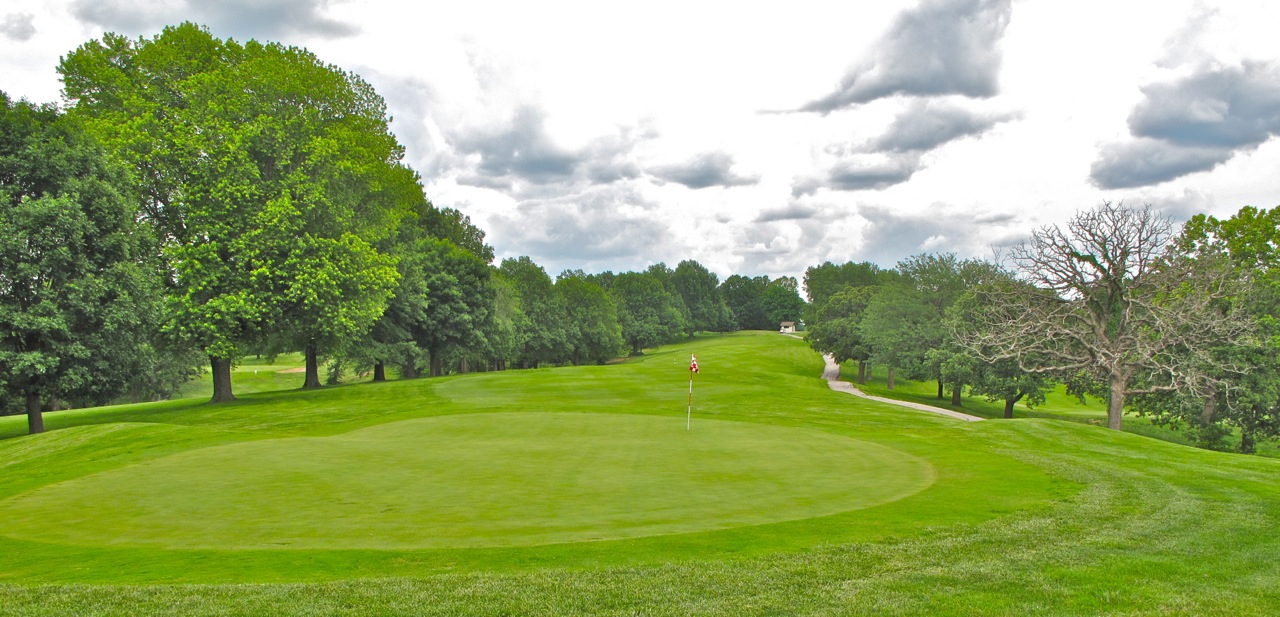
The fifth at Heartland reflects the collaborative efforts of Donald Ross and Bill Amick.

Amick begins, “I was extremely pleased to learn that Casserly Par 3 Golf Course has finally broken into your Top 50. It has been neglected far too long in this regard.”

But I’m still disappointed to see that two highly-regarded aqua-ranges — the one at the Mike Beebe-designed Grand Reserve Golf Club in Bunnell, Fla., and mine at Meadow Oaks Golf and Country Club in Hudson, Fla. — are not on your Best Aqua-ranges list. [See right sidebar] The Grand’s range is filled with greywater, I think. (I can never remember if it’s greywater or graywater, although both seem to come out of a sewer pipe.) The Meadow’s is a plain old Florida sinkhole filled with stagnant water.

Treating Amick’s concerns with the proper sense of urgency, I immediately called Gary Van Sickle, our aqua-range ratings manager. Van Sickle listened to the Florida-based architect’s critique before issuing a decisive “Whatever.” So, as of this afternoon, Grand Reserve is No. 4 in the Aqua-range ranking, passing Imperial Lakewoods GC of Palmetto, Fla. Meanwhile, the aqua-range at Meadow Oaks remains unranked despite Amick’s puffing it up as “a plain old Florida sinkhole filled with stagnant water.” That’s because I never allow friendship, reputation or inadequate monetary considerations to influence our rankings.

Amick had more to say in his e-mail, including his role in celebrating the upcoming opening of the so-called “Best Course in the World” in Scotland. I’ll address that, as well as Amick’s plans for a “dwarf course” in Ghana, in my next post.

Royal Portrush Golf Club

Tenth-ranked Royal Portrush is a gold-medal track. (John Garrity)

Top 50 on TV: The Irish are holding their Irish Open on one of my personal favorites, the 10th-ranked Dunluce Course at Royal Portrush Golf Club. I played there last July on the finest afternoon County Antrim has ever seen, so my perceptions may be rose-colored. But I think not. While there, I got to see Darren Clarke’s Open Championship medal in a clubhouse display case previously devoted to 1947 Open champion Fred Daly. “For me this is the best golf course in the world,” Clarke had said earlier in the week. “I am very privileged to give Royal Portrush the gold medal.”

Others must rate Royal Portrush almost as highly. With roughly 27,000 spectators per day, Clarke’s home course is the first European Tour venue to completely sell out for every round.


Leave a comment

Filed under golf

Coastal Par-3 Breaks Into Top 50

Pebble Beach is so over-rated,” grouses a reader from Ft. Meade, Fla., dissing our ninth-ranked course. Another reader insists that sixth-ranked Augusta National is “a lot of fancy grass and prom corsages masquerading as a golf course.”

It would be easy to dismiss these comments as the ravings of unschooled dolts, but the Top 50 doesn’t operate that way. We investigate such claims. We put all our resources to the task. We even make calls.

Gary Van Sickle

Van Sickle ponders Pebble’s ranking while covering the U.S. Open at Olympic. (John Garrity)

To placate the Ft. Meade correspondent, we sent chief course rater Gary Van Sickle to Monterey to see if the iconic California layout had deteriorated since we last played it. Gary immediately wired back that it had not. “PEBBLE BEACH REMAINS THE GREATEST GOLFING EXPERIENCE IN THE WORLD STOP SEND EXPENSE MONEY STOP.”

He filed the rest of his report in the form of a GOLF.com article from which we quote to the full extent of the fair-use provisions of the Copyright Act:

Purists like to rate golf courses based on absolutes like shot values, relation to par and other inside-golf things. I’ve read those who say Pebble has 10 great holes and eight mediocre ones, and that it’s grossly overrated. I wish one of those critics could have been out on the peninsula with my group Sunday afternoon, basking in the early-evening golden light with postcard views in every direction, hearing the crashing of the waves, the squawk of the gulls and smelling the scent of the sea. Race the sun to the finish, like we did (although it was a very slowwww race), and try to play the 18th hole in the dark when you could no longer see the ball at your feet, and tell me Pebble Beach is overrated.

It isn’t. It’s an experience you can’t put a price on. You would pay just to walk this hallowed green and savor the dramatic meeting between land and sea. It’s special.

After playing Pebble, Gary visited the previously unranked Casserly Par-3 Golf Course in Watsonville, just up the coast. Finding it to be “better than a pleasant surprise” at $9 per round, he called our attention to Casserly’s signature hole, the 112-yard seventh, which calls for a carry over a ravine and a 60-foot pine that blocks the green. “I COULDN’T SEE THE PIN BEHIND THE PINE STOP VERY COOL STOP”

Gary’s enthusiasm for Casserly was almost as great as his enthusiasm for Pebble, so we have tentatively installed the Par-3 at No. 49, displacing Robert Trent Jones Jr.’s CordeValle Resort course, site of the PGA Tour’s Frys.com Open.

Practice round at Olympic

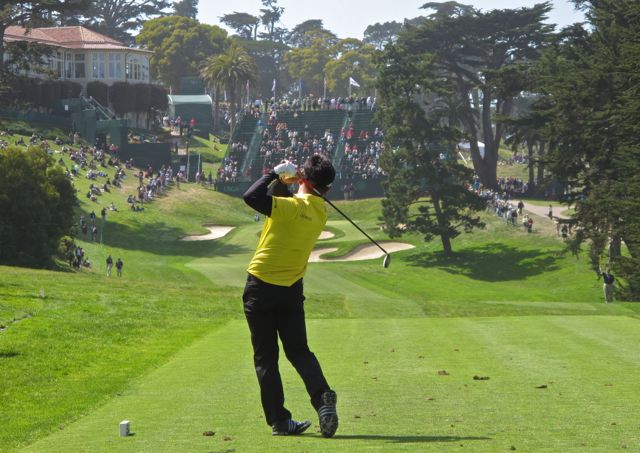
51st-ranked Olympic Club is tough from the back tees. (John Garrity)

Top 50 on TV: Nothing this week, but the U.S. Open is being played on the famous Lake Course at San Francisco’s Olympic Club, currently ranked No. 51. Further west, in Japan, they’re still agonizing over the abysmal attendance, in late May, at the Diamond Cup at the Country Club of Japan in the Tokyo suburbs. “Miserable results,” writes Duke Ishikawa, our chief Asian correspondent. “The four-day total was 6,839. Same week as Colonial. Thursday was only a thousand.”

There are several reasons for Japan’s attendance slump, but Duke says it’s mostly the fans’ infatuation with young Ryo Ishikawa (no relation), who is playing more American events. “I have suggested in my articles that Ryo play more in the U.S. because it’s the world’s strongest tour,” he writes, “and especially the Memorial, because that’s Jack’s tournament. But Katsuji Ebisawa, our tour’s new chairman, sent an official letter to Ryo entreating ‘please don’t forget the Japanese Tour.’

Duke continues: “The New York Times said ‘One Star Between Two Tours,’ but I don’t think Ryo is a star. He is just an idol, a gallery’s pet. Or a pin-up boy. But he still influences the sports show in Japan. To stay on the U.S. Tour or not, that is Ryo’s question.”

Pressed for another reason why fans might shun the Japanese tournaments, Duke mentions the high prices at concession stands. “At Japan Open my friends paid US $11 for a piece of sausage and a coke.”

1 Comment

Filed under golf

Heartland and Harding Making Moves

A reader from Muskegon, Mich., asks if we change a course’s ranking based upon minor alterations to the design. “Like, say, if they were to chop down the Eisenhower Tree at Augusta National, would that give them a higher or a lower score? Or what if at a certain course in Grand Rapids they fixed a certain tee so that it didn’t point way right when you need to hit it left to stay out of the trees? Would that make a difference?”

Heartland Rebuilding Ross Green

Heartland GC, the only Donald Ross design in Missouri, is restoring the Ross green on its ninth hole. (John Garrity)

I see two points that need correcting in Muskie’s e-mail. The first is the perennial misunderstanding of “higher or lower score” as it pertains to the Top 50 rankings. The Cal Sci algorithm is concentrically weighted around “a perfect 10,” which means that high and low scores are to be avoided, not pursued. Put another way, if Smash star Katharine McPhee scores a 10 on the Carnegie Mellon Feminine Pulchritude Scale (FPS), she’s got no way to go but down. Or up. She can’t do better.

Secondly, it would make no difference if they re-oriented that tee so it pointed straight down the fairway. Muskie would still slice his drive into the trees.

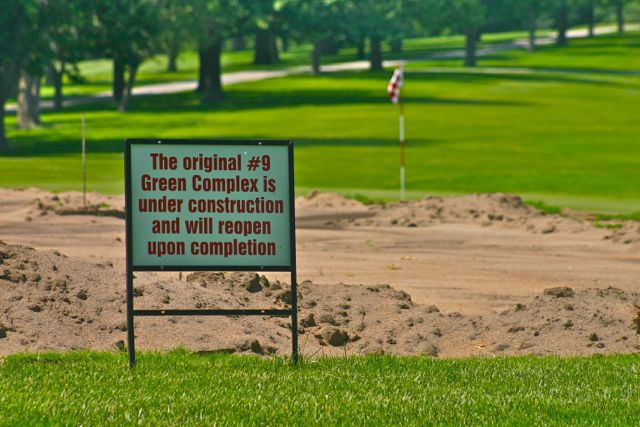
But to the larger point, yes, we take minor alterations of a design into account when we issue our adjusted ratings.* For instance, the 45th-ranked Heartland Golf Club of Kansas City, Mo. (aka Hillcrest Country Club) is restoring Donald Ross’s original ninth green, correcting a 21st-century design blunder. When the green is completed in the fall, Heartland could leap into the Top 40.

* A new Top 50 is posted daily at 2:15 a.m. CDT. We publish hard-copy Mandarin and Portuguese versions on a weekly basis, but only in Africa and the Middle East.

“That’s all well and good,” writes a junior golfer from Sun City, Ariz., “but you can’t possibly know what’s happening at courses around the world. I’ve heard that Pete Dye, just to name one architect, keeps ‘tweaking’ his designs ad infinitum, jumping on a sand pro at the drop of a hat. So your ratings must necessarily be flawed.”

Practice facility, Harding Park

TPC Harding Park’s new short-game practice area will be the perfect place to test the theories in Tour Tempo 2: The Short Game and Beyond. (John Garrity)

Wrong! The Top 50’s vast network of course raters keeps an eye on all the work being done at ranked courses. Last week, for example, workers in San Francisco applied the finishing touches to a new short-game practice area at TPC Harding Park, site of the 2009 Presidents Cup. Positioned between the parking lot and the practice range, the new practice area overlooks beautiful Lake Merced. But it wasn’t overlooked by us! Harding Park jumps three positions to No. 78.*

* If the new grass survives the typically-brutal San Francisco summer, HP will climb even higher.

As for Pete Dye and his constant course-doctoring, give us some credit. We shadow his every movement with unpaid interns.

Top 50 on TV: Nothing this week, but The Memorial Tournament is being played on the immaculate fairways and greens of the 51st-ranked Muirfield Village Golf Club, designed by Jack Nicklaus and the late, great land-form artist, Desmond Muirhead. (Nicklaus is famous for winning 18 major championships. Muirhead is famous for designing golf holes in the shapes of states, stringed instruments and farm animals.)

1 Comment

Filed under golf

Final Shots in Fifth-Major Battle

Bowing to reader demands that Gary Van Sickle’s The Players: NOT the Fifth Major be given an extended run, we’ve held onto his third act until this afternoon. (Actually, Matt Kuchar’s second-round 68 at the HP Byron Nelson Championship reminded me that I had not posted the final installment, as promised. Fortunately, it was one of those “we” promises, not an “I” promise.) Kuchar, you’ll recall, won last week’s edition of THE PLAYERS. It was his fourth PGA Tour victory and his first “fifth major.”

Or not. Gary picks up the thread with some ruminations about another would-be biggie.

Now to the last real contender, the Memorial Tournament. Jack Nicklaus founded it in Dublin, Ohio, and he has said that no, he wasn’t trying to build a major championship. Come on, of course he was! Check out the current Nicklaus.com home page:  “The Memorial Tournament has grown into one of golf’s premier events, often called the fifth major.”

Actually, it isn’t. Maybe for 15 minutes about 30 years ago. The hometown Columbus Dispatch jumped on Jack’s bandwagon early. After Roger Maltbie beat Hale Irwin in an experimental three-hole playoff in the inaugural ’76 Memorial, and Nicklaus himself won the next year, Paul Hornung wrote in the Dispatch, “The first two tournaments have been more than memorable athletic events. In that short time, they have established the Memorial as a candidate for fifth major designation.”

The Memorial was Jack’s ode to Augusta National. Concession tents were dark green. Caddies wore white jump suits. The course was immaculately maintained, and say, that par-3 12th hole over water looks familiar. Tour players were gushing in their praise. From Bob Baptist in the Dispatch before the ’81 Memorial: “When he was asked, What do you think about the Memorial’s chances of one day being a major, Mark Hayes flatly predicted, ‘One day I think it will be bigger than Augusta.’”

That’s right. Bigger than Augusta.

In 1984, Baptist quoted former Memorial champ David Graham in the Dispatch: “Nicklaus is a legend who has surpassed Bobby Jones and probably everyone else. One of these years, he’s going to retire. The only place players and fans will be able to see Jack will be Muirfield Village during the Memorial. Shades of Augusta National. You think that won’t make the Memorial a major?”

Perhaps it might have if the Tournament Players Championship hadn’t barreled right over it. A new era began in 1982 when Jerry Pate won and inaugurated the terrifyingly difficult Stadium Course and its infamous island-green 17th hole. It had a surprise—if choreographed—ending on national television in which Pate pushed tour commissioner Deane Beman and course designer Pete Dye into the lake and dived in after them.

Just that quick, the Memorial fell to second place in the Fifth Major arms race. From Ian O’Connor’s 2008 book, Arnie & Jack: “In fact, the Memorial was battling the tour’s Player Championship at the TPC at Sawgrass for unofficial honors as the game’s fifth major.  ‘Deane came up with a great idea with the Players Championship… but you can’t buy a major championship and that was sort of the effort being made,’ Nicklaus said. ‘The Memorial was his only competition… but everything he could do to put one ahead of the other, he would do and that’s always stuck in my craw.’”

It’s not as if Nicklaus didn’t see it coming. He joked that he won the first TPC event in ’74 “just in case” it became a major later, but despite winning the tour’s new flagship event three times, Nicklaus never treated them as significant wins. For obvious reasons. Just ask Deane Beman, the happily retired PGA Tour commissioner who helped create The Players from scratch, as detailed in Adam Schupak’s tale of the tour’s dramatic rise, Golf’s Driving Force: “’Bobby Jones was Jack’s model,” Beman said. ‘His goal was to win more majors than Bobby Jones. When Jack decided to build his own facility and have his own tournament, that tournament would be to him what the Masters was to Bobby Jones. And of course, our tournament stood in his way.’”

While rain often poured on the Memorial and it’s late-May date, almost the only thing that poured on the Players and its new Stadium Course was more publicity. Dye’s design was controversial. “It was like playing Donkey Kong out there,” Tom Weiskopf said, likening it to a popular video game. There was Pate, his orange ball and menacing camera shots of a trolling alligator. There was even media hype. From Golf’s Driving Force: “Before the first putt has been stroked, the first hot dog sold or the first complaint made about the rough, it has been billed as golf’s Super Bowl,” wrote Golf Digest’s Dwayne Netland. “This is quite a burden for any unborn event, no matter how noble its blood, but if the grandiose plans materialize, the Tournament Players Championship may become the sport’s fifth major event.”

Greg Larson, the golf writer then for the Florida Times-Union in Jacksonville, raised the bar with his report from the 1985 PGA Championship: “Deane Beman was quoted in a New York Times story yesterday as calling for the TPC to be declared a fifth major. If the PGA, which begins today at Cherry Hills, is any measurement, Beman should be screaming for fourth place… After two days of walking around Cherry Hills… nothing jumps out and says, ‘Hey, this is different than the Memorial, the Crosby or the Bay Hill Classic.’”

So here we are three decades later, on the verge of a fifth major… or not.

If there is going to be a fifth major, Dan Jenkins said, it has to be The Players. Lawrence Donegan, the respected golf writer for Scotland’s The Guardian, has a different idea. “America doesn’t need any more majors,” he said, presenting a view widely shared in Europe. “It’s ludicrous that we have four majors and three of them are on one continent. Golf is becoming more global and if Asia is the new frontier, and it is, where better to have another major? The fifth major should be the Australian Open. It’s got the history, the tradition, the courses. But four’s a great number. So forget the PGA Championship—just plug in the Australian Open.”

Larson, who’s still going strong as a Jacksonville-area sports-talk radio personality since leaving his paper in ’89, thinks Pate put The Players on the short list of contenders but… “The tour was always blowing in people’s ears, ‘This is a major,’ and I think they pushed it too hard,” Larson said. “If they’d just left it alone, everybody would consider it a major by now.”

Beman is hopeful but said he never had any illusions that his tournament would get major status quickly. “The last element to become the fifth major, or to replace one of the others, is that the players need to fully understand how important it is to their enterprise and they have to fully embrace it,” he said. “The tour is reluctant to tell them that. Somebody else needs to.”

There is one other possibility, Beman believes, that might accelerate the coronation of The Players—Tiger regaining form and winning more Opens or Masters. “Then Jack may want this to become a major after all,” Beman said with a laugh. “Because he won it three times.”

If The Players is a major, the new score is: Jack 21, Tiger 15.

And Kooch 1. Thanks to Gary for his analysis.

Top 50 on TV:  Nothing this week, but Mike Van Sickle of Wexford, Pa., advanced to U.S. Open sectional qualifying after earning medalist honors with a 67 at Quicksilver Golf Club in Midway, Pa. Van Sickle, who starred at Marquette University, is a prominent blogger.

2 Comments

Filed under golf