Monthly Archives: May 2010

Spanish Layout Is for Real

“How do your course raters document their findings?” asks a reader from Lower Venice, Italy. “Is it merely checked boxes on pages? Do you obtain sworn affidavits? How do we know that your raters have even visited the courses on the list — or, more importantly, the courses not on your list?”

Good question, Vinny. I can answer it by reminding you that our course raters have photographed every hole on every golf course in the world, from top-ranked Askernish Old right down to our perennial bottom-ranked layout, the Ft. Meade City Mobile Home Park Golf Course of Ft. Meade, Fla. Furthermore, Top 50 raters are bonded and they have to produce a signed chit from the superintendent or head pro of each club before they can collect their honoraria.*

*We typically pay our raters in carnival script to minimize the possibility that they will be caught short by international currency devaluations.

By the way, the image bank at Catch Basin is not limited to golf course photos. We ask our globetrotting nitpickers to document every aspect of a facility, from the front gate to the darkest corner of the superintendent’s shed. Just this morning, for instance, we downloaded hundreds of photos from Real Sociedad Hipica Espanola Club de Campo in San Sebastian de los Reyes, Spain, site of this week’s Madrid Masters. The RSHECC has two championship golf courses with mountain views, a splendid ivy-covered clubhouse, a sprawling parking garage, and a terraced practice range that offers three levels of grass tees plus a mats-only range with both covered and rooftop tee lines.
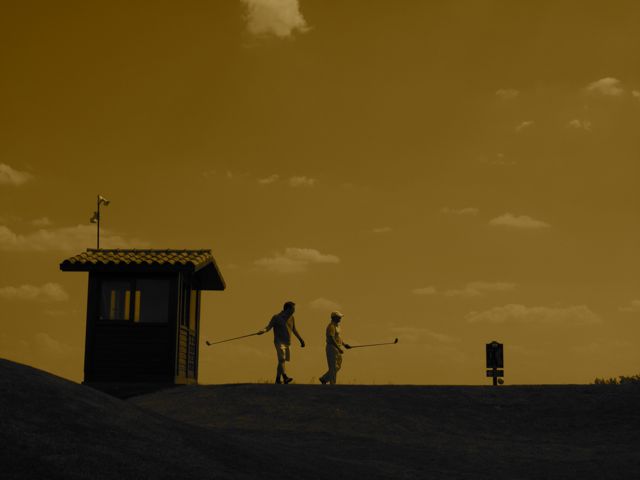
South Course Starter's Shed

Sketches of Spain: The starter's shed at RSHECC South. (John Garrity)

“I was particularly taken with the starter’s shed on the first tee of the South Course,” our rater told me by satellite phone. “It made me feel nostalgic in some hard-to-describe way, so I gave the facility a few hundred discretionary points.”

The beauty of the Cal Sci algorithm is that we can adjust for this bonehead’s misapplication of the ratings formula, leaving RSHECC with a more appropriate bonus of 25. We’ll post the club’s new ranking when we get fresh numbers back from Pasadena, probably on the Memorial Day weekend. (No, the Top 50 does not “holiday.” The full-capacity golf weekends are when we are needed most.)

By the way, Real Sociedad Hipica Espanola Club de Campo translates as “The Royal Spanish Horse Society Country Club.” I asked our rater to send me a hat, but he claimed their hats don’t make it through the embroidery process.

Top 50 on TV: The PGA Tour finishes off its Texas Swing at Colonial Country Club, No. 24. I planned to post a course photo, but I got distracted scrolling through our gallery of “Colonial C.C. Bark Beetles,” which takes up about 5 gigs of storage space. If you’re desperate to see what Colonial looks like these days, check back here later. Otherwise, you can tune in to the Nick Faldo Networks (Golf Channel and CBS), which will cover all four rounds of the $6.2 million Crowne Plaza Invitational at Colonial.
Leave a comment

Filed under golf

China’s Best: Lost in Translation?

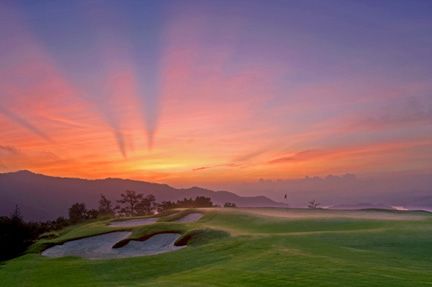
Sunset Photo, Mission Hills China

The 7th on the Sorenstam course, Mission Hills, China

“Here’s an idea for a new Top 50 list,” writes the 14-handicap owner of a restaurant on Spring Street in NYC. “You could rank the world’s Mission Hills courses. I mean, there must be a thousand of them.”

A thousand? Well, maybe — if you count “Mission Hills Labradoodles,” one of the Google options that popped up as I typed “Mission Hills” into the search box. (“We are a small breeder of Australian Labradoodles located in the heart of America,” reads their home page. “Our goal at Mission Hills Labradoodles is to raise top quality dogs that will be a joy and an asset to your home and family.”)

Add the word “golf” or “country club” and you narrow the search to a few dozen courses from Texas to Thailand. There is a Packard & Packard-designed Mission Hills C.C. in Northbrook, Ill. and an Al Watrous-designed Mission Hills G.C. in Plymouth, Mich. There is an admirable Mission Hills C.C. about a mile from the Top 50’s Kansas City headquarters. (Situated in the aptly named town of Fairway, Ks., this Mission Hills track was laid out by Tom Bendelow, the Johnny Appleseed of American golf. Bendelow is best remembered for Medinah Country Club No. 3, site of next year’s Ryder Cup.)

If we were to create a Mission Hills list — and all that’s holding us back is a lack of outside funding — the top spot would have to go to the one Mission Hills layout that is already in the Top 50. That would be Desmond Muirhead’s 44th-ranked Tournament Course at Mission Hills Country Club in Rancho Mirage, Calif., permanent site of the LPGA’s Kraft Nabisco Championship.

But given our correspondent’s Chinatown address, I’m guessing that she’s carrying water (or oolong tea) for the Mission Hills Golf Club of Shenzhen, China. A resort complex that is roughly the size of Delaware, China’s Mission Hills has the largest tennis center in Asia (51 courts and a 3,000-seat stadium court), several golf academies, four clubhouses, four spas, a convention center, a 5-star hotel, and no less than a dozen courses designed by the likes of Pete Dye, Jack Nicklaus, Greg Norman, Nick Faldo and Annika Sorenstam. Mission Hills is so big that it isn’t content hosting the Asian Amateur Championship and the occasional World Cup. It sponsors football matches between world-class teams such as FC Barcelona and, uh … opponents of FC Barcelona.

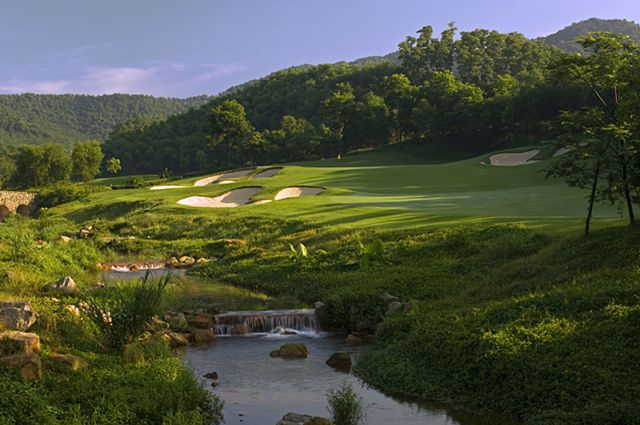
Photo of Olazabal course, Mission Hills China

The 3rd at the Olazabal Course, Mission Hills, China

The helmsman of this golfing supertanker is Tenniel Chu, executive director of Mission Hills Properties Holdings Ltd…, a really big outfit. “Golf is the fastest growing sport in China,” Mr. Chu told me at this year’s Masters, where I chatted up a number of international golf titans before playing second-ranked Augusta National Golf Club as a guest.* “By 2020,” Mr. Chu continued, “China will have the world’s largest population of golfers.”

*I am not a member of either club, although I would never rule out a future alliance.

It is not lost on me that China, with a population of roughly 1.3 billion souls, might have a golf course worthy of a Top 50 ranking. Unfortunately, our Chinese course-raters/calligraphers submit their reports in the 50-year-old simplified Chinese character system employing the common caoshu shorthand variants, while our Cal Tech analysts read only traditional Chinese characters, which use standardized forms dating to the Han dynasty. That has led to some anomalous results, including the counter-intuitive ranking of the aqua-range at the Chung Shan Hot Spring Resort at No. 64, ahead of the world-renowned Pine Valley Golf Club of southern New Jersey.

We’ve got our best minds working on this problem. In the meantime, we’re provisionally ranking the Mission Hills Shenzhen complex — all twelve courses, including the Zhang Lianwei-designed par-3 course — as No. 1 in China.

2 Comments

Filed under golf

New Richmond GC Moves Up List

It is a good nine months since Sports Illustrated senior writer Gary Van Sickle called Wisconsin’s New Richmond Golf Club “the Augusta National of small-town courses,” but praise for the Willie Kidd/Don Herfort design has not abated. The Minneapolis Star-Tribune hails New Richmond’s semi-private Old Course as “perhaps the greatest relatively unknown public course near the Twin Cities,” and Cowboytuff gives it a four-star rating on golflink.com. Now the Little Course that Could has put a move on Wisconsin’s other nationally-ranked track, the Straits Course at Whistling Straits, by moving up to No. 25 in the Top 50.

New Richmond Golf Club photo

"Springtime for Littler" -- the 1st tee at New Richmond GC (John Garrity)

Some will find the comparison to Augusta National Golf Club, No. 2, a stretch, but I have recently played both New Richmond and the National, and found each to be evocative of the other. Both, for instance, are famous for their plantings. Flowering trees frame their greensites, and each presents a variety of flora calculated to send the hearts of botanists racing. (“Driving down Magnolia Lane melts down your spikes,” Greg Norman once said. “You can’t tee off quickly enough.”) The two clubs also have three- or four-hole stretches known as “Amen Corner” — although New Richmond’s is pronounced AH-men by some of its members.

You get religion a little earlier in the round at the Wisconsin course. New Richmond’s most challenging stretch, holes 4 through 7, is anchored by the 406-yard, par-4 fifth hole. A classic floodplain hole — lined with pines and firs on the right and defined by the sinuous Willow River and a marsh on the left — the fifth calls for a thread-the-needle drive and an over-the-water mid-iron past a couple of top-heavy trees eager to lean in the way of perfectly hit approaches. Van Sickle, when asked to compare New Richmond’s signature hole to the lakeside par-4 16th at nearby Hazeltine National Golf Club, said, “I suppose you could compare them….” — and Johnny Miller once called Hazeltine’s 16th “probably the hardest par 4 I ever played.”

I could go on listing the similarities between Augusta National and New Richmond, but I’d rather point out the most significant difference: Their pedigree. The Georgia course started out as a nursery and was nannied to greatness by the regal combination of Grand Slam champion Bobby Jones, legendary course designer Alister MacKenzie and imperious club chairman Clifford Roberts. New Richmond’s stunner had more modest beginnings in the Coolidge-era* as a 9-hole, laid-out-on-a-weekend, concrete-tees-and-sand-greens golf course. In fact, my father** used to call his home-town nine “the worst damn course in the whole state of Wisconsin.”

*Donald Reppe’s The New Richmond Golf Club: A History dates the club to 1924, based upon recorded deeds, diaries and the memories of old timers. Today’s club members, however, wear caps with “Founded 1923” printed on the side, and certain Web sites give 1922 as the inaugural year. (Warren G. Harding, 29th president of the United States, served from 1921 until his death from a heart attack on August 2, 1923.)

**John B. “Jack” Garrity, grew up in New Richmond, helped build the original sand-greens course, and was one of the club’s most avid members in the late twenties. His own monograph, “Remarks and Reminiscences on the Founding of the New Richmond Golf Club,” was excerpted in the Oct. 2007 issue of Travel + Leisure Golf.

Falling to No. 29 is the Pezula Golf Club of Knysna, South Africa.

Top 50 on TV: Nothing this week, but Hall of Fame golfer Annika Sorenstam has signed an agreement to design a championship course for the Olivion Golf Resort in Belek, Turkey. Olivion will be Sorenstam’s first course design project in Europe, her ninth worldwide, and the first to be named for “the powerful being” in a juvenile novel by a writer employing capital letters for his last name. (See “CLE, Troy.”)

Leave a comment

Filed under golf

Island Greens: Time to Drain the Moat?

The debate over island greens has raged for three decades. The argument started in 1982, when Alice Dye unveiled her bulkheads-in-the-swamp design for the par-3 17th at the Tournament Players Club of Sawgrass in Ponte Vedra, Fla. It grew in intensity when Alice’s husband Pete surrounded his own version of sod a l’leau with boulders at the PGA West Stadium Course in La Quinta, Calif. It reached a fever pitch when developer Duane Hagadone and architect Scott Miller planted the 14th green at Club Coeur d’Alene on a 7,500-ton barge and set it adrift on a glassy lake in Idaho.

But now that an oil slick the size of Donald Trump’s ego has hit the Louisiana shore, the debate should end. Island greens are a bad idea.

This will not be news to current or former PGA Tour players, who have suffered the most extreme humiliations trying to land their tee shots on the original island green at Sawgrass. “When I play that hole, I don’t know whether to genuflect or spit,” says Brandel Chamblee, analyzing this week’s Players Championship for the Golf Channel. Chamblee echoes the sentiments of 8-time major champion Tom Watson, who after his first exposure to the TPC of Sawgrass asked, “Is it against the rules to carry a bulldozer in your bag?”

Granted, island greens appeal to the eye. My all-time favorite is — or rather, was — the notorious “Jaws” par-3 7th at Stone Harbor Golf Club in Cape May Court House, New Jersey.* Jaws featured a boat-shaped green flanked by toothy island bunkers, separated from the putting surface by narrow moats. The designer, Desmond Muirhead, said he was inspired by the story of Jason and the Argonauts, with the boat-shaped green representing Jason’s boat and the jagged bunkers representing the blue rocks thrown down by the gods to crush the boat.

*I use the past tense because Stone Harbor’s members — stung, perhaps, by my droll critique of the hole in America’s Worst Golf Courses — destroyed Muirhead’s inspired design and replaced it with a conventional island green.

But aesthetics and playability issues aside, island greens suffer from erosion, mould, wharf rats and bad drainage, require Army-Corps-of-Engineers-scale infrastructure to ferry players and caddies to and from the putting surface, and raise the risk of involuntary baptism by forcing players to chip or putt while balanced on slippery timbers. It’s no coincidence, I think, that the current Top 50 recognizes only one course with an island green.

Downpatrick Head

The island-green 17th at Downpatrick Head, Ireland. (John Garrity)

I must add, however, that I have a soft spot for the island-green 17th on yet another Pete Dye track, the Pete Dye Challenge at Mission Hills Country Club, Rancho Mirage Calif. I registered my only hole-in-three there some years ago, holing out a re-teed range ball after drowning my 8-iron tee shot near the pilings. Fred Couples duplicated my feat during the 1999 Players Championship, gaining greater-than-deserved attention because he covered the same distance with a 9-iron.

I can also appreciate the need for water around the green on the par-5 18th at the adjoining Dinah Shore Tournament Course, No. 44. Without the moat, LPGA players celebrating victory by leaping headfirst off the final green would break their lovely necks.

Top 50 on TV: Nothing this week, but last Saturday was Demo Day at the New Richmond Golf Club, No. 29. A half-dozen equipment reps hawked their wares on New Richmond’s Top 10-quality driving range while I sat at a table and autographed copies of my latest book, Ancestral Links: A Golf Obsession Spanning Generations, in a three-club wind. Space does not permit a full report on “The Augusta National of Small-Town Courses,” but on the basis of my most recent round I will be very surprised if New Richmond doesn’t move up in the next Top 50 ranking. Watch your back, Pacific Dunes!

2 Comments

Filed under golf