Category Archives: golf

Mickelson 77 Disappoints at Torrey

LA JOLLA, CALIF. — Phil Mickelson’s walk around 51st-ranked Torrey Pines South didn’t go so well this morning. He chunked a chip on one hole, failed to get up and down on several others, and generally F-gamed his way to a first-round 77. Phil’s a three-time winner of what we’re now calling the Farmers Insurance Open, but he hasn’t won here since the South got a total makeover by Rees Jones in preparation for the 2008 U.S. Open. Last year, Phil came close, finishing runner-up to Bubba Watson.*

* I’ve got my golf-writer hat on, as you can see. This is classic first-round reportage — i.e., obsessive attention paid to a star golfer who has blown himself out of the tournament before the dew is off the grass.
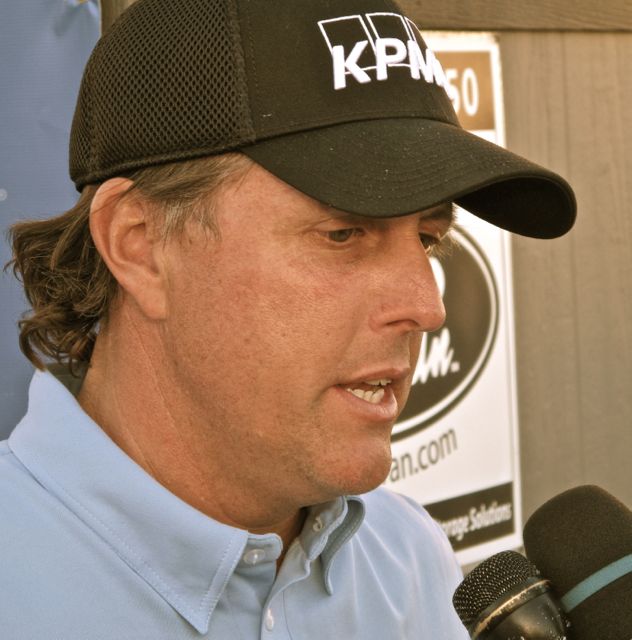
Phil Mickelson

Good form in Wednesday presser didn't help Mickelson in the first round of the Farmers Insurance Open. (John Garrity)

Mickelson’s close call in 2011 was memorable for the way he played the 72nd hole. Needing eagle to force a playoff, Phil sent caddie Bones Mackay up to the green to pull the flag before he hit his wedge from 72 yards. The grandstand spectators and the television audience ate it up, but there were skeptics — Philistines, if you will — who rolled their eyes. “He’s good,” they muttered, “but he’s not that good.”**

** I haven’t lost my touch with that old golf-writer standby, the totally-made-up quote. I can get away with it because it’s transparently bogus. Phil’s “skeptics” obviously didn’t mutter those seven words in unison, unless they were seated together in a greenside skybox, chanting under the direction of a skeptics-conductor — which you rarely see.

Or is he? Asked at his Wednesday press conference*** if he had really thought he might hole that wedge shot, Mickelson replied that, yeah, he did, because he practices a lot. “I practice flying my wedges to a specific yardage three days a week,” Lefty said. I hit over 1,500 golf balls and try to fly it within a yard or hit a target, and, for the most part, I’m able to fly it within a yard 90 percent of the time.****

*** This is one of the perks of golf writing. You can draft off another reporter’s good questions, and you don’t even have to credit that reporter. Sweet!

****Another golf-writer blessing. I can meet my assigned word count by simply quoting golfers and their caddies, throwing in an occasional “he said” or “he recalled” to prove that I’m “writing.” I don’t even have to attend the press conference; transcripts are provided in the press room and on line. I just have to make sure that the transcript is accurate.

I once puzzled over a transcript of my own interview with baseball great George Brett, which said that he “planned to rent a Vada house.” Turned out he was planning to “renovate” a house.

“So the fact that it landed close to the hole,” Mickelson continued “– it was supposed to. I mean, I work at that. That’s what I practice.

Elaborating, Mickelson said,****** “About a dozen times a year, I hit the pin with a wedge, and I end up getter a worse result because of it. [Dave} Pelz wants me to have the pin removed on every wedge shot.” Mickelson said he doesn’t do that******* “because it just looks bad. But the fact is that I hit the pin a dozen times a year, and probably eleven out of those twelve, the ball ends up in a worse spot because of it.”

******My three words, entirely.

******* I paraphrased here. Mickelson actually said, “which I won’t do because it just looks bad.”

“So two things,” Mickelson said. “I wanted to give it [the wedge shot] two chances to get in — one, trying to fly it in, and two, trying to back it up into the hole. And it came close.” He shrugged.******** “It didn’t go in, so what does it matter? But it came close.”

******** In golf writing, a shrug doesn’t necessarily mean shoulders. We count lifted eyebrows, a dismissive wave — even a backward-twitch of the ears.

So that’s my Mickelson report from Torrey Pines. If time and inclination permit, I’ll run over to the locker room to see if he has anything to say about today’s awful round. Or maybe I won’t. He might bite my head off!

Gotta go now. I smell burgers.

Leave a comment

Filed under golf

Sponsor Invites: The Good, Bad & Ugly

While we work on upgrades to the Bomar Brain, our senior course rater, Gary Van Sickle, has been entertaining you with his analysis of 2011 PGA Tour sponsor exemptions, which he hopes to package as a coffee table book called America on a Shoestring: Migrant Golfers in a Landscape of Plenty. Here is Gary’s take on last year’s most prominent invitees:

John Daly

John Daly: Did he wear out his welcome in 2011? (John Garrity)

John Daly received seven exemptions last year but complained when he was turned down for spots at the Bob Hope Classic and Waste Management Phoenix Open. It’ll be interesting to see how many free spots he gets in 2012 — in other words, has he finally worn out his welcome? He had a televised meltdown at a tournament in Austria, then withdrew from the Australian Open after hitting seven shots into a lake on the 11th hole and running out of golf balls. (Daly was seven over par before the disaster.) Many observers thought Daly’s conduct was not only unprofessional but premeditated because he was angry after drawing a two-shot penalty for playing the wrong ball — a range ball — from a fairway bunker on the 10th hole. Australian golf officials were upset enough to rescind Daly’s invitation for the subsequent Australian PGA Championship. (Daly has a long history of withdrawing from tournaments before, during and after rounds.) Last year, Daly received exemptions from the Farmer’s Insurance Classic, Mayakoba Classic, Transitions Championship, Zurich Classic, Colonial Invitational, Travelers Championship and Canadian Open. Though he hasn’t been exempt for years, Daly has not attempted to regain his card by going back to Q-school.

Bud Cauley gave up his final year of eligibility at the University of Alabama to turn pro and apparently knew he was ready. Cauley parlayed four exemptions into a PGA Tour card. He’s exactly the kind of player sponsor’s exemption should go to — promising young talent that needs a chance. Cauley received an exemption from the Viking Classic in July, where he finished fourth. He was in contention at the Frys.com Classic, where he placed fifth and won $340,000.  Those top-10 finishes got him into tour events the following weeks. He was able to bypass Q-school by having more winnings on the non-members’ money list than the player who finished 125th on the official money list. Cauley won $735,150 in eight starts.

Sam Saunders proved for a second straight year that it’s good to have a famous relative. He’s the grandson of Arnold Palmer and was able land his maximum of seven exemptions for a second straight year since dropping out of Clemson University. Saunders also scored some Nationwide Tour exemptions. Saunders finished 15th at Pebble Beach, where his grandfather is a part-owner, and 30th at Bay Hill, the tournament his grandfather hosts. Kevin Tway, son of former PGA champion Bob, scored four exemptions and missed four cuts.

Patrick Cantlay came off a remarkable freshman season at UCLA and enjoyed an even better summer. He was low amateur at the U.S. Open and runner-up at the U.S. Amateur. His stellar play prompted four sponsor’s exemptions, and Cantlay made the cut each time, finishing ninth at the Canadian Open. Had he been a pro, he would’ve won more than $380,000 in his PGA Tour appearances, but Cantlay went back to UCLA to be a sophomore.

Scott Stallings, a former star at Tennessee Tech, got into the Transitions Championship because his friend and mentor, Kenny Perry, helped him get an exemption. (Perry has an endorsement deal with Transitions, the eye care company.) Stallings contended for the title, finished third and used that good finish as a springboard to get in more tournaments during the summer. He won at Greenbrier and is fully exempt.

Gary Woodland won that Transitions Championship. Like Stallings, he was a Q-school grad the previous year, but he finished third in Phoenix after Waste Management offered him an exemption. Woodland won more than $3.4 million last year, finished top 20 on the money list and paired with Matt Kuchar to win the World Cup.

Brendan Steele was another young player who needed exemptions early in the year to get into tournaments. He got passes for Riviera and Bay Hill, then won the Valero Texas Open in May.

Rory McIlroy, who won the U.S. Open in June, ironically needed an exemption to defend his title at the Wells Fargo Championship because he decided to drop his PGA Tour membership at the end of 2010.

Cantlay, by the way, had the best record of making cuts among players who got exemptions, going 4 for 4. Scott Piercy and Lee Westwood (not a PGA Tour member), were 3 for 3.

Thanks, Gary. Your next assignment is to rank the tournament courses you mentioned, three of which are already in the Top 50, in your order of preference.

Top 50 on TV: Nothing this week, but the above-mentioned Bud Cauley got lots of air time while shooting a first-round 66 in the Sony Open at Honolulu’s 184th-ranked Waialae Country Club. “I did a lot of things right,” Cauley told the AP. “I did a lot of things I was doing last summer.” [Assignment for the weekend: Watch Jennifer Love Hewitt in “I Know What You Did Last Summer.”]

Leave a comment

Filed under golf

Ogilvie Was Best Guest of 2011

Gary Van Sickle, senior writer at Sports Illustrated (and director of course rating for the Top 50), writes that “while the PGA Tour is abuzz with talk about proposed changes to the qualifying tournament (Q-school), another route to the tour has been overlooked.”

That would be sponsor’s exemptions. Each event gets a handful of exemptions — a free invite into the tournament — to do with as tournament officials please. Non-tour members can accept up to seven free passes in a season, but for tour members there is no limit. And there is no watchdog.  In this oh-so-political game, it’s often not what you’ve done, but who you know.

Gary Van Sickle

Gary Van Sickle, Top 50's chief course rater, at Coyote Springs Golf Club in Mesquite, Nev. (John Garrity)

Van Sickle, who is no relation to the Gary Van Sickle who presides over the California Tree Fruit Growers Association, goes on to analyze the past year’s sponsor’s exemptions:

In 2011, 270 playing spots were awarded via sponsor’s exemptions in 31 tournaments. That’s an average of nearly nine spots per tournament — a pretty big number considering how tough it is to win a card through Q-school or the Nationwide Tour. Of those 270 free passes, recipients made the cut (and a check) 109 time. That’s 42 percent, not bad. Fourteen SE’s finished among the top ten (that’s five percent), and the best finish by a player competing on an exemption was third place. In all, 26 SE’s (9.6 percent) finished among the top 20.

“Another overlooked route to the tour,” Van Sickle continues, “is the Monday qualifier, a one-day, 18-hole event in which a field of players competes for three or four available spots.”

Not every tournament has Monday qualifying, and in 2011 the successful Monday qualifiers didn’t fare very well. Only 20 of 91 Monday qualifiers made cuts (22 percent). John Merrick, who was ninth at the Travelers Championship, earned the only top-ten finish by a Monday qualifier. Merrick, Lee Janzen and Michael Letzig were the only players to be successful twice in Monday qualifying this year.

Who is the king of sponsor’s exemptions?

“In 2011,” Van Sickle reports, “it was Joe Ogilvie.”

While Ogilvie, Scott McCarron and Brad Faxon each received 11 sponsor’s exemptions, Ogilvie was the only one to cash in on his opportunities. The 2007 U.S. Bank/Milwaukee champion made six cuts in 11 events, and his third-place finish at the Byron Nelson Championship, worth $377,000, was the biggest payday scored by any player receiving an exemption. Ogilvie won $541,650 in six events, and that, combined with 13 other appearances, enabled Ogilvie to finish 116th on the money list and regain exempt status.

Faxon called in a career’s worth of favors for his 11 spots as he waited to turn 50 in late summer and start competing on the Champions Tour. Faxon missed 11 cuts in 11 tries, but the work apparently paid off. He won a senior event late in the year.

McCarron made six cuts, like Ogilvie, but had only one finish better than 38th, a tie for sixth at the McGladrey Classic that earned him $125,200, more than one-fourth of his winnings for the year. McCarron finished 145th on the money list and is only conditionally exempt for 2012.

“I’ve worked up a report on other notable sponsor’s exemptions,”Van Sickle concludes, “like John Daly, Gary Woodland and — would you believe it? — Rory McIlroy. I’ll file them as soon as I complete my rating of the Jack Nicklaus layout at Coyote Springs Golf Club in Mesquite, Nev. Until then, Happy New Year!”


 Sponsor’s Exemptions, 2011

(Cuts made in parentheses)

11 Brad Faxon (0)

11 Scott McCarron (6)

11 Joe Ogilvie (6)

7 John Daly (3)

7 Rod Pampling (4)

7 Sam Saunders (2)

5 Will MacKenzie (1)

4 Notah Begay (1)

4 Patrick Cantlay (4)

4 Bud Cauley (3)

4 Erik Compton (3)

4 Morgan Hoffman (2)

4 Kevin Tway (0)

4 Charles Warren (1)

3 Billy Andrade (0)

3 Jay Williamson (1)

3 Joseph Bramlett (0)

3 Todd Hamilton (1)

3 Lee Janzen (2)

3 Colt Knost (1)

3 Scott Piercy (3)

3 Brett Quigley (1)

3 Jeff Quinney (2)

3 Lee Westwood (3)

3 Brett Wetterich (1)


Money Won by Players Playing on Exemptions

$541,650 Joe Ogilvie

$500,804 Bud Cauley

$374,000 Scott Stallings

$369,153 Rod Pampling

$359,112 Adam Hadwin

$251,600 John Cook

$222,650 Gary Woodland

$205,704 Lee Westwood

$204,354 Scott McCarron

$177,375 Shigeki Maruyama

$164,286 John Daly

$155,440 Brett Wetterich

$135,525 Sam Saunders

$112,840 Ben Curtis

$  88,000 Peter Hanson

$  82,650 Justin Hicks (Honda)

$  69,031 Morgan Hoffman

$  67,786 Josh Teater

$  61,590 Scott Piercy

$  55,481 Martin Kaymer


Money Won by Monday Qualifiers

$190,925 John Merrick

$  54,987 Frank Lickliter

$  51,837 Erik Compton

$  42,000 Mathias Gronberg

$  29,000 Michael Letzig

$  17,356 Josh Broadaway

$  16,336 Robert Gamez

$  16,087 Erick Justesen

$  14,430 Andre Stolz

$  13,542 Troy Kelly

Leave a comment

Filed under golf

Changes Ahead for Top 50 Blog?

Dear Readers: Although Mr. Garrity has not visited our Catch Basin headquarters for several weeks, he keeps in touch through texts and “honks.”* On Christmas Day he alerted us to a possible change of emphasis on the Top 50 blog. “More tour analysis,” he honked. “Less anime.” In a follow-up text, he wrote, “Offer Van Sickle premium to leave SI and cover tour full-time.”

Falcon Ridge's 15th hole

The 15th hole at 51st-ranked Falcon Ridge Golf Club, Mesquite, Nev. (John Garrity)

*Honks are 63-character messages from Honker Ltd., a Twitter rival in which Mr. Garrity has invested much of his fortune. If you would like to learn more about Honker, feel free to enter your social security and credit card numbers in the comment box.

We’re not sure what Mr. Garrity has in mind for 2012, but we know he’d like to wish you all a Happy New Year and remind you of the recent publication of Tour Tempo 2: The Short Game and Beyond by John Novosel and John Garrity, now available in iPad, Kindle and Nook editions.

On behalf of the Top 50 staff, I thank you for your past support and hope you’ll continue to count on the Top 50 for all your course-rating needs.

Sincerely,

M. G. Snead, Operations Director

Leave a comment

Filed under golf

Van Sickle Caps Best Season with Philly Cricket Club Triumph

The Presidents Cup at 51st-ranked Royal Melbourne seems to be occupying the middle-of-the-fairway media. I can think of no other reason for the relatively-short shelf life of Gary Van Sickle’s recent triumph at the 21st Annual Shivas Invitational. Van Sickle, the Top 50‘s chief course rater, withstood 40-degree temperatures, gale-force winds and a donut breakfast to shoot 78 on the Philadelphia Cricket Club’s 37th-ranked Wissahickon course.

A score of 78 may not sound impressive, but par was about 80 on a day that reminded neighbors in nearby Valley Forge of the winter of 1777-78, which sent the handicaps of General Washington and his 12,000-man Continental Army soaring. Finishing a stroke behind Van Sickle were Mike Donald, remembered for his 19-hole playoff loss to Hale Irwin in the 1990 U.S. Open, and 15-year PGA Tour veteran Bill Britton.

Van Sickle, upon presentation of the Shivas Trophy by tournament chairman Michael Bamberger, said, “You’ll have to ship it to me. There’s no way I can take this on my flight back to Pittsburgh.”

Also in the field were Sirius Satellite Radio host Peter Kessler, R.E.M. bass player and songwriter Mike Mills, and Top 50 founder and chief executive John Garrity, all of whom finished in the top 18.

Top 50 on TV: Nothing this week, but Alister MacKenzie’s Royal Melbourne composite course was in the Top 50 for an uninterrupted span of 252 months before dropping off the list this past July. Asked why the famous sandbelt course had been demoted, Van Sickle said, “No, really, I have to catch that plane.”

2 Comments

Filed under golf

Top 50 Author Debuts at No. 1

A worried reader asks,“Is this a golf course blog? A week or so ago, you popped up on Golf Channel’s Champions Tour Learning Center with some snake-oil swing remedy. This morning I caught you dispensing tips on bunker play on “Teed Off,” Brian Katrek’s PGA Tour Network program. Now I’m in my dentist’s waiting room, and here’s your byline on an SI Golf Plus rant about Tiger Woods’s screwed-up tempo. What gives? Have you forsaken course rating for the Hollywood allure of swing-guru celebrity?”

John Novosel Jr. on "Learning Center"

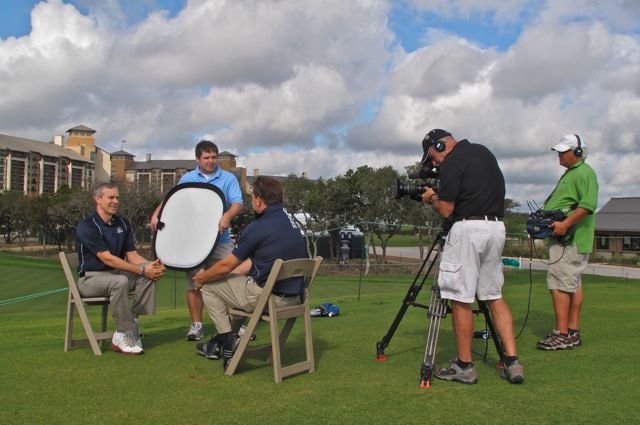
John Novosel Jr. explained Tour Tempo to a Golf Channel crew at the TPC of San Antonio. (John Garrity)

Fear not, Worried Reader. I just spent a working weekend in the Atlantic time zone, checking up on our two Canadian courses (24th-ranked Cabot Links and No. 31 Highlands Links) and I’m already packing for a trip to Oregon’s Bandon Dunes Golf Resort, where I’ll tee it up and trade rants with Tom Doak, designer of Pacific Dunes, No. 26. And just to forestall confusion, the Top 50 is not “a golf course blog.” It is the golf course blog.

However, like the late Steve Jobs, I take pride in revolutionizing whole industries. To that end, I co-authored the best-selling golf instructional, Tour Tempo: Golf’s Last Secret Finally Revealed, now in its 11th printing by Doubleday. And now John Novosel and I are out with an e-book sequel, Tour Tempo 2: The Short Game & Beyond, available on the Amazon Kindle* and Apple iBooks** platforms.

*Tour Tempo 2 debuted at No. 1 on Amazon’s golf books list. No surprise, that, since the original Tour Tempo was Amazon’s best-selling sports book of 2004, beating out Leigh Montville’s compelling Ted Williams biography.

**The Apple edition [which also debuted at No. 1 among golf books in the iTunes Store] is “enhanced” with color photography, instructional video clips and the  Tour Tempo short-game training tones. Buyers of the Kindle version can acquire these TT2 extras via a free download from the Web.

Naturally, promoting the new book has kept me from blogging as often as I’d like. But that hasn’t kept our highly-paid Top 50 evaluators from their appointed rounds. Within the past hour, for example, the A.W. Tillinghast-designed Wissahickon course at the Philadelphia Cricket Club jumped from No. 62 to No. 53 upon news of a breakthrough in the European sovereign-debt crisis. At the same time, a perennial Top-50 favorite, Colonial Country Club of Fort Worth, Texas, plummeted from No. 24 to No. 238.*

*Colonial’s fall, a by-product of program trading, was interrupted by a computerized “circuit breaker.” Our IT staff is looking into it.

Tour Tempo 2 Cover Art

TT2 is $9.99 on the iPad and Kindle reader.

How good is Tour Tempo 2?  Sports Illustrated senior writer Michael Bamberger, co-author of the best-selling golf novel, The Swinger, rates it ahead of the collected output of every last golf guru of the past half-century. “Since Eisenhower took to the links,” Bamberger writes in his latest blurb, “there have been two important golf instruction books: Five Fundamentals, by Ben Hogan and Herbert Warren Wind, and Tour Tempo, with John Novosel playing the Hogan role and John Garrity as Herb. TT2 is clearer yet. It’s like a wonder drug.”

Coming from Bamberger, a master of understatement, this is high praise. But let’s talk value. For a mere $9.99, you get the aforementioned color photography, the short-game tones, and the instruction videos. And if you order in the next hour, you’ll receive at no extra cost a bonus chapter, “The Force,” from an upcoming e-book by long-drive specialist John Novosel, Jr. Act this very instant and we’ll throw in “The Force” video clip, which will take strokes off your game faster than you can say “Popeil’s Pocket Fisherman!”

As for Worried Reader … stop moping and play some golf before winter sets in. I recommend any of the courses on the adjacent list.

Top 50 on TV: Nothing this week, but Rory McIlroy leads after one round of the Shanghai Masters, which is being played on the Lake Malaren Masters course, a Jack Nicklaus design. Robert Allenby, meanwhile, is the first-round leader at the Asia Pacific Classic, held at The Mines Resort & Golf Club in Selangor Malaysia, a Robert Trent Jones Jr. track. Both courses are “Unrated” pending a review of the Colonial situation.

Leave a comment

Filed under golf

Carne Chowder: Is It the Best?

No matter how carefully we police the collection of Top 50 data, shills for certain courses keep trying to influence the ratings. There’s “JH”, a Massachusetts businessman, who complains that The Country Club at Brookline deserves a ranking higher than No. 51. There’s a Philadelphia sportswriter — I’ll call him “Kernsie” — who pleads the case for 418th-ranked Stone Harbor Golf Club of Cape May Court House, N.J.  And if you’ll indulge my eye-rolling, there’s a reality-show “developer/statesman” who insists that his golf courses, all of them, are better than Pine Valley, Augusta National or Royal Portrush.

Hackett Lounge

Carneivores share recipes in the Eddie Hackett Lounge. (John Garrity)

And now a once-respected Texas journalist has turned to the dark side, wielding recipes in a sad effort to dislodge Askernish Old from the top spot. His name is Bruce Selcraig*, and his byline appears in all the top magazines. But he moonlights as a golf-course critic. If you’ve got a coastal property bigger than a fairground with dunes on it, Bruce has probably photographed it. If it isn’t fenced, he’s probably played it.

*Full disclosure: He’s a friend.

Anyway, Bruce is an admirer of the Carne Golf Links of Belmullet, Ireland. (As  are we. Carne has held the number-two spot since the Top 50’s inception.) He plays there so often that he’s on a first-name basis with the clubhouse and greenkeeping staff and with many members of the Belmullet Golf Club. It is Bruce’s practice, after a round at Carne, to send us an unsolicited report on the course’s myriad charms, leaning heavily on exclamation points and adjectives such as “dazzling,” “tear-inducing,” and “unparalleled.”

On Tuesday, however, he sent this: “I got rained and winded out of Carne this time, but had a hot chowder with Eamon [Mangan]. I have written him just now, but do you happen to know the recipe or main ingredient of [Carne’s] chowder, which I like far more than the milky white stuff at many courses.” Stymied by his syntax, he added: “???”

Recognizing this as a variant of the “milkshake ploy” — as in, “Castle Pines is the best course west of the Mississippi because of their amazing milkshakes” — I wrote Bruce back, explaining that my usual lunch at Carne was the tasty vegetable soup and brown bread.

He exploded. “You have NOT had the chowder? You elongated girly man from dubious BBQ territory!” Still working the food theme, Bruce provided a link to his freshly-written PostGame blog about the 8th-ranked European Club  in County Wicklow, which led off with the news flash that he had liked the salmon-and-prawn salad at Jack White’s Lounge & Restaurant.

Today, he raised the ante, writing, “This just in from Eamon … good luck,” followed by a document titled Blacksod Bay Seafood Chowder Recipe. The recipe began, “Make fish stock from shellfish shells & white fish bones, e.g. monkfish, cod, etc. Don’t use oily fish. Sweat off 1 diced onion, one head celery, 3 leeks chopped, 2 diced carrots …. And that’s as much as I’ll share, because the recipe was signed by Carne’s head chef (and 2005 Irish Chef of the Year) John Conmy, and I’d rather not have to defend a recipe-infringement suit.

Selcraig knows that. He sent the recipe because he thinks it will tip the clubhouse-food metric in Carne’s favor and put the Mayo links ahead of Scotland’s Askernish. To which I publicly say: “No way.” The Top 50 algorithm treats unsolicited course evaluations as corrupted data —at least until the best minds at Cal Sci figure out how to digitize monkfish-bone scores.

So Carne, even if it rules the chowder rankings, is still the runner-up among courses.

As for that BBQ crack, Bruce knows that Kansas City holds six of the top ten spots in the latest World Barbecue Ranking, while Texas’ top joint limps in at No. 14. And that’s a fact.

CordeValle

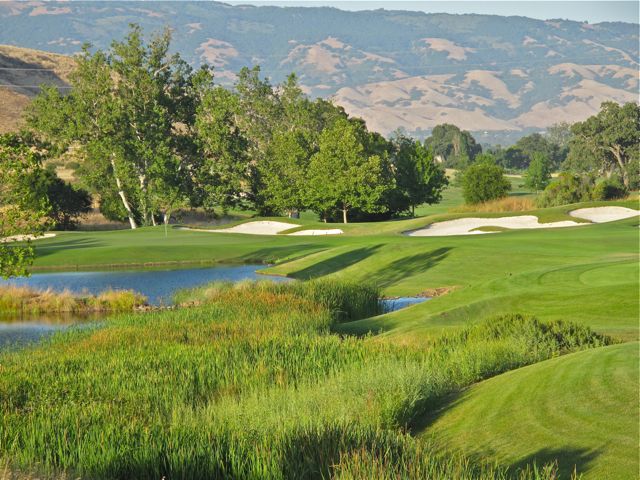
CordeValle: Wining, yes. Whining, no. (John Garrity)

Top 50 on TV: They’ve had record crowds this week at the Frys.com Open, thanks to the Top 50. The host venue, the CordeValle Resort Golf Club, debuted at No. 50 in June of 2010, and has since soared to the 49th spot. Lured by our reports of oak-studded foothills, sprawling vineyards and soaring sycamores, Tiger Woods made a rare fall appearance. Was he impressed? Can’t say, but he decided to stay for the weekend.

1 Comment

Filed under golf

Top 50 Staff: Stickin’ It!

“You’ve obviously been on vacation,” said the receptionist at Catch Basin, our Kansas City headquarters.

I chuckled. “Did my tan give me away?”

“No,” she said, reaching for her coat. “But you haven’t checked your voice mail for two weeks, and we couldn’t reach you when the cat died. I closed out the petty cash account in lieu of severance. You’ll find my resignation letter on your desk.”

Turnberry Lighthouse

Top 50's Van Sickle drains putt at Virginia tourney. (John Garrity)

The last I saw of her, through the glass entry doors, she was dancing in little circles on the way to her car.

But the receptionist — I forget her name — was right about my being on vacation. Once or twice a year I put my Top 50 obligations on hold to devote all my time and energy to my first love: competitive golf.

Last week, for example, I anchored the Sports Illustrated/Golf.com team to a 9-6 shellacking of the GOLF Magazine staff at the Golf.com World Amateur Handicap Championship in Myrtle Beach, S.C. Playing for the first time at the venerable Dunes Golf and Beach Club, I scored two out of a possible three points and shared MVP honors with dot-commie Billy Tucker. (“Well done,” said a gracious David Denunzio, GOLF’s captain. “You have been reported to the handicapping committee.”)

Should I be playing tournament golf on the eve of the all-important Indian Summer golf season? Yes, I should. The Top 50 is the world’s most credible course-ranking site because our raters are more than sparkling intellects and polished writers; we are also tournament-hardened, trophy-grasping, spotlight-seeking sportsmen.

Today, for example, our Pennsylvania ratings director, Gary Van Sickle, fired a first-round 77 at the USGA Senior Amateur Championship in Manakin-Sabor, Va. If Gary  survives a weekend of medal play and then rumbles through the 64-man match-play brackets, he will copy the feat of Atlantic Coast ratings chief Dave Henson, who recently blew away six opponents on his way to the Palmetto Hall Plantation Club Handicap Match Play title.

Dave Henson at Askernish

Top 50's Henson digs himself out of a jam at Palmetto Hall. (John Garrity)

“Tournament experience may not be a requirement if you rate courses for Golf Digest,” Dave said in a statement issued through his web site. “You’ll have to ask their editors why not.”

Next up on my tournament schedule: The St. Francis Xavier Charity Scramble, Sept. 25, at  51st-ranked Swope Memorial Golf Course, Kansas City, Mo.

Top 50 on TV: Nothing this week, but Britain & Ireland have taken a 7-5 lead over the U.S. going into the final day of the Walker Cup at Scotland’s Royal Aberdeen links. Our U.K. ratings director, Gary Van Sickle, calls the venue “a classic and wild links course.”

1 Comment

Filed under golf

Michael Murphy Riffs, Act 2

With routine maintenance occupying the Bomar Brain, I’ve decided to do the crowd-pleasing thing and post more of my interview with Golf in the Kingdom author Michael Murphy. Our conversation, from 20 months ago, was filmed and recorded at the Warner Bros. studios in Burbank, Calif., not far from the sound stage where Casablanca was filmed. Michael wore jeans and a brown sweater, and he looked much the same as I remembered him — thin gray hair, face not-to-deeply lined for 79, complexion slightly florid, quick to smile.

JG: Are you still playing golf?

MM: Nope.

JG: When did you stop? After we played at Pebble?*

*The novelist and the blogger shared a memorable round, complete with a metaphysically-induced hole-in-one by a third party, at the 1994 Shivas Irons Games of the Links.

MM: I quit four or five years ago. Finally, I — well, you know my game, John. I modeled my swing on Byron Nelson, down the middle and 200 yards. But it’s so boring to be out-driven by 100 yards. Two shots to get to my partner’s drive. I don’t like that, actually. To hell with that!

Royal Portrush

Northern Ireland's Royal Portrush links — another course that could have been the inspiration, but wasn't, for Burningbush. (John Garrity)

JG: Did you have a final round that you knew would be your final round?

MM: I can’t remember. [frowning] No, it’s receded into the misty past. But I make up for it, I walk my four or five miles every day. When you and I played, I was a runner, competing in the over-40 divisions. That took a lot of my time and energy. But now it’s just pride. Some would call it ego. I went out with my brother once, it was in the last year of his life. He had various afflictions. To be 100 yards behind my younger brother, who was in bad shape — it’s humiliating.

JG: But you do remember our round at Pebble Beach?

MM: Very.

JG: And the hole-in-one that Andy Nusbaum made on the seventh?

MM: The only hole-in-one I’ve ever seen!

JG: And since it was part of the “Games of the Links,” you had a flautist and a cellist playing Renaissance music on the tee, and an actor in the role of Seamus McDuff, and I was covering it for Sports Illustrated, and it was all being videotaped. Andy not only got the best-documented hole-in-one in history — it even came with a live musical score!

MM: High point of his life. All downhill after that.

JG: Getting back to Golf in the Kingdom, how much time did you spend on location at Bandon Dunes?

MM: Well, almost four weeks. I think I only missed the last week.

OFF-CAMERA VOICE: Twenty days.

MM: Twenty days?

OFF-CAMERA VOICE: Well, [apparel titan] John Ashworth is a great friend of mine, and I was visiting him down in Carlsbad, and he said, “If you really want to make a low-budget feature of Golf in the Kingdom, go up to this place called Bandon Dunes. It’s just perfect.” I’d never heard of it, so I said, “Well, you’re going to have to call for me.” So he called Mike Keiser, and Mike said, “Have Mindy call me.” And I called him. He said, ‘It’s destiny, come on up.”

JG: Well, anyway, you go up there and they’re making a film after all these years, 38 years. They’re bringing your novel to life. But these are new people with their own vision. What’s that like for you? I mean, you obviously had in your head an idea about the characters and what everything looked like.

MM: Well, it helped me understand why they say, “Keep the damn writer off the set.” I mean, these are two radically different art forms. It’s like two species mating; they can’t mate, but they think they can. So I gained tremendous insight into my own vast incompetence. I mean, to see twenty people or so, every one of them with a job. You have the director, the two assistant directors, the photographer, the assistant photographer, all of them certified pros. Then you have these “grips” with these belts of tools — weird tools that you’ve never seen before, and they’re coming in from different angles. And I realize that the photographer [Arturo D. Smith], who’s a tremendously gifted guy, and the director [Susan Streitfeld] are seeing things that I don’t see — things that I haven’t been trained to see — and they have been doing this for thirty years. So after two or three days, I retired to the sidelines.

JG: You took a knee.

MM: With a great sense of relief. But I had a fantastic time with David O’Hara, who plays Shivas Irons. We practiced meditation together, we had drinks together, we had great talks at night. It was a lot of fun, and it really opened my eyes to the vast amount of skill that goes into a feature film. And the difficulties! God, it’s a miracle that any of these films turn out well. There’s so many moving parts. I use the line — don’t print this, because they’re all watching, including the lawyer ….

JG: I’m good about these things. I understand “off the record.”

MM: Well, I say, “It’s a lot like making love. A lot can go wrong.” [Laughter] My wife’s not going to like that. Whatever. Keep it in.

JG: But you have seen actors, over the years, perform scenes from the book. The Games of the Links was part dinner theater.

MM: Yes, and I’ve always loved that, because I have friends who write screenplays or write for the theater. They write with anticipation of how it’s going to sound. I never did. Golf in the Kingdom was the first book I ever wrote, and it wasn’t really edited. It just came out. But Annie Long, who plays Agatha in the movie, she said, “Boy, you write in such a way that it’s fun to deliver.” And that was so flattering. I don’t know how true it is, but it was flattering. You know, you think it up here [pointing to his head], and then you feel it [pointing to his chest], and then somebody does it. And it’s a wonderful miracle, you know?

JG: But every actor, I assume, brings something different to it.

MM: Right, exactly. And the same for every director and every director of photography. But first and foremost is the actor.

JG: The cast [Malcolm McDowell, David O’Hara, Frances Fisher, Tony Curran, et al.] obviously had the chops for playing these roles. Did they also bring some knowledge of golf to the project?

MM: Well, the young guy who plays Michael [Mason Gamble], he has a nice golf swing and has played a lot of golf. Malcolm McDowell, he plays golf all the time. Six of the cast are Brits, two or three of them Scots-Irish. So there’s a lot of command of the language, and they’re all talented. For the amount of money that was paid, it defies the laws of gravity.

JG: What scenes were they shooting when you were on the site?

MM: Well, I missed the banquet scene. It was primarily David as Shivas Irons and Mason as the Michael character. And Jim Turner as the MacIver character.

JG: People describe movie making as this agony of waiting and waiting to do something, and finally doing it, and then sitting down and waiting some more. Was that your take?

MM: Very much so. I mean, it’s a tough, tough job.

JG: Would you have the temperament for that?

MM: I doubt it. I can sit and write all day — but see, I’m in charge of everything. The author is the producer, the director, the actor, he’s everything. So to be out there with the movie makers and to be reduced to a mere widget — well, I’m not trained for that. So I just rooted from the sideline. Once I owned up to the staggering size of my incompetence, I actually had a very good time.

Speaking of staggering incompetence, the Top 50’s IT director just stopped by to tell me that the latest shipment of fanfold paper was folded wrong side out. I’ll pick up the Murphy interview again in a couple of days. Meanwhile, if any of you have actually seen the movie, I’d welcome a short review.

Top 50 on TV: Nothing this week, but the PGA Championship will be contested  on the 512th-ranked Highlands Course at the Atlanta Athletic Club in Johns Creek, Ga. Informed this afternoon that this is the first major to which fans can bring cell phones, Masters champion Charl Schwarzel said, “Every single phone these days has got a silent mode, so put the thing on silent. That’s about all I can say.”

Leave a comment

Filed under golf

Murphy Riffs on Golf in the Kingdom Links Courses

Old Course eighteenth green

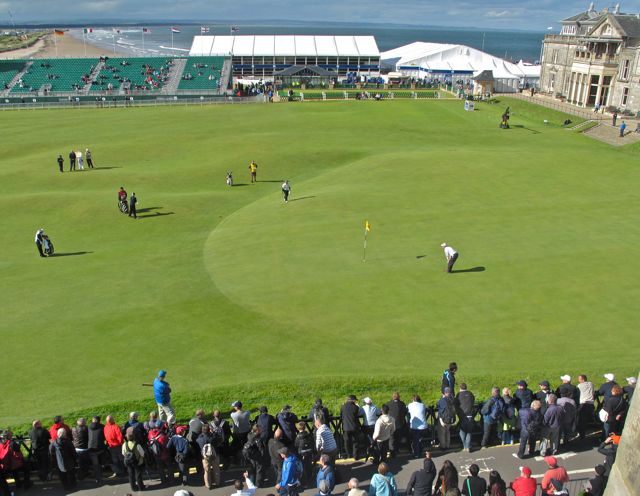
Burningbush, aka "the Old Course," is No. 16 on current list. (John Garrity)

The long-awaited release of Golf in the Kingdom, the movie version of Michael Murphy’s lyrical golf novel, has us jumping here at Top 50 headquarters, as we struggle to keep up with media inquiries about certain links courses. Consequently, the ranking itself has not yet been adjusted. Routine summer maintenance on the Bomar Brain has also slowed us down, as has a totally unexpected August heat wave. Yesterday’s high of 109 in Kansas City, a record for the day, forced me to send workers home early.*

* It is company policy to subsidize only fifty percent of an employee’s personal-cooling costs.

Frustrated by the delays, I personally ransacked Catch Basin until I came up with the  transcript of an interview I conducted with Murphy twenty months ago on the Warner Bros. studio lot in Burbank, Calif. The interview, which was filmed for a “Making of” documentary, delved deeply into metaphysics and therefore was largely unintelligible to anyone lacking a graduate degree. But the author and I touched upon golf and links courses, including the top-ranked layouts at Oregon’s Bandon Dunes Golf Resort, where the film was shot. Here, then, are edited excerpts from that interview, with Murphy’s grammar corrected as needed:

JG: Tell me a little about Bandon Dunes and what it was like as a setting for this film.

MM: It is ravishingly beautiful. I mean, when you see the film, it’s just gorgeous. The courses themselves are staggeringly beautiful, but they’re also photogenic. Certain people are gorgeous up front, but they don’t photograph well, and vice versa.

JG: Interestingly enough, the great links courses are often in that category.

MM: Yes. You mean that they don’t come out?

JG: Right. They’re spectacular in person, but on film everything gets flattened out.

MM: Exactly. A lot of people see St. Andrews for the first time, and they’re — “This?” [Look of utter bafflement.] But you see the course in another aspect and “Wow!” So no, absolutely. That’s a great observation. But Bandon Dunes is both beautiful to the eyeball and beautiful to the camera. [Developer] Mike Keiser and all his people, it was just a stroke of genius putting those courses together. And [land planner] Howard McKee, who I knew before — he did a master plan for the Esalen Institute back in the late seventies — so we were very lucky to have those courses. Have you been up there?

JG: I haven’t had the chance.

MM: Oh, John, you’ve got to get up there. You’ve got a treat when you see it. And this new one, Old Macdonald, it might be the most beautiful one of all.

JG: So how did this come about?

MM: Well, I had known Howard years back, and Howard had found these properties on the Oregon coast for Mike Keiser. And Mike was devoted to Golf in the Kingdom. So there was that connection. And one of the people who worked up in Bandon while we were filming told me that Howard, before they had built any of the courses, insisted that he read Golf in the Kingdom. This was, you know, 12 years ago. Howard said, “Someday that movie’s going to be made up here.” So he had an intention.

JG: But in the decades after the book became a hit, where had you envisioned the film being made?

MM: Well, Clint Eastwood [who plotted for years to direct the movie] went over to St. Andrews with, I think, Jack Nicholson and Sean Connery. I know he explored three different courses. Clint had thought of Crail. Do you know Crail?

JG: Yes, I’ve played there.*

Pointless understatement. The Balcomie Links at Crail is a perennial Top 50 standout and one of my all-time favorites.

MM: Now, at Crail they’re convinced that’s where I got inspired to write Golf in the Kingdom. They believe that Crail is Burningbush.

JG: The locals like to point out this hollow where [golf pro/mystic] Shivas Irons lurks.

MM: There is a par 3 up on the hill with a cave underneath. How I fished that up out of the deep, writing the book, I don’t know. It came in a rush. But it’s just a curious coincidence. I had never heard of Crail. Burningbush is actually St. Andrews. That was my model. And the various people who owned the options on the book over this long period always visualized it being filmed in Scotland. But it wound up being a low-budget, independent film, so Bandon Dunes was a marriage made in heaven. You can never tell how a film’s going to do, but those courses are going to be shown to great advantage. They’re gorgeous.

Reading these excerpts, I find that I rather enjoy playing the role of Charlie Rose. That being the case, I’ll post some more of my Murphy interview in a couple of days. In the meantime, I’ve moved the Bomar Brain to a climate-controlled room, ready for re-booting. I’ll post the updated rankings as soon as they’re available.

Top 50 on TV: Nothing this week, but Tiger Woods, No. 28, returns to tournament golf at the Bridgestone Invitational, played on the 728th-ranked, 7,400-yard South Course at Firestone Country Club, Akron, Ohio. Woods claimed his famous “shot in the dark” victory on Firestone’s eighteenth hole, finishing the 2000 WGC-NEC Invitational in the glow of butane lighters. The club later upgraded to tiki torches.

1 Comment

Filed under golf