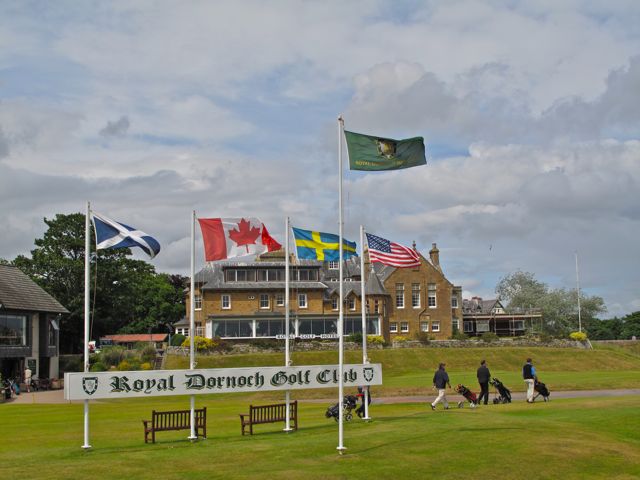
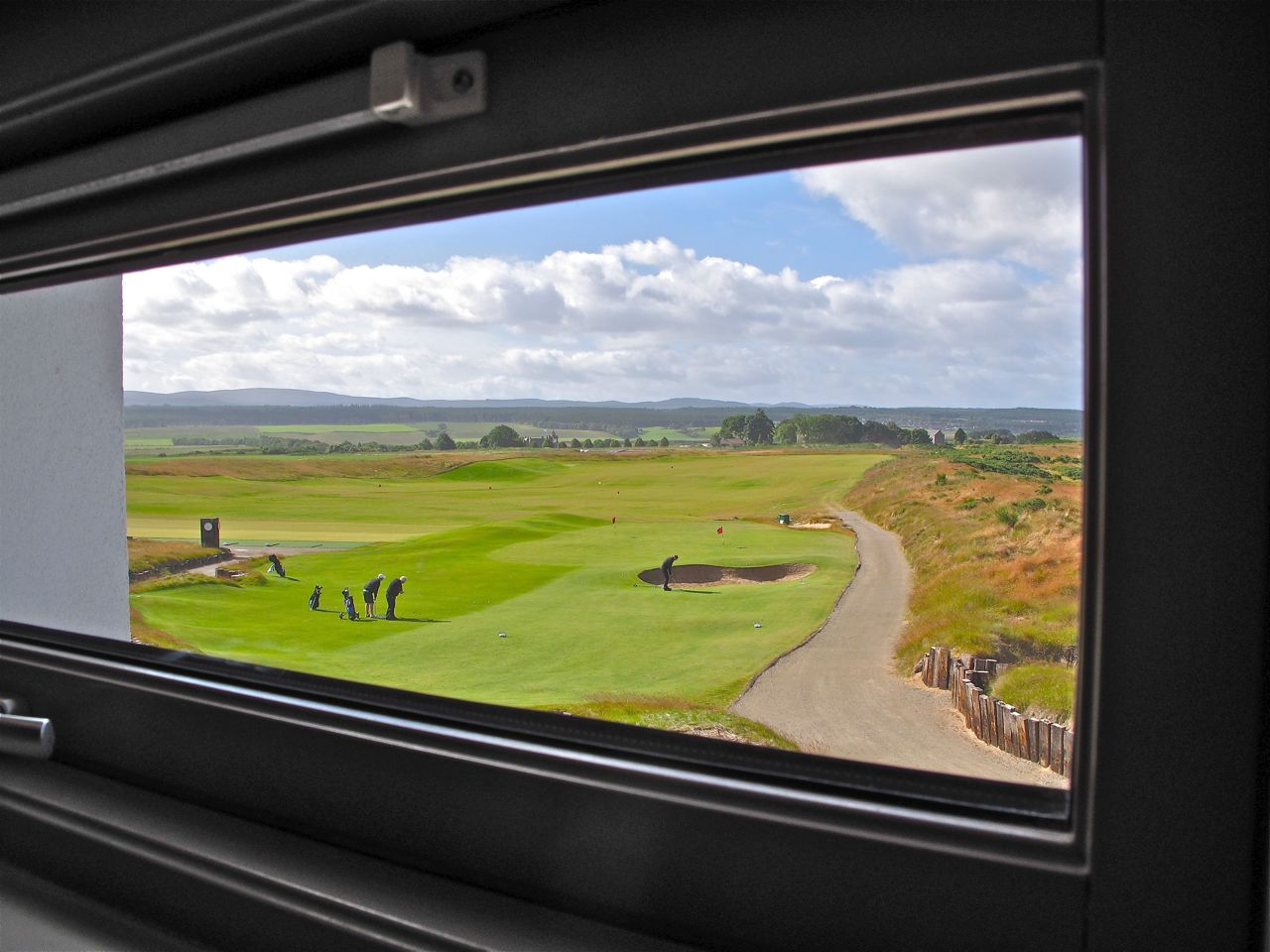
Engh Reaches Top Rung with Awarii Dunes

“We’re efficient with our construction budgets,” award-winning course designer Jim Engh said yesterday, after giving me a guided tour of his new Awarii Dunes course in Kearney, Neb. “That has to be my niche. I didn’t win a Masters. I have to put out high-class golf courses for modest budgets.”
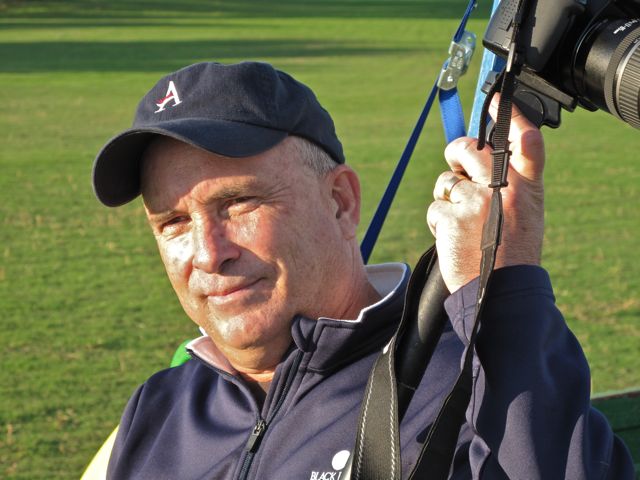
Jim Engh

Colorado architect has two courses in Top 50. (John Garrity)

The fact checkers at our Catch Basin headquarters tell me that Jim was truthful. He didn’t win a Masters.*

*The course-designers-with-green-jackets club has eight living members, using an arbitrary definition of “course architect.” They are Jack Nicklaus, Tom Watson, Gary Player, Arnold Palmer, Nick Faldo, Ben Crenshaw, Raymond Floyd and Tiger Woods. (Tiger’s membership is contingent on one of his designs actually opening for play.)

The “modest budgets” claim Jim had already backed up by pressing me into service as his driver, flag planter and photographer’s assistant. For a couple of hours on Monday afternoon, I followed him around as he engaged in a duel of wits with the setting sun, trying to capture shadow-rich photographs of his new course for his home page and promotional brochures. Like the professional course photographers who charge five figures for their product, Jim had lashed a stepladder to the bed of a utility cart. But it was a used stepladder, to save money.

“I see Awarii Dunes as a template for what golf will be in the U.S. when we start building courses again,” Jim said during a break in the inaction. “Maintenance expenditures have to come down. That means less precise irrigation, so you don’t get that trimmed-out look. That means sand-and-gravel cart paths instead of concrete.” As for the fairways and greens, “hard and firm and fast and brown is great.”

Jim Engh at Awarii Dunes

Engh photographs a par-3 at Awarii Dunes. (John Garrity)

With that buildup, I half expected Awarii Dunes to resemble the battlefield at Agincourt before it rained. Instead, the newly-planted fairways and greens are a deep green framed by fescue-covered dunes, golden fields of wheat and elegant cottonwood trees. When it opens for play next spring, Awarii Dunes will provide a closer-to-I-80-and-more-affordable alternative to Crenshaw-Coore’s acclaimed Sand Hills Golf Club, No. 19.

The price tag for Awarii Dunes, according to Jim, was “a million and a half,” mostly for irrigation. “The sand was here, we didn’t have to move a lot of dirt.”

The only obvious corner-cutting is on the greens, which do not have actual holes or flagsticks. (“We’ll take care of that before we open,” Jim said dryly.) For his photography, Jim carried a flagstick with a sharpened point, which he plunged into various greens with the ferocity of an explorer claiming new lands.

I got to get me one of them.

Top 50 on TV: Nothing this week, but last week’s Alfred Dunhill Links Championship featured a final-round 66 on the 16th-ranked Old Course at St. Andrews by the hottest player in golf, Martin Kaymer. Kingsbarns, No. 40, and Carnoustie, No. 203, were the other venues for the European Tour’s annual pro-am/frostbite festival, which features actor Hugh Grant and various knighted athletes and news presenters in wooly sweaters and oven mitts, with knit caps pulled over their ears and eyes to hide their identities.


Leave a comment

Filed under golf

Scottish Courses Survive Careful Audit

To sum up — which is pretty much my only alternative, since subterranean water issues at our Catch Basin headquarters have interrupted my usual stream of posts — the Top 50 rankings have withstood a rigorous audit by yours truly. And as they say in the NFL, “The ruling on the field stands.” My three weeks in Scotland and Ireland, during which I played an unprecedented 14 rounds of golf, convinced me that our Cal Sci algorithm has not lost a step. Every traditional links course on my itinerary met or exceeded my expectations, and several made such a strong impression that they have since advanced in the ranking.

Kingsbarns Golf Links, for example, jumped from No. 51 to No. 40 after I played it with SI colleagues Gary Van Sickle and Alan Shipnuck the week of the Open Championship. Gary, one of our unpaid course raters, leaked the preamble of his Top 50 report to Golf.com. “I had read the glowing reviews of Kingsbarns,” he wrote ….

…. a relatively new course on the ocean a few miles east of St. Andrews, but had no idea just how good it was until I played there …. Kingsbarns combines the rolling terrain and scenic views of Turnberry with the linksy charms of the Old Course …. If you could play just one course in the area, well, it would be a difficult choice. No course in the world has the history or the charm of the Old Course, located between the ocean and the middle of town in St. Andrews, but Kingsbarns’ beauty is striking. You don’t need a camera at the Old Course once you’ve snapped the obligatory first-tee photo with the clubhouse in the background, but at Kingsbarns you need a camera for nearly every hole. You can debate whether it’s the best course in St. Andrews, but it is unquestionably the prettiest.

Alan was similarly smitten, saying, “I would PAY to play Kingsbarns again.” That testimonial alone accounts for .13 of the course’s current score of 11.65.

But Kingsbarns was not the only Scottish course to advance. The Balcomie Links at Crail, just up the road from Kingsbarns, tiptoed from No. 37 to No. 33 (accompanied by Tom & Jerry-style pizzicato strings), while Machrihanish Golf Club, on Scotland’s Atlantic coast, floated from No. 38 to No. 35.

Crail, as most everyone knows, is one of my personal favorites, an Old Tom Morris links course with more quirkiness, charm and natural beauty than a hundred modern designs. I played it at 7 on a Monday morning with p.r. phenom Dove Jones and my buddy Mike Kern of the Philadelphia Daily News, and we zipped around in a little more than three hours. “If I never play another round of golf,” Mike said afterwards, “I’ll be happy to say that my last round was at Crail.”

First Tee at Machrihanish

"Swimmers Beware" -- the first tee at Machrihanish. (John Garrity)

That same afternoon, to everyone’s amazement, I motored clear across Scotland — a good six-hour drive — and checked into a B&B opposite the 18th green at Machrihanish. I don’t usually make golf dates that require commutes lasting longer than a Hollywood marriage, but I couldn’t turn this one down. I was meeting another SI colleague, Michael Bamberger, who just happens to be a longtime Machrihanish member, having joined after falling in love with the course during the writing of his classic, To the Linksland. Michael and I played on Tuesday afternoon, starting our round with the most exhilarating first-tee shot in golf — a gulp-inducing carry over a sandy beach, complete with sunbathers and kite-fliers — to a Cape-style fairway swinging sharply left. The delicious irony was that Michael had to ask me where to aim his tee shots and what trouble to avoid. It turned out he hadn’t been to Machrihanish in 19 years, while I had played it as recently as 2007, while researching Ancestral Links: A Golf Obsession Spanning Generations.

At the end of the round, I couldn’t resist asking him, “So — what do you think of it?”

“I really like it,” Michael replied, smiling like a grade-schooler. He added, “Which is something of a relief, considering all the years I’ve been paying dues.”

He declined, however, to fill out my 64-page course rater’s questionnaire, pleading jet lag. So I’m left with the Bamberger quote from To the Linksland that is painted on the wall above the bar in the Machrihanish clubhouse: “If I were only allowed to play one course for the rest of my life, Machrihanish would be the place.”

Personally, I think they should have used his other quote. (“If I promise to play Machrihanish only one more time as long as I live, will you let me join?”)

Top 50 on TV: Nothing this week, but the top pros from the U.S. and Europe have flown to Wales to face off in the Ryder Cup at the Celtic Manor Resort. The Twenty Ten Course, one of three Celtic Manor tracks, was built specifically for the Ryder Cup and claims to have “six signature holes.” This, of course, is not possible, four being the maximum allowable. (See Oxblood, Rodney, “Fundamentals of Golf Course Marketing,” unpublished Ph.D. dissertation, University of Iowa.)

2 Comments

Filed under golf

Askernish Retains Hold on Top Spot

“My game is coming back since returning from Scotland,” Top 50 staffer Dave Henson writes from Hilton Head, S.C. “Haven’t been in the 70s yet, but low to mid 80s. It seems I developed a strong left hand grip somewhere – probably from trying to drive the ball into 75 mph winds.”

Dave Henson at Askernish

Top 50's Henson celebrates at Rainbow's End. (John Garrity)

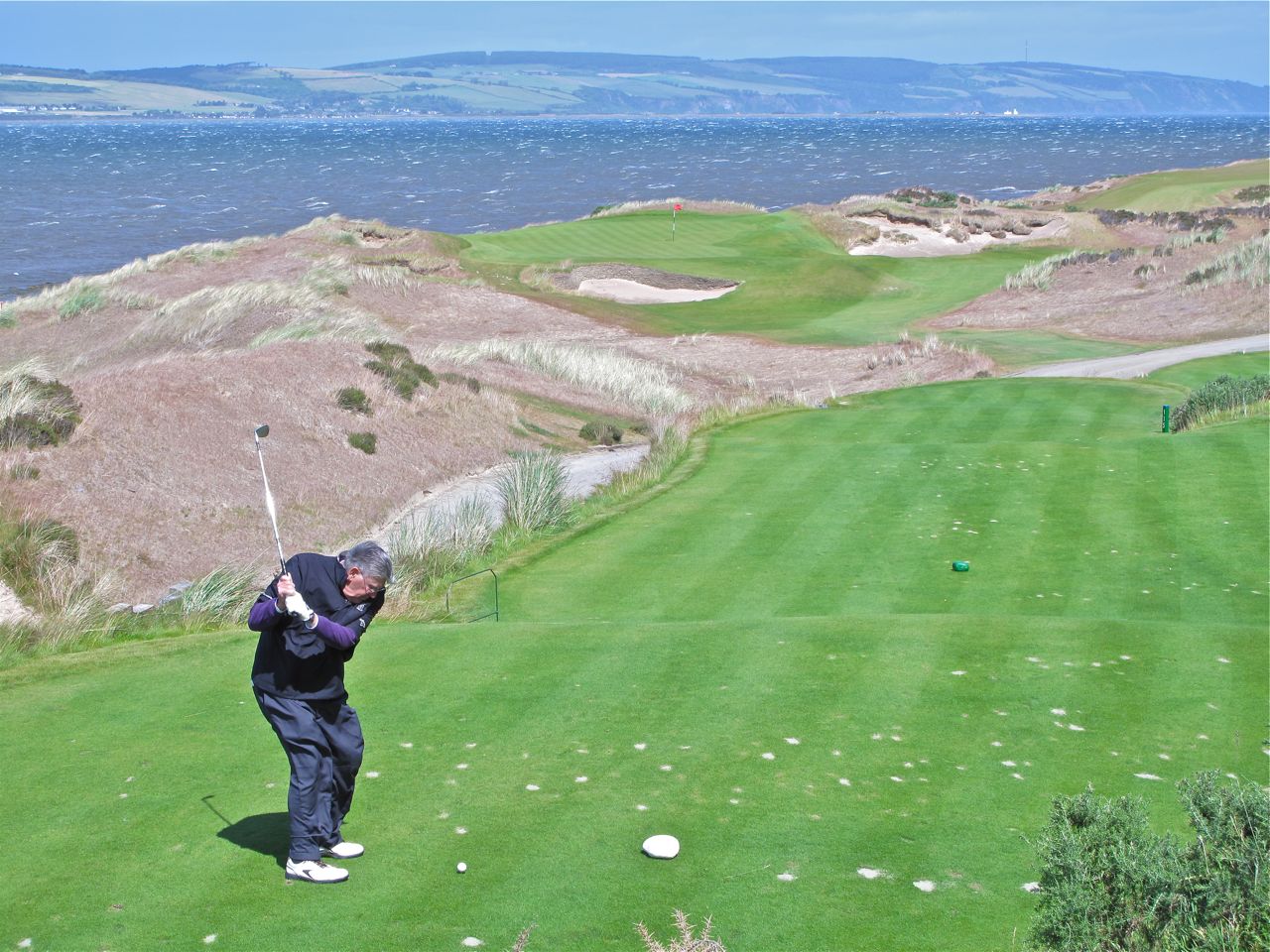
My old friend refers to a rather gusty mid-summer round at Castle Stuart Golf Links, No. 9, during my Top 50 Audit of Highly-Ranked Links Courses. That round in the Scottish Highlands, I should point out, was the only one in which conditions were severe enough to actually wreck one’s swing. The winds at Royal Dornoch, Nairn and Askernish never exceeded 40 mph, and there were intervals of relative calm when we could talk in normal tones and Dave could light his pipe without burning his hand. But the most rewarding birdies and eagles, as I think even galeaphobic Dave will agree, are those produced in hurricane-force winds. (See photograph, left.)

Unfortunately, Dave had to return to the States after our three-day inspection of top-ranked Askernish Old, the Old Tom Morris-designed ghost course on the Hebridean isle of South Uist. Health was an issue for my right-hand man, who had to endure the indignities of free and attentive treatment from a nurse-practitioner at a village clinic, followed by the prompt filling of an outrageously cheap prescription for his bronchitis. “Socialized medicine at its worst,” Dave grumbled, pining for the ninety-dollar meds and hour-long waits of home.

Askernish, in contrast to Dave, was in great shape. Greenkeeper Alan MacDonald had the greens rolling at a bouncy 5 or 6, and the fescue roughs were hacked down to a height that would barely conceal a dozing poet. Three years of dedicated labor have pushed most of the rabbit warrens to the boundaries of the course, so it’s no longer a common occurrence to have a border collie chase a hare between your legs as you address the ball. “It’s really coming around,” said Ralph Thompson, the affable chairman of the Askernish Golf Club. “It wouldn’t hurt you to pay the green fee.”

J Garrity putting at Askernish Old

Garrity on Old Tom's Pulpit: "Do you see a break?" (Dave Henson)

Since Askernish is closer to a perfect 10 than any other course, you might expect an air of complacency. Instead, the locals have jumped on an offer from famed course designer Tom Doak to lend staff and material resources to their restoration effort. As the Hebridean winter closes in, Doak’s team will work with MacDonald and British architect Martin Ebert (who designed the six new holes that lead up to Old Tom’s sublime stretch of seaside holes) on a subtle tweaking of the ancient links. As I write this, it’s not clear whether the work will start before or after the local crofters drive their livestock onto the course for their winter keep.

No matter. Based upon its summer condition and Dave’s scribbled report, Askernish retains its number one ranking and improves on its previous record score, edging down .03 points to 10.15.

Top 50 on TV: Nothing this week, but every time I turned on a set last week it was tuned to [the] Golf Channel’s “Golf in America.” For some reason, an audio-visual team had followed SI senior writer Alan Shipnuck and a friend as they played all four courses at the Bandon Dunes Golf Resort — including Tom Doak’s Pacific Dunes, No. 26 — in a single day.* (Spoiler Alert: It ends with Shipnuck walking into his motel room and falling face-first on the bed — a scene that would have been lost to posterity but for the fortuitous pre-placement of the video crew and their equipment.) If you missed this tribute to sore joints and sunburn, I invite you to read Shipnuck’s SI Golf Plus report on his long day, titled “14 Hours, 21.7 Miles, 2 Barking Dogs”, at Golf.com.

*Not to complain, but I’ve played several rounds with Shipnuck in recent months — most notably at Kingsbarns, No. 40, and Erin Hills, No. 23 — without drawing even a flicker of interest from [the] Golf Channel. Maybe their cameras would follow me around if I played all the crummy courses from my near-best-seller, America’s Worst Golf Courses, finishing up at the very worst, the Ft. Meade (Fla.) City Mobile Home Park Golf Course.**

**For TV, I would need an appropriate playing partner. Charles Barkley? Ray Romano? Tiger Woods? Send me your ideas.

2 Comments

Filed under golf

Castle Stuart Passes Latest Test

A reader from “Lake Wobegon” — a transparent alias for Lake Michigan, which provided the backdrop and fog for last week’s PGA Championship at Whistling Straits, No. 18 — asks for my definition of the word overrated. “If I can figure out what dictionary you’re using,” he writes, “I can maybe understand your omission of Pine Valley, Pinehurst No. 2, Medinah No. 3, Cherry Hills, The Country Club, Riviera, Inverness, Oakland Hills, Firestone South, Winged Foot, Congressional and Baltusrol from your ridiculous rankings.”

Simply by perusing Wobegon’s list of “slighted” courses I can tell a lot about the man. (There can be no doubt he is a man.) He lives on the far side of fifty, plays to a single-digit handicap, drives a Cadillac Escalade, walks about with a sweater around his neck, drinks Johnny Walker Black, has a home library with more than 200 golf books and a wing chair, votes Republican, has a trophy wife, and files an amended tax return two years out of five. He is, in other words, a man very much like myself.*

*I drive a Honda Insight hybrid, never touch alcohol and vote Democratic, but I roughly conform to the stereotype.

So I can understand Wobegon’s reluctance to accept that Time has passed him — and his beloved Canon of Great Golf Courses — by. (“It strikes! one, two,”  declaims Ben Jonson. “Three, four, five, six. Enough, enough, dear watch, Thy pulse hath beat enough.” ) All the courses he names have resided for a while in the Top 50, only to flow down and off the list like water going over a falls. As for my definition of overrated, I go with American Heritage: “to rate or appraise too highly.”

Which brings me back to the Castle Stuart Golf Links of Inverness, Scotland. Castle Stuart, open only a few months when it debuted last year at No. 10, has since risen to ninth, raising suspicions that insiders with personal agendas might have influenced the rating.*

*Specifically, critics have pointed to my middle name, which happens to be Stuart, and to my most recent book, Ancestral Links: A Golf Obsession Spanning Generations, which has three chapters on the golfing history of the Royal Stuart family, ending with a thwarted visit to the Castle Stuart construction site in the autumn of 2007. My critics, of course, are complete asses.

Castle Stuart

Whitecaps on the Firth? The 11th at Castle Stuart (John Garrity)

As mentioned in an earlier post, Dave Henson and I played only five holes at Castle Stuart on the Fourth of July, due to winds of up to 70 mph and precipitation in the form of horizontal rain, sleet, snow, hail and frozen desserts. Returning three days later at mid-morning, we were happy to see the sky cleared of clouds and the sun spreading its warmth; the only hangup was the wind, which was inexplicably stronger, gusting to 75. Dave was dubious about playing, but I assured him that Mark Parsinen and Gil Hanse had taken wind into account when they designed Castle Stuart. “Just remember to keep one foot on your trolley when you’re hitting a shot,” I told him. “And don’t hit your driver into the wind.”

Dave, whose former post in the Labor Department had him giving advice rather than taking it, apparently thought I was joking. He spent most of the round picking up his  toppled bag, chasing his trolley as it rolled toward cliffs, and watching his drives get swatted down by the gale. I, on the other hand, played most of my shots with a hybrid-4,  employing a hinge-and-hold technique that produced a steady tattoo of 130- to 150-yard wormburners. “It’s golf as it was meant to be played,” I told my frazzled friend, mentally pocketing skin after skin.

Despite the extreme conditions, Castle Stuart was playable. The ball rolled on its own accord on just one green, the twelfth, which clings to a promontory above the beach. The broad fairways, meanwhile, were receptive to smartly-struck drives, and the green complexes tended to collect and contain wayward shots rather than repel them. Aesthetically, Castle Stuart most resembles Top 50 evergreens Pebble Beach and Whistling Straits. The first three holes on each side run low along the water but in opposite directions, bringing the wind into play in contrary fashion. Subsequent holes ride the higher ground, and it’s only when you walk over to cliff’s edge that you see the holes below. The views, needless to say, are spectacular, and there are so many memorable holes that it’s hard to pick out a favorite. The postcard hole is probably the par-3 11th, played from a cliff-wall tee to a hanging-over-the-water green guarded by a nasty pot bunker.

Anyway, having played the course twice now — once last summer in a modest breeze and more recently in wind-tunnel conditions — I can confidently say that Castle Stuart, at No. 9, is not overrated. If anything, it is underrated. (“To rate or evaluate too low; underestimate.”) Personally, I put it right up there with Askernish Old and Carne, my two favorite courses.

Top 50 Alert: Erin Hills Golf Course of Erin, Wisc., recently picked to host the 2017 U.S. Open, debuts at No. 23, the highest first-time ranking for a course since Castle Stuart debuted at No. 10.  Built on farmland outside Milwaukee, Erin Hills echoes the trend toward rural courses with links-style characteristics, a la Prairie Dunes, Sand Hills, Whistling Straits and Medicine Hole. In fact, the bag drop/caddyshack at Erin Hills is an actual barn. (Note to USGA: Provide paved parking for Escalades.)

2 Comments

Filed under golf

Rain Man Tackles Nairn Golf Club

The second stop on our tour of suspected-of-being-overrated Scottish links courses was Nairn, a bustling village just up the road from Castle Stuart, outside Inverness. The Nairn Golf Club will host the 2012 Curtis Cup, so Dave Henson and I were not surprised to find a course groomed to tournament standards. The greens were suspiciously smooth, providing none of the mystifying bumps and bobbles that make small-town golf satisfying, but several of my putts found the hole, leaving me in a forgiving mood. There were a few too many steep-faced bunkers to suit Dave, and I could have done without the 20-inch fescue roughs, but difficulty does not disqualify a course from mention in the Top 50.

My colleague and I did have a piffling disagreement over what constitutes a links course. Midway through our late-afternoon round the holes turned away from the shore and climbed a tree-lined hill, putting us on farmable soil that scarcely resembled the thumpable, sandy underpinning of a true links. The closing holes presented a similar confusion: out-in-the-open, linksy greens requiring long, backward hikes into the woods to new tees that might have been transplanted from Alabama. I argued for a surgical trimming of trees to restore the openness of the closing holes, while Dave — pointing out that it was raining buckets and he was practically coughing up blood, due to his bronchitis — simply shook his head and walked off the course.

That left me to play the last three holes in total isolation, the club members having fled at the first sight of a dark cloud. (So much for the myth of Scottish golfers braving the elements!) As I holed my last putt in a drizzle on the 18th green, Dave came out to greet me, knocking ashes from his pipe, while perhaps a dozen diners cast me admiring glances from the glassed-in warmth of the club dining room.

“So how would you rate Nairn?” Dave asked on the drive back to Inverness.

“Fifty,” I said. “Maybe higher, if they chop down the trees.”

Next Up: Our Fourth of July round having been disrupted by seventy-mile-an-hour winds, we return to Castle Stuart to play a make-up round in seventy-five-mile-an-hour winds.

Whistling Straits Golf Course

Whistling Straits: Are 1,000 bunkers enough? (John Garrity)

Top 50 on TV: The PGA Championship, the fourth and final major of the season, is being played at Whistling Straits in Kohler, Wisc., currently ranked No. 18. (The course, not the state.) Already famous for his island greens and railroad-tie bulkheads, architect Pete Dye gave developer Herb Kohler something no other golf course has: a thousand sand bunkers. Other ideas for Whistling Straits, considered but ultimately rejected, included reversible greens, asphalt tee boxes and torch-lined fairways for night golf.

Leave a comment

Filed under golf

First Stop on Links Tour: Royal Dornoch

As I explained last time, fears that the Top 50 ratings might be flawed led me to cross the Atlantic for three weeks of club-in-hand research on some of our most highly-rated links courses. To get started, I met my longtime friend and America’s Worst Golf Courses researcher Dave Henson at the Glasgow airport, loaded his sleepy carcass and his golf clubs into the rental car, and then drove north along the shores of Lochs Lomond and Inverness to the banks of the Moray Firth, where the staff at Castle Stuart Golf Links rolled out the red carpet for us.

What they should have done was roll the red carpet over us — to keep us from blowing away. “We’re clocking steady winds of 45 to 50 miles per hour with gusts of 70,” said the young man behind the counter in the golf shop. “If your schedule allows, we’d recommend you come back in a couple of days, when you can better appreciate the course.”

Bunker Shot at Royal Dornoch

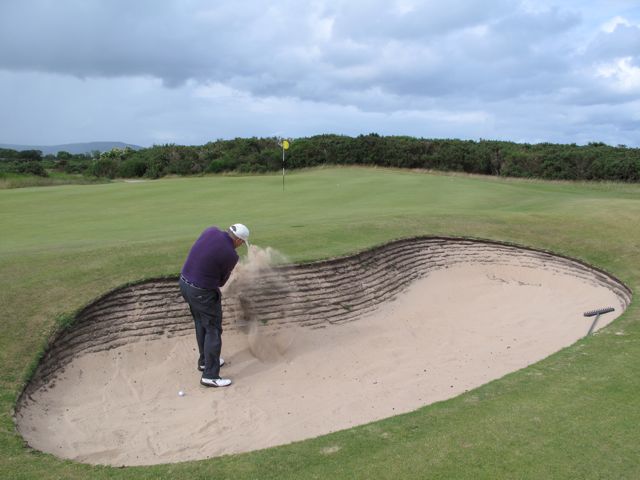
Top 50 Staffer Dave Henson tests the sand at Royal Dornoch. (John Garrity)

Dave, who was nursing a case of bronchitis, thought that was a great idea, and since I was already familiar with Castle Stuart, having played it last July, when it opened, I concurred. “But let’s play just a few holes,” I suggested, “to loosen up after the drive and your flight.” To that end, the club’s general manager, Stuart McColm, offered to drive us out to the fourth tee in his SUV, so we wouldn’t have to play the first three holes along the water into the gale.

So we were on the tee of the par-3 fourth when the next squall swept down behind us, blowing over our golf bags, puffing out our rain suits and pelting our necks with stinging sleet. “This should wake you up!” I shouted over the wind, drawing a withering glance from my old friend, who woud prefer to puff on his pipe by a cozy fire whenever the barometer needle dips a fraction. Anyway, we played holes four through nine in varying inclemencies and then drove back into Inverness to check into the Craigside Lodge B&B and change into dry clothes for dinner.

Day Two. A cold, windy, dreary morning followed by a cool, breezy, but clearing afternoon. Dave kept looking at the clouds as if he expected anvils to fall out of them. However, the promise of a round at Royal Dornoch improved his mood. It took us less than an hour to cross the big bridge and motor up past lochs, farms and forest to Dornoch, which is pretty much the northern outpost of the old British Empire, golf division. The great Donald Ross, I didn’t have to remind Dave, was head professional and greenkeeper at Dornoch before emigrating to the United States and establishing himself as the preeminent course designer of his time.

“You didn’t have to remind me,” Dave said.

Golfer teeing off at Royal Dornoch

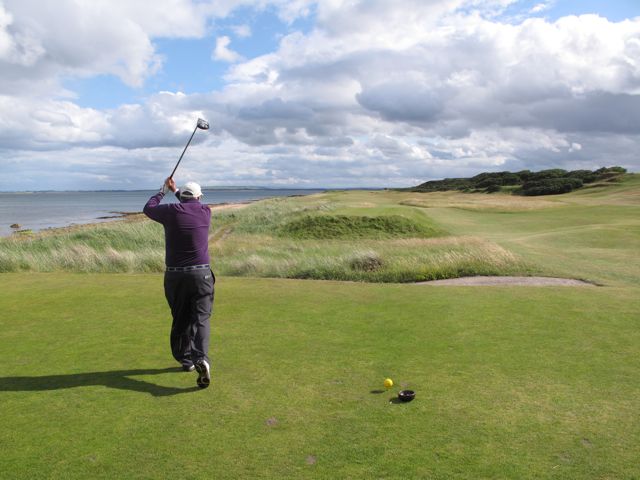
Royal Dornoch: Well worth the drive. (John Garrity)

It was blowing 25 or 30 knots when we teed off at Dornoch, making the national and club flags snap and crackle atop their poles. But it was a helping wind, not the in-your-face variety we had encountered at Castle Stuart.

Not that Royal Dornoch needed any help. Checking my notebook after the round, I found that it was filled with pithy praise: “A classic links …. lovely gorse-covered banks … delightful changes of elevation … unpretentious, a small-town feel … beautiful green complexes … sod-faced bunkers to be avoided at all costs … great sea views! … a perfect distillation of traditional course design with contemporary shot values …” Those are not scientific judgements, to be sure, but the point of our visit was to see if Dornoch’s Top 50 rating stood up to soft-spikes-on-the-ground scrutiny.

It did. In fact, I drove out of town at dusk convinced that Royal Dornoch deserves to be ranked in the top twenty of any reputable course-rating system. And that’s without factoring in the wonderful dinners we enjoyed in the club’s upstairs lounge, which looks down on the first tee and beyond to that long stretch of sand and sea.

I was reassured by Dornoch, but it was just one of many links courses in the Top 50. “Tomorrow,” I told Dave back at the Craigside Lodge, “we’ll check out Nairn.”

So, tomorrow, we’ll check out Nairn.

1 Comment

Filed under golf

Top 50 CEO Comes Clean on Golf Trip

First, a confession. I have been telling friends (and foes) that my recent trek through Scotland and Ireland was a golf holiday. “Fourteen rounds in three weeks!” I say with a self-satisfied smirk, trying to leave the impression that I have nothing better to do with my post-retirement days than chase old-man Bogey up and down a Celtic shore.

Truth is, I was working. And although I would like to ratify that old saw about “my worst day on the golf course being better than my best day at the office” — I can’t. (I work at home, so my best days at the office consist of a lot of napping, snacking, piano playing and careful monitoring of Rumpole of the Bailey and Rockford Files DVDs.)

Next, an apology. To the dedicated staffers here at Catch Basin and to the equally-dedicated Cal Sci mathematicians who manage the Top 50 Algorithm, I publicly announce: “I am sorry.” Sorry for doubting you. Sorry for challenging the raw data. Sorry for sprinkling talcum powder in your pay envelopes.*

*The Company pledges to honor all legitimate claims for emergency room services, doctor visits and treatments for PTSD up to the state-mandated cap of fifty dollars per household.

Third, an explanation. Reader mail, in the past year or so, has consistently challenged the Top 50’s claim to be “the only truly authoritative and scientific course-rating system” by pointing out seeming anomalies. “Pine Valley is not on your list!” complained one correspondent, while another grumbled that “the Augusta National practice range [No. 47] is not even a golf course.” I brushed off most of these criticisms as the product of parochial minds clouded by the puffery of local chambers of commerce and golf-tour operators. But I found it hard to dismiss the charge by a few dozen golf-industry insiders — some of them with college degrees — that my list was top-heavy with links courses in the British Isles. “Five or six Celtic courses is believable,” wrote a Moroccan travel agent. “But 38 of the top fifty? Highly implausible.”

Sunset Golf at Askernish

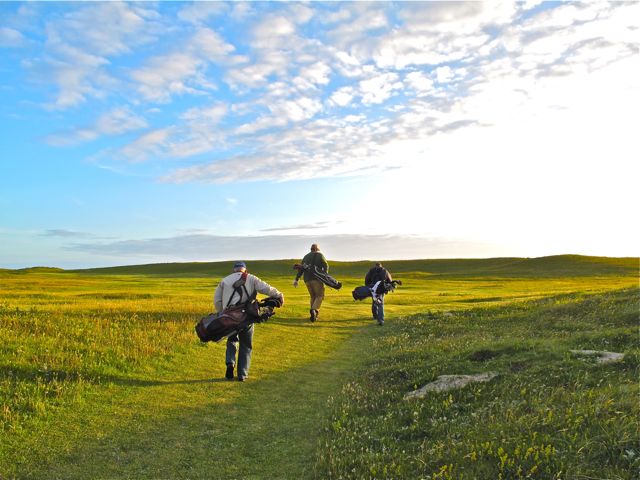
Links courses: Overrated? Underrated? Properly rated? (John Garrity)

The Moroccan’s claim of 38 was pure hyperbole, but a quick glance at the current Top 50 [see sidebar] reveals no fewer than 16 courses of the British links variety. What’s more, ten of the remaining layouts either have the word “links” in their name or boast of links-style features in their designs — e.g., Pebble Beach, Fancourt, Sand Hills, and Medicine Hole. I have long argued that traditional links courses get the highest marks for one simple reason: They are better golf courses.

Because they are.

But even I began to have doubts last year when Castle Stuart, a brand-new course on the banks of Scotland’s Moray Firth, debuted at No. 10. That was followed by another improbable leap (Kingsbarns to No. 40, pushing the Irish parkland gem, Druids Glen, into the second fifty) and a weird oscillation at No. 50, where Scotland’s Nairn and Ireland’s Donegal have been alternating every hour or so like one of those ballpark banner ads behind home plate.

Was there a flaw in the Top 50 algorithm? Had a mole infiltrated our Catch Basin headquarters? Does Charlie Daniels play a mean fiddle?

I had to find out. And the only way to test the integrity of the Top 50 ranking, as I explained to my wife, was by traveling to the British isles and playing the disputed links courses. Which I did. (Note to IRS: I will not be claiming non-golf expenses as deductions.)

Finally, my report. But that will have to wait a day.*

* Negotiations with Ryan Lawn and Tree have taken longer than expected, due to their lead agronomist’s insistence that sod cannot be laid over the hardwood floor in our TV room.

2 Comments

Filed under golf

No Substance to Reader’s Complaint

“Where have you been?” asks a reader from Peculiar, Mo. “Geoff Shackelford posts more in a day than you give us in a month.”

The reader, of course, couldn’t be more wrong. My Top 50 Blog is all about the adjacent list, and the list is constantly being updated by the Cal Sci math department. Last Saturday, for example, the Carne Golf Links of Belmullet, Ireland, briefly snatched the No. 2 ranking from the Augusta National Golf Club of Augusta, Ga. Yesterday, the new Machrihanish Dunes course on Scotland’s Kintyre Peninsula surged to No. 50, only to be beaten back by the Nairn Golf Links, a well-regarded Highlands course that will host the 2012 Curtis Cup matches. And now, in just the past two hours, those four courses have reverted to the ranks they held last Friday. Had the reader been paying attention, she would have spotted the activity and held off on her nagging e-mail.

My “columns,” as I like to think of them, are a different matter. I try to knock one out on at least a monthly basis, but I lead a busy life. In addition to my SI/GOLF/Golf.com duties, I serve on two Presidential commissions, take occasional gigs as a hotel-lobby jazz pianist, coach a parochial-league basketball team, assist several NBA teams with their draft choices, serve as official photographer for the Missouri Snipe-Hunt Association and  — on doctor’s orders — play golf as often as I can. Finding time to craft these columns is difficult, and readers‘ complaints don’t make it any easier.

Did I mention how much I travel? I spent the last three weeks in Scotland and Ireland checking up on several of the Top 50’s links courses. After each round I filled out the 22-page Top 50 course-rating form and mailed it off to the States, a procedure that took from two to four hours. (The longer time was for top-ranked Askernish Old, where the backup generator didn’t always kick in when the clubhouse windmill slowed.) Many of these rounds lasted until well past ten p.m. with hours of paperwork to follow, so no one, least of all my wife, should be surprised that I had to bang on a farmhouse door at 1 a.m. on the Herbridean island of South Uist to get the key to the front doors of the Borrodale Hotel, which was inexplicably locked.

That said, I hope to post several brief course reports in the next few days. They may not satisfy the reader in Peculiar, but they should go over well in Normal, Ill.

1 Comment

Filed under golf

Rolex Jumps on Top 50 Bandwagon

Reading the foreword to The Rolex World’s Top 1000 Golf Courses — which has appeared, as if by magic, on my desk in the press tent at the Open Championship in St. Andrews, Scotland — I find myself blushing with false modesty. In the just-published volume’s “Dear Golfers” opener the watchmakers boast that their book, which weighs about as much as a loaded picnic hamper, took three years to complete.

“We have a network of over 200 ‘inspectors,’” the minutemen continue, “composed of enlightened amateurs, professional golfers and journalists specializing in golf course architecture. They have anonymously worked their way around the golfing world, completing an in-depth questionnaire and adding incisive and personalized comments of their own. Our Editorial Committee has given each course a score, geared primarily to the excellence of the site, the course architecture involved, and of course maintenance and condition. After considerable deliberation and verification, we took the entire 33,000 courses currently registered worldwide and ended up with those we consider to be the Top 1000.”

Royal Dornoch Golf

Royal Dornoch rated a mere 95? Really? (John Garrity)

This, of course, is pretty much the modus operandi of The Top 50, so I accept Rolex’s imitation as the sincerest form of flattery and wish them the best as they attempt to catch up.

But now I read the next paragraph.  “For the first time in the history of golf,” the sundial salesmen crow, “a genuine world ranking has been established; like all rankings it is of course subjective but it is the result of unbiased and independent opinion with no commercial pressure.”

This preposterous claim is easily debunked. The Top 50 has been cranking out genuine world rankings since July of 2007, when, by the watchmaker’s own account, they were still looking up courses on MapQuest. Furthermore, Rolex concedes that its rankings are subjective — unlike the Top 50, which concedes nothing. As for the claim that their ratings are reached “with no commercial pressure,” I can only tip my hat in admiration. Like the Times Square huckster with a hundred watches pinned to the lining of his raincoat, Rolex cranes its neck looking in all directions and finds no corporate involvement.*

*Nothing in this paragraph should be interpreted as a criticism of Rolex, valued sponsor of the biennial Writers Cup matches between teams of golf writers from the United States and Europe.

Those points aside, I give the editors credit for compiling an impressive catalog of meritorious golf courses from all corners of the admittedly spherical earth. In addition to course addresses, phone numbers and dress codes, Rolex provides altitudes and GPS coordinates. (For example, the Moonah Links Legends Course in Fingal, Australia,  sits at an altitude of 15 meters at 38˚24‘24.27” S 144˚51‘14.68” E — information that would have kept me from missing my tee time on my last trip Down Under.) Rolex also designates a “signature hole” for each course — an important detail if you send a lot of COD packages to golfers.

As for the Rolex rankings themselves, what can I say? First of all, they aren’t true rankings. To avoid hurt feelings, the Editorial Committee scored the courses in five-percentile blocks, corralling the top 15 into the “100” category, the next 73 into the “95” category, and the rest of the sorry lot into “90s,” “85s,” “80s,” and “75s.” It’s an original scheme, but you wind up with a 73-way tie for sixteenth that puts Pebble Beach, Pinehurst No. 2 and Prairie Dunes on the same level. (Their scientifically-accurate Top 50 ratings are 6, 51, and 7, respectively.) Furthermore, Rolex’s top-15 reads like an tardy schoolboy’s test paper, correctly guessing only three courses from the Top 50 blog (Augusta National, Cypress Point and St. Andrews Old Course), while canonizing Top 50 no-shows such as Bethpage Black and Torrey Pines South.

The real problem with the Rolex Thousand is that they published it. I love hardcover books as much as the next man — if the next man is Johannes Gutenberg — but I don’t take my grocery lists to the bindery. Golf course rankings, to be meaningful, must be updated every few hours, and only the Top 50 performs this valuable service. Rolex, having to meet printers’ deadlines, doesn’t even mention the new Castle Stuart course in Scotland. The Top 50, attuned to the digital age, has the Highlands masterpiece at No. 10.

Still, I give the Rolex 1000 a solid 95 for effort. It’s not their fault that the Top 50 is a perfect 10.

(10-4.)

Top 50 on TV: The tour pros are still hogging the tee times on the St. Andrews Old Course, No. 16, as I type this on a breezy Sunday afternoon in the Kingdom of Fife. Fortunately, there are three other Top-50 courses within easy driving distance of the R&A clubhouse. (The Balcomie Course at Crail, the Torrance Course at St. Andrews Bay, and Kinghorn.) And that doesn’t include the wonderful Kingsbarns Golf Links (alt. 30 feet), which will debut in the Top 50 as early as next week, pending resolution of drainage issues at Catch Basin, our Kansas City headquarters.

Leave a comment

Filed under golf

Castle Stuart: Still Lookin’ Good

A reader from Lake Lotawana, Mo., has a question about tenth-ranked Castle Stuart, the brilliant, one-year-old links course on Scotland’s Moray Firth. “A few months back,” he writes, “you wrote that the Castle Stuart clubhouse has the best men’s room view in all of golf. But you didn’t back up your claim photographically, and you left the impression that Castle Stuart’s high ranking was based solely on clubhouse amenities.”

I’ll address the reader’s points in order. First, the claim that Castle Stuart’s lavatory view is unsurpassed. The Top 50 staff photographs the clubhouse and halfway house interiors of all our ranked courses, and if the facility has windows we document the view from every window. We can’t publish all these photos, obviously, so we go by the old adage, “A thousand words is as good as a picture.” I described the view from the Castle Stuart men’s loo. That seemed, to me, to be sufficient. But if my correspondent needs to have it spelled out for him in pixels, here is a selection of photos taken from the second-floor men’s lavatory of the Castle Stuart Golf Links.

Lavatory view

Castle Stuart's 9th green, as seen from the clubhouse lav. (John Garrity)

View of driving range

The Castle Stuart driving range from the men's shower room. (John Garrity)

9th Green Castle Stuart

Close up of 9th green from loo. (John Garrity)

Panoramic photo

Panoramic loo view, Castle Stuart Golf Links. (John Garrity)

The second point of the e-mail, implying that we ignored the Gil Hanse/Mark Parsinen golf course in our evaluation of Castle Stuart, is totally off the mark. No course in the Top 50, with the obvious exceptions of Sand Hills and Cypress Point,* achieved its elite ranking until it had been played by yours truly, either anonymously or (in the case of courses with outrageous green fees) not. Just last week, in fact, I played Castle Stuart in conditions that some would call extreme — wind gusts of 75 miles per hour — and left convinced that Inverness is home to the greatest new links course in the British Isles and one of the top ten golf courses in the world. It would not surprise me to see Castle Stuart, given a year or two to mature, to wind up in my top three with Askernish and Carne.

*And a couple of others.

I’m not the only one to be enchanted by Castle Stuart. Golf Digest managing editor Roger Schiffman, who played it last week as a member of the U.S. Writers Cup team, used words like “unforgettable … magnificent … stunning … beguiling … arresting …,” stopping only when he forgot whether he was describing the course or the barmaid in the third-floor lounge. George Peper, the author and former GOLF Magazine editor, calls Castle Stuart “the most significant British Isles debut since Loch Lomond in 1993 …. Think Pebble Beach, Pacific Dunes, Royal County Down …. restrained, insightful design combined with a breathtakingly beautiful site ….” Since I arrived in St. Andrews for this week’s Open Championship, I have been approached by total strangers asking if  I have played the new Highlands course that rivals or even surpasses Royal Dornoch Golf Club. “You’ll be blown away,” one of them told me, unaware of the irony.

So, here’s what I’ve got to say to that reader in Lake Lotawana and anybody else who thinks he or she can trip up the Top 50 staff: Forget it. When it comes to golf courses, we cover all the basins.

Top 50 on TV: The one, the only, Old Course at St. Andrews, Scotland. The 139th Open Championship begins tomorrow morning on the Fife muny, which is the only God-designed course in the Top 50. The Bottom 50, however, features the unforgettable Ft. Meade City Mobile Home Course Golf Course of Ft. Meade, Fla., which is reputed to have been built by God, Jr., with help from his brother Rees.

Leave a comment

Filed under golf