Parascenzo Weighs in on Duke

Fans of the Top 50’s current focus on tour coverage have singled out the contributions of our chief Asian correspondent, Duke Ishikawa. “This Duke guy must be psychic,” gushes a reader from Glendive, Mont. “He singles out a rookie I never heard of, Sang-Moon Bae, and Bae reaches the quarter-finals at the Accenture Match Play. He then focuses his all-knowing gaze on another rookie, John Huh, and Huh wins the Mayakoba Golf Classic. So here’s my question. Is ‘Duke’ his real name?”

Before I answer Glendive’s question, I have to correct him. Duke tipped us off to Bae, but credit for the Huh coverage goes to me and my print-media partner, Sports Illustrated Golf Plus, for which I pounded the Huh beat. And we weren’t psychic. We just couldn’t resist the opportunity to put “HUH?” in a headline.

But getting back to Duke Ishikawa, I was going to query him about his nickname when it struck me that he might demand a million yen for his answer. So I forwarded Glendive’s question to our chief Allegheny correspondent and former Golf Writers Association of America president, Marino Parascenzo, who volunteered an answer in less time than it takes to set a Bear Trap.

“The story of Duke Ishikawa goes back to the 1970s,” Marino replied in one of his elegant e-mails.

Duke was getting to be a pretty regular visitor to U.S. tournaments back then, and one day he was chatting with Joe Concannon of the Boston Globe. (Did you know the late Joe?) Duke told Joe he wished he had an American name because people had so much trouble with his given name, Hiroshi. He said ‘Ishikawa’ was tough enough. An American first name would make things easier.

So Joe asked him, “Well, can you think of an American name you would like?”

And Hiroshi said, “Harold.”

And Joe said, “Hell no. That really sucks.”

Hiroshi couldn’t think of another American name he wanted, so Concannon said, “Okay, who’s your favorite American?”

And Hiroshi said, “John Wayne.”

And Joe said, “Okay, John’s no good. So now you’re ‘Duke.’”

And Duke it was.

Concannon told me the story, and Duke confirmed it. He liked Joe a lot.

“I don’t think either of them considered ‘Joe” for a name,” Marino added in his freely volunteered, no-payment-expected e-mail. “It just doesn’t have the same ring to it as ‘Duke.’”

Hillcrest CC 2nd hole

The second hole at the former Hillcrest Country Club is a welcome sight for victims of the notoriously difficult par-3 first. (John Garrity)

Top 50 on TV: Nothing this week, but a press release informs us that 45th-ranked Hillcrest Country Club of Kansas City, Mo., a classic Donald Ross design, is being re-branded as The Heartland Golf Club. Operating under new management, the former PGA Tour venue will re-open on March 30 with new membership options. “We’re excited to start the process of re-creating the former Hillcrest site into a multi-purpose facility,” says Heartland general manager Kurt Everett. “Our first step is to get the golf course back into play, and we’re busy now with turf and green improvements and an updated pro shop.”

Leave a comment

Filed under golf

Naruo Leads Duke Ishikawa’s Top 5

As part of our commitment to round-the-clock course rating, I asked our chief Asian correspondent, Duke Ishikawa, to compile a list of his favorite Japanese courses. He promptly sent the following ranking, which I will post to the sidebar when repairs are completed on the Bomar Brain:

1. Naruo Golf Club, Kawanishi-shi, Hyogo (Charles Alison). “Most overseas panelists give Naruo the number one rank in Japan, so it’s not just my favorite. It’s our Pine Valley.”

2. Tokyo Golf Club, Sayama-shi, Saitama (Komei Otani) “Ninety years ago, the Prince of Wales (later Edward VIII) and Emperor Showa played a friendly international match at Tokyo Golf Club’s then-nine-hole course. Today, each hole has two greens, the other green serving as a hazard to the one in use.”*

*“Summer and winter in Japan present extremes of temperature and humidity, so many courses need to keep two different grasses to provide a good roll on the greens. It used to be bent and korai, a native rice grass, but now it’s two different types of bent.”

3. Hirono Country Club, Miki-shi, Hyogo (Charles Alison). “This is Jumbo Ozaki’s favorite, but it’s my third. One reason, it was designed in 1930 with korai grass, but it later switched to bent without changing the size or design of the greens. It became a different course after that. That is my viewpoint.”

4. Karuizawa Golf Club, Karuizawa-shi, Nagano (Kodera Yuji). “Another course designed by a Japanese man more than seventy years ago. Karuizawa, by the way, is one of the most exclusive clubs in Japan. Karuizawa-shi will host the 2014 Eisenhower Trophy, but that will be on two of the Prince Hotel’s Karuizawa 72 daily-fee courses, one of them by R.T. Jones, the father.”

5. New St. Andrews Golf Club, Otawara-shi, Tochigi (Jack Nicklaus, Desmond Muirhead). “I have been very fortunate as a golf writer. I first covered the Masters in 1975, right after I finished college. My first US Open was at Baltusrol. Both tournaments were won by Nicklaus. That same year, Jack opened New St. Andrews, his first course in Japan. We had never seen that kind of design in Japan. It gave us a smell of Scotland. In fact, some two holes play to one big green, just like at the Old Course. I fell in love with it, and I’ve played it as often as any course in Japan.”

“New St. Andrews is about a hundred miles north of Tokyo,” Duke concludes, “so you have to pay more than a hundred US dollars for tolls and gas, and then you need to stay at a lodge. Cost me a lot, and it’s cold in winter. But I still enjoy it. Thanks, Barbara, for your husband’s good job.”

Top 50 on TV: Nothing this week, but the world’s top pros are bumping heads in the WGC-Accenture Match Play Championship at the Ritz Carlton Golf ClubDove Mountain, in Marana, Ariz. Just two years old, the Ritz-Dove Mountain is a Nicklaus design without the slightest smell of Scotland.


2 Comments

Filed under golf

More Honors for Top 50 Staff

“What happened?” asks a reader from North Sydney, Australia. “You were covering the tour event in San Diego, and then … nothing. Is this your idea of ’24/7 tour coverage’?”

Not exactly, Sid.

First of all, as Steve Allen used to ask his studio audiences after a joke failed, “Who paid to get in?” The Top 50  is still working on a plan to monetize its award-winning tour coverage, but at present we’re laboring for zip. We do have corporate sponsors — Sports Illustrated generously paid for my California trip, and my pressroom lunches were catered by Flemings and Souplantation — but no Top 50 reader, as of yet, has sent in a check for twenty or thirty thousand dollars along with a note of appreciation for our in-depth coverage of Sang-Moon Bae’s California swing.

Secondly … well, actually, that first explanation is enough.

Here’s what actually went down at the Farmers Insurance Open. We had just posted Tokyo correspondent Duke Ishikawa’s report on the Japanese PGA Tour when word came that our course rating director, Gary Van Sickle, had won three of the top writing prizes at the ING Media Awards in Orlando, Fla. That good news called for a non-alcoholic celebration, which lasted well into the early-morning hours.

Stanford U

Garrity's U-Day victory will benefit Stanford's golf team. (John Garrity)

So I was already a bit groggy when I arrived at Torrey Pines Golf Club, a little before noon on Sunday. Nevertheless, I had gotten halfway through a Flemings steak, medium rare, when FIO communications director Rick Schloss pulled me away to share more good news: “Congratulations, John. You’ve won the University Day competition* for Stanford University.”

*He may have said “drawing” instead of “competition.” The conversation was not recorded.

I don’t have to tell you how big this was. For the third round of the tournament, players and media who wore their school colors competed for a share of a $70,000  charitable pot put up by Farmers Insurance. With Saturday’s low round of 65, Jonas Blixt earned $20,000 for the golf team at his alma mater, Florida State University. Cameron Tringale’s 66 was worth $10,000 to his former team, the Bulldogs of Georgia Tech. Every other player who wore their college colors got $500 for their team.

My triumph in the media division, Schloss informed me, was worth an additional $500 to the Stanford golf team. Furthermore, I, personally, had won a PING golf bag and a sand wedge, which would be shipped directly to Top 50 headquarters.* He then dragged me off to the interview room for a round of prize-accepting handshakes in front of a University of Farmers backdrop. (I’m still blinking from all the camera flashes.)

*Note to Catch Basin staff: The bag and club had better be in my office when I get home.

Anyway, two big honors in two days was more than this veteran scribe could handle. I wisely bagged my final-round coverage and spent the afternoon spamming the good news to the world’s major media outlets.

For the record, I have a second alma mater, the University of Missouri, where I labored as a freshman and for one semester of graduate school. I thought I was covering all bases by wearing a Stanford-logoed black polo shirt, black being half of Mizzou’s color scheme; but my cardinal-colored, Rick Santorum-style sweater vest gave the Farmers judges the impression that I was an all-Stanford entry. But don’t worry, Mizzou golfers. I’ll send you the wedge.*

*If it doesn’t fit my specs.

Top 50 on TV: The AT&T Pro-Am at Pebble Beach (Golf Channel, CBS) is finishing up at 9th-ranked Pebble Beach Golf Links near Monterey, Calif. If anything of interest happens there, I’ll let you know.

Leave a comment

Filed under golf

Van Sickle Scores Trifecta at ING Media Awards

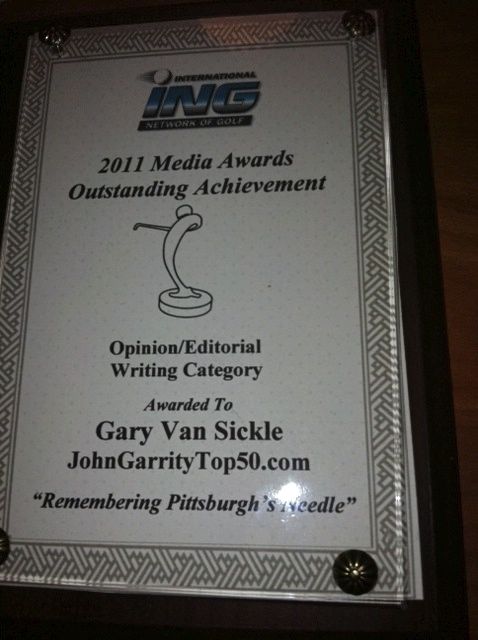
LA JOLLA, CALIF. — The awards have started to pour in, reflecting the Top 50’s recent emphasis on 24/7 tournament coverage. Yesterday, our director of course rating and chief tour correspondent, Gary Van Sickle, dominated the 19th Annual ING Media Awards in Orlando, Fla., taking three of the top writing awards, including the coveted Outstanding Achievement Award for “Remembering Pittsburgh’s Needle.”*

ING Media Award Plaque

Catch Basin's trophy room is getting crowded, but we can always stack the plaques.

* Our man also took two first places for Sports Illustrated stories: “The Trials of Jobe” (Competition Writing) and “Get Real, USGA” (Opinion Writing).

Asked for a transcript of his acceptance speeches, Van Sickle writes, “You don’t get to talk, but there were glorious cupcakes, imprinted with the ING logo in the frosting. Best cupcakes ever.”

I’ll try to get Gary to sit down next week for an extended interview (not a contract renegotiation). In the meantime, stay glued to this prize-winning site for continuing coverage of the Farmers Insurance Open.

Leave a comment

Filed under golf

“Bus” to Tokyo Was Bae’s Ticket to Torrey Pines

LA JOLLA, CALIF. — As I write this, the second-round leader at the Farmers Insurance Open is PGA Tour rookie Sang-Moon Bae (65-67–132). I know very little about Bae, beyond the fact that sang is Sino-Korean for “benevolence” and moon is a variant of myung or myeong, which mean “clever” or “bright,” the secondary meaning of which provides a clue to the Anglicized spelling, as in “bright moon.” (Bae, of course, is Korean for “inspiration” or, if you favor the b-y-e spelling, “goodbye.”)

Knowing so little about Bae, I sent an emergency e-mail to the Top 50’s Director of Japanese Course-Rating and Chief Asian Correspondent, Duke “No Relation to Ryo” Ishikawa.

Duke immediately shot back a splendid e-mail informing me that Bae is the Korean who won last year’s Japan Open and topped the money list on the Japanese PGA Tour. “The same story was written in the year 2010,” Duke added, “but the player was different.

“For Koreans,” Duke explained, “the Japanese tour is just a bus stop on the way to Broadway or Hollywood. You get off the bus with 14 clubs in Tokyo. Then you beat all the Japanese and make enough money to buy a bus ticket to the next stop, which is the world’s strongest and richest tour.

Let’s continue in the popular Q&A format that relieves me of the responsibility of crafting sentences:

JG: Why are Korean golfers so successful in Japan?

Duke: One reason is our weak fields. The Japan tour doesn’t have good-enough players. That’s why many of our old-timers still have playing privileges on the regular tour. Massy Kuramoto and Kiyoshi Murota (who finished second last year at the U.S. Senior PGA Championship) will be 57 this year, but Murota still plays 16 regular tour events and Kuramoto plays 12. Isao Aoki, the first Japanese player to win on the PGA Tour, will be 70 this summer, but he played six tournaments in 2011.

JG: Senior events?

Duke: No, regular JPGA events. We ought to call it the “Old Timers Tour.” Aoki is older than my old friend Hale Irwin; he’s the same age as Tom Weiskopf. Murota and Kuramoto, they’re the same age as the Shark and two years older than Sir Faldo.

JG: Sir Faldo is here at Torrey Pines.

Duke: Playing the tournament?

JG: No, cracking wise for CBS.

Duke: That’s O.K., he’s old.

JG: Any other reasons why Korean golfers go to Japan?

Duke: The bigger reason is we have too easy courses almost every single week. Many of the courses were designed by a Japanese architect whose results have never been good. He gets the re-design job for many Japan Open courses — not because he’s good, but because he’s a director of the Japanese Golf Association. It’s all under the table, the negotiations are on the dark side. But that’s why many foreign golfers agree with the Australian, Paul Sheehan, who complains that the Japan Open plays similar courses every year.

JG: I know that golf is popular in Japan, but is it treated as a serious sport?

Duke: No, and that is the third reason. When you play at a Japanese private club, one female caddie still carries four bags the whole 18 holes.

JG: You don’t mean “carry,” do you? They’ve got those motorized trollies that rattle along over buried tracks.

Duke: Yes, but one female caddie for four players. Then we have to stop for lunch after nine holes.  You eat steak and drink a big glass of beer, like you’re at Octoberfest in Munich. It takes nearly an hour. How can you keep your concentration for the afternoon round?

JG: Do you have to have a caddie?

Duke: I carry a PING Mantis bag myself, because it saves time and I make better scores. But most courses still charge me the normal caddie fee. I tell them that in England even Winston Churchill and Lloyd George carried their own bags, but Japanese never understand. The courses provide caddies to all golfers because they believe that’s the best treatment.

JG: You sound pretty glum. Do you think the Japanese tour will bounce back in the years ahead?

Duke: I don’t know. Ryo Ishikawa is still twenty, but we see so many younger and better players like Tom Lewis, Patrick Cantley, Bud Cauley, Harris English, that whole bunch. It’s because many old courses here don’t like to open their doors to local kids. Plus there are no municipal-type courses in Japan. I’m very pessimistic about the future of golf in Japan.

Duke concluded by writing, “Anyway, I really want to see the Korean, Bae, win at Torrey Pines this week. Because he is our recent champion.”

Post Script: Duke might get his wish. The second round of the Farmers ended with Sang-Moon Bae in a third-place tie with Martin Flores, two strokes behind the leader, Kyle Stanley. Asked about his chances of winning, Bae said, “Well, first time on the PGA Tour this year, and there are many good players. I will try to be aggressive tomorrow and Sunday.”

2 Comments

Filed under golf

Mickelson 77 Disappoints at Torrey

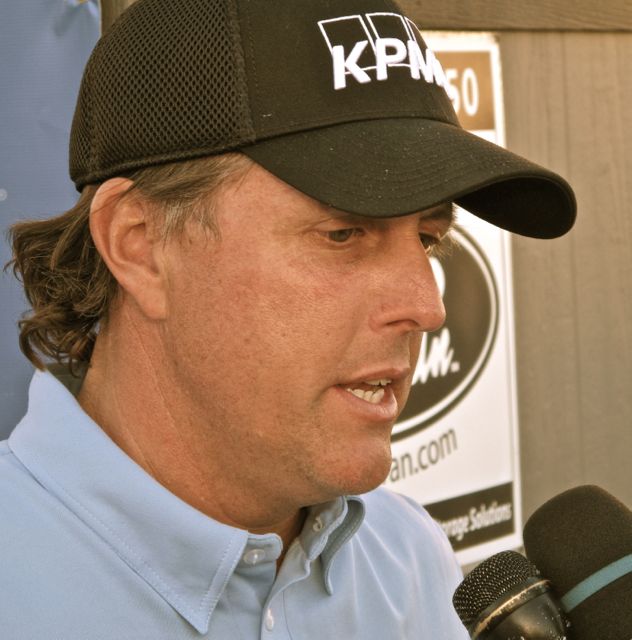
LA JOLLA, CALIF. — Phil Mickelson’s walk around 51st-ranked Torrey Pines South didn’t go so well this morning. He chunked a chip on one hole, failed to get up and down on several others, and generally F-gamed his way to a first-round 77. Phil’s a three-time winner of what we’re now calling the Farmers Insurance Open, but he hasn’t won here since the South got a total makeover by Rees Jones in preparation for the 2008 U.S. Open. Last year, Phil came close, finishing runner-up to Bubba Watson.*

* I’ve got my golf-writer hat on, as you can see. This is classic first-round reportage — i.e., obsessive attention paid to a star golfer who has blown himself out of the tournament before the dew is off the grass.

Phil Mickelson

Good form in Wednesday presser didn't help Mickelson in the first round of the Farmers Insurance Open. (John Garrity)

Mickelson’s close call in 2011 was memorable for the way he played the 72nd hole. Needing eagle to force a playoff, Phil sent caddie Bones Mackay up to the green to pull the flag before he hit his wedge from 72 yards. The grandstand spectators and the television audience ate it up, but there were skeptics — Philistines, if you will — who rolled their eyes. “He’s good,” they muttered, “but he’s not that good.”**

** I haven’t lost my touch with that old golf-writer standby, the totally-made-up quote. I can get away with it because it’s transparently bogus. Phil’s “skeptics” obviously didn’t mutter those seven words in unison, unless they were seated together in a greenside skybox, chanting under the direction of a skeptics-conductor — which you rarely see.

Or is he? Asked at his Wednesday press conference*** if he had really thought he might hole that wedge shot, Mickelson replied that, yeah, he did, because he practices a lot. “I practice flying my wedges to a specific yardage three days a week,” Lefty said. I hit over 1,500 golf balls and try to fly it within a yard or hit a target, and, for the most part, I’m able to fly it within a yard 90 percent of the time.****

*** This is one of the perks of golf writing. You can draft off another reporter’s good questions, and you don’t even have to credit that reporter. Sweet!

****Another golf-writer blessing. I can meet my assigned word count by simply quoting golfers and their caddies, throwing in an occasional “he said” or “he recalled” to prove that I’m “writing.” I don’t even have to attend the press conference; transcripts are provided in the press room and on line. I just have to make sure that the transcript is accurate.

I once puzzled over a transcript of my own interview with baseball great George Brett, which said that he “planned to rent a Vada house.” Turned out he was planning to “renovate” a house.

“So the fact that it landed close to the hole,” Mickelson continued “– it was supposed to. I mean, I work at that. That’s what I practice.

Elaborating, Mickelson said,****** “About a dozen times a year, I hit the pin with a wedge, and I end up getter a worse result because of it. [Dave} Pelz wants me to have the pin removed on every wedge shot.” Mickelson said he doesn’t do that******* “because it just looks bad. But the fact is that I hit the pin a dozen times a year, and probably eleven out of those twelve, the ball ends up in a worse spot because of it.”

******My three words, entirely.

******* I paraphrased here. Mickelson actually said, “which I won’t do because it just looks bad.”

“So two things,” Mickelson said. “I wanted to give it [the wedge shot] two chances to get in — one, trying to fly it in, and two, trying to back it up into the hole. And it came close.” He shrugged.******** “It didn’t go in, so what does it matter? But it came close.”

******** In golf writing, a shrug doesn’t necessarily mean shoulders. We count lifted eyebrows, a dismissive wave — even a backward-twitch of the ears.

So that’s my Mickelson report from Torrey Pines. If time and inclination permit, I’ll run over to the locker room to see if he has anything to say about today’s awful round. Or maybe I won’t. He might bite my head off!

Gotta go now. I smell burgers.

Leave a comment

Filed under golf

Free-Lunch Reprise for Top 50 CEO

LA JOLLA, CALIF. — As you probably have heard, I paid something less than a hundred grand last year to have the consulting firm, Mackinsay & Company, find ways to enhance reader satisfaction while cutting costs at our Kansas City headquarters. Mackinsay, after making certain that my check had cleared, recommended that I fire forty staffers at Catch Basin and plunder the pensions of those lucky enough to keep their jobs.*

*Having just re-read A Christmas Carol, I rejected Mackinsay’s advice and gave every employee a Christmas goose and a copy of my latest book, Tour Tempo 2: The Short Game & Beyond, available as an e-book on all iPads, Kindles and Nooks.

Highland Links, Cape Breton Island

Top 50 courses like Cape Breton Island's Highland Links (above) could suffer if consultant's advice is followed. (John Garrity)

Mackinsay’s second recommendation called for a de-emphasis of golf course reviews (“because they’re closing more courses than they’re building”) offset by a boost in tour coverage (“because pro golfers get a lot more air time than golf architects do”). This advice made more sense, but I pointed out that qualified golf writers, such as I used to be, are paid immensely more than the quasi-galley slaves who work in my basement computer room.

Mackinsay’s rejoinder: “You only paid for two recommendations. A third will cost you forty thousand.”

So now that Mackinsay is out of the picture, I’m wrestling with a decision: Should I spend more time at pro tournaments, trying to extract something quotable from sweaty guys who spend most of their days in the hot sun? Or should I spend most of my time in the hot sun, playing the world’s greatest golf courses on behalf of my readers?

To help with that decision, I’ve put on my old reporter’s hat — the fedora with the press pass sticking out of the band — and planted my laptop on a black-fabric-draped table in the media center at the Farmers Insurance Open. I’m working for my old employer, Sports Illustrated, but I’m also here for you, my Top 50 readers. If something pops into my head that I am not contractually or ethically obligated to share with SI, I promise to share it with you.

Fortunately, nothing like that has yet popped into my head. And since it’s been a long day, I think I’ll pack up and drive over to the Del Mar Driving Range for a sunset bucket of balls.

Top 50 on TV: Nothing this week, but Phil Mickelson praised a couple of courses at his post-pro-am presser. “My favorite golf course out here is probably Hilton Head,” he said, referring to Pete Dye’s 51st-ranked Harbour Town Golf Links. “And I don’t even play there any more because it’s the week after the Masters.” Reminded that the U.S. Amateur was returning to 52nd-ranked Cherry Hills Country Club in Denver, Col., site of his 1990 Amateur triumph, Lefty said, “I loved that golf course. I thought it was spectacular. There is so much history there, from Palmer driving the green on 1, to Hogan backing up his wedge on 17 … you can’t help but feel it.”

Until prodded, Mickelson modestly left out his own contribution to Cherry Hills lore: his jaw-dropping concession of a 30-foot par putt on the first hole of his second-round match with perennial New Jersey amateur champ Jeff Thomas. “I’ll never forget the look that he gave me,” Mickelson recalled with a smile. “I ended up making a three- or four-foot birdie putt to win the hole.”

Those of us who were there remember that Mickelson minimized the length of his birdie try after the match, saying, “I wasn’t going to try to lag a two-footer. I thought it was a gimme.”

My contemporaneous account of Mickelson’s memorable week at Cherry Hills is in the SI Vault. Check it out.

Leave a comment

Filed under Uncategorized

Sponsor Invites: The Good, Bad & Ugly

While we work on upgrades to the Bomar Brain, our senior course rater, Gary Van Sickle, has been entertaining you with his analysis of 2011 PGA Tour sponsor exemptions, which he hopes to package as a coffee table book called America on a Shoestring: Migrant Golfers in a Landscape of Plenty. Here is Gary’s take on last year’s most prominent invitees:

John Daly

John Daly: Did he wear out his welcome in 2011? (John Garrity)

John Daly received seven exemptions last year but complained when he was turned down for spots at the Bob Hope Classic and Waste Management Phoenix Open. It’ll be interesting to see how many free spots he gets in 2012 — in other words, has he finally worn out his welcome? He had a televised meltdown at a tournament in Austria, then withdrew from the Australian Open after hitting seven shots into a lake on the 11th hole and running out of golf balls. (Daly was seven over par before the disaster.) Many observers thought Daly’s conduct was not only unprofessional but premeditated because he was angry after drawing a two-shot penalty for playing the wrong ball — a range ball — from a fairway bunker on the 10th hole. Australian golf officials were upset enough to rescind Daly’s invitation for the subsequent Australian PGA Championship. (Daly has a long history of withdrawing from tournaments before, during and after rounds.) Last year, Daly received exemptions from the Farmer’s Insurance Classic, Mayakoba Classic, Transitions Championship, Zurich Classic, Colonial Invitational, Travelers Championship and Canadian Open. Though he hasn’t been exempt for years, Daly has not attempted to regain his card by going back to Q-school.

Bud Cauley gave up his final year of eligibility at the University of Alabama to turn pro and apparently knew he was ready. Cauley parlayed four exemptions into a PGA Tour card. He’s exactly the kind of player sponsor’s exemption should go to — promising young talent that needs a chance. Cauley received an exemption from the Viking Classic in July, where he finished fourth. He was in contention at the Frys.com Classic, where he placed fifth and won $340,000.  Those top-10 finishes got him into tour events the following weeks. He was able to bypass Q-school by having more winnings on the non-members’ money list than the player who finished 125th on the official money list. Cauley won $735,150 in eight starts.

Sam Saunders proved for a second straight year that it’s good to have a famous relative. He’s the grandson of Arnold Palmer and was able land his maximum of seven exemptions for a second straight year since dropping out of Clemson University. Saunders also scored some Nationwide Tour exemptions. Saunders finished 15th at Pebble Beach, where his grandfather is a part-owner, and 30th at Bay Hill, the tournament his grandfather hosts. Kevin Tway, son of former PGA champion Bob, scored four exemptions and missed four cuts.

Patrick Cantlay came off a remarkable freshman season at UCLA and enjoyed an even better summer. He was low amateur at the U.S. Open and runner-up at the U.S. Amateur. His stellar play prompted four sponsor’s exemptions, and Cantlay made the cut each time, finishing ninth at the Canadian Open. Had he been a pro, he would’ve won more than $380,000 in his PGA Tour appearances, but Cantlay went back to UCLA to be a sophomore.

Scott Stallings, a former star at Tennessee Tech, got into the Transitions Championship because his friend and mentor, Kenny Perry, helped him get an exemption. (Perry has an endorsement deal with Transitions, the eye care company.) Stallings contended for the title, finished third and used that good finish as a springboard to get in more tournaments during the summer. He won at Greenbrier and is fully exempt.

Gary Woodland won that Transitions Championship. Like Stallings, he was a Q-school grad the previous year, but he finished third in Phoenix after Waste Management offered him an exemption. Woodland won more than $3.4 million last year, finished top 20 on the money list and paired with Matt Kuchar to win the World Cup.

Brendan Steele was another young player who needed exemptions early in the year to get into tournaments. He got passes for Riviera and Bay Hill, then won the Valero Texas Open in May.

Rory McIlroy, who won the U.S. Open in June, ironically needed an exemption to defend his title at the Wells Fargo Championship because he decided to drop his PGA Tour membership at the end of 2010.

Cantlay, by the way, had the best record of making cuts among players who got exemptions, going 4 for 4. Scott Piercy and Lee Westwood (not a PGA Tour member), were 3 for 3.

Thanks, Gary. Your next assignment is to rank the tournament courses you mentioned, three of which are already in the Top 50, in your order of preference.

Top 50 on TV: Nothing this week, but the above-mentioned Bud Cauley got lots of air time while shooting a first-round 66 in the Sony Open at Honolulu’s 184th-ranked Waialae Country Club. “I did a lot of things right,” Cauley told the AP. “I did a lot of things I was doing last summer.” [Assignment for the weekend: Watch Jennifer Love Hewitt in “I Know What You Did Last Summer.”]

Leave a comment

Filed under golf

Ogilvie Was Best Guest of 2011

Gary Van Sickle, senior writer at Sports Illustrated (and director of course rating for the Top 50), writes that “while the PGA Tour is abuzz with talk about proposed changes to the qualifying tournament (Q-school), another route to the tour has been overlooked.”

That would be sponsor’s exemptions. Each event gets a handful of exemptions — a free invite into the tournament — to do with as tournament officials please. Non-tour members can accept up to seven free passes in a season, but for tour members there is no limit. And there is no watchdog.  In this oh-so-political game, it’s often not what you’ve done, but who you know.

Gary Van Sickle

Gary Van Sickle, Top 50's chief course rater, at Coyote Springs Golf Club in Mesquite, Nev. (John Garrity)

Van Sickle, who is no relation to the Gary Van Sickle who presides over the California Tree Fruit Growers Association, goes on to analyze the past year’s sponsor’s exemptions:

In 2011, 270 playing spots were awarded via sponsor’s exemptions in 31 tournaments. That’s an average of nearly nine spots per tournament — a pretty big number considering how tough it is to win a card through Q-school or the Nationwide Tour. Of those 270 free passes, recipients made the cut (and a check) 109 time. That’s 42 percent, not bad. Fourteen SE’s finished among the top ten (that’s five percent), and the best finish by a player competing on an exemption was third place. In all, 26 SE’s (9.6 percent) finished among the top 20.

“Another overlooked route to the tour,” Van Sickle continues, “is the Monday qualifier, a one-day, 18-hole event in which a field of players competes for three or four available spots.”

Not every tournament has Monday qualifying, and in 2011 the successful Monday qualifiers didn’t fare very well. Only 20 of 91 Monday qualifiers made cuts (22 percent). John Merrick, who was ninth at the Travelers Championship, earned the only top-ten finish by a Monday qualifier. Merrick, Lee Janzen and Michael Letzig were the only players to be successful twice in Monday qualifying this year.

Who is the king of sponsor’s exemptions?

“In 2011,” Van Sickle reports, “it was Joe Ogilvie.”

While Ogilvie, Scott McCarron and Brad Faxon each received 11 sponsor’s exemptions, Ogilvie was the only one to cash in on his opportunities. The 2007 U.S. Bank/Milwaukee champion made six cuts in 11 events, and his third-place finish at the Byron Nelson Championship, worth $377,000, was the biggest payday scored by any player receiving an exemption. Ogilvie won $541,650 in six events, and that, combined with 13 other appearances, enabled Ogilvie to finish 116th on the money list and regain exempt status.

Faxon called in a career’s worth of favors for his 11 spots as he waited to turn 50 in late summer and start competing on the Champions Tour. Faxon missed 11 cuts in 11 tries, but the work apparently paid off. He won a senior event late in the year.

McCarron made six cuts, like Ogilvie, but had only one finish better than 38th, a tie for sixth at the McGladrey Classic that earned him $125,200, more than one-fourth of his winnings for the year. McCarron finished 145th on the money list and is only conditionally exempt for 2012.

“I’ve worked up a report on other notable sponsor’s exemptions,”Van Sickle concludes, “like John Daly, Gary Woodland and — would you believe it? — Rory McIlroy. I’ll file them as soon as I complete my rating of the Jack Nicklaus layout at Coyote Springs Golf Club in Mesquite, Nev. Until then, Happy New Year!”


 Sponsor’s Exemptions, 2011

(Cuts made in parentheses)

11 Brad Faxon (0)

11 Scott McCarron (6)

11 Joe Ogilvie (6)

7 John Daly (3)

7 Rod Pampling (4)

7 Sam Saunders (2)

5 Will MacKenzie (1)

4 Notah Begay (1)

4 Patrick Cantlay (4)

4 Bud Cauley (3)

4 Erik Compton (3)

4 Morgan Hoffman (2)

4 Kevin Tway (0)

4 Charles Warren (1)

3 Billy Andrade (0)

3 Jay Williamson (1)

3 Joseph Bramlett (0)

3 Todd Hamilton (1)

3 Lee Janzen (2)

3 Colt Knost (1)

3 Scott Piercy (3)

3 Brett Quigley (1)

3 Jeff Quinney (2)

3 Lee Westwood (3)

3 Brett Wetterich (1)


Money Won by Players Playing on Exemptions

$541,650 Joe Ogilvie

$500,804 Bud Cauley

$374,000 Scott Stallings

$369,153 Rod Pampling

$359,112 Adam Hadwin

$251,600 John Cook

$222,650 Gary Woodland

$205,704 Lee Westwood

$204,354 Scott McCarron

$177,375 Shigeki Maruyama

$164,286 John Daly

$155,440 Brett Wetterich

$135,525 Sam Saunders

$112,840 Ben Curtis

$  88,000 Peter Hanson

$  82,650 Justin Hicks (Honda)

$  69,031 Morgan Hoffman

$  67,786 Josh Teater

$  61,590 Scott Piercy

$  55,481 Martin Kaymer


Money Won by Monday Qualifiers

$190,925 John Merrick

$  54,987 Frank Lickliter

$  51,837 Erik Compton

$  42,000 Mathias Gronberg

$  29,000 Michael Letzig

$  17,356 Josh Broadaway

$  16,336 Robert Gamez

$  16,087 Erick Justesen

$  14,430 Andre Stolz

$  13,542 Troy Kelly

Leave a comment

Filed under golf

Changes Ahead for Top 50 Blog?

Dear Readers: Although Mr. Garrity has not visited our Catch Basin headquarters for several weeks, he keeps in touch through texts and “honks.”* On Christmas Day he alerted us to a possible change of emphasis on the Top 50 blog. “More tour analysis,” he honked. “Less anime.” In a follow-up text, he wrote, “Offer Van Sickle premium to leave SI and cover tour full-time.”

Falcon Ridge's 15th hole

The 15th hole at 51st-ranked Falcon Ridge Golf Club, Mesquite, Nev. (John Garrity)

*Honks are 63-character messages from Honker Ltd., a Twitter rival in which Mr. Garrity has invested much of his fortune. If you would like to learn more about Honker, feel free to enter your social security and credit card numbers in the comment box.

We’re not sure what Mr. Garrity has in mind for 2012, but we know he’d like to wish you all a Happy New Year and remind you of the recent publication of Tour Tempo 2: The Short Game and Beyond by John Novosel and John Garrity, now available in iPad, Kindle and Nook editions.

On behalf of the Top 50 staff, I thank you for your past support and hope you’ll continue to count on the Top 50 for all your course-rating needs.

Sincerely,

M. G. Snead, Operations Director

Leave a comment

Filed under golf