Wentworth Redesign Inflames Poulter

It went unnoticed last year, the precipitous Top 50 dive of the Wentworth Club’s West Course from No. 58 to No. 712. I had meant to comment on it, since Wentworth, just outside London, is the most storied non-links venue in European golf — headquarters of the PGA European Tour, site of the 1953 Ryder Cup, host to the World Match Play from 1964 to 2007, and longtime venue for the British PGA Championship. But one of my aides pointed out that criticism of Wentworth by an American, coming at a delicate stage in Anglo-American peace talks, might not be in the national interest. So I simply tweeted, “els redesign of wntwrth sucks, shld blowit up n strt ovr.”*

*I dictate my tweets in standard English.  My granddaughter converts them to Twitterese.

Yesterday, however, an Englishman known for his Union Jack trousers tore into Wentworth West with such abandon that I no longer see the need for reticence. “Bloody hell,” Ian Poulter almost said yesterday, after he double-bogeyed the tarted-up 18th hole for a second-round 74 at the aforementioned BMW PGA Championship. My GOLF Magazine colleague, Paul Mahoney, reports that Poulter “ranted” when asked what he found most challenging about the redesign by golf legend Ernie Els:

“The tees, the fairways, the rough, the greens, and those 20-foot-deep bunkers,” he ranted. “I don’t like this golf course, period. End of story.”

The new green at the par-5 18th hole, fronted by a mail-order brook, received the brunt of Poulter’s opprobrium. “We are trying to land it on a dining room table from 230 yards out,” he sputtered. “I’ve hit what I thought was a perfect third shot, maybe caught out a tiny bit by the wind, and it pitches by the green and finishes in the hazard. Marvelous!”

Asked if he was begging permission to play from the forward tees, the world’s 14th-ranked golfer reddened. He said, “I don’t have a problem with tough courses, but I’ve walked off the golf course and I’m headless, absolutely fuming.”

Tokyo Neon Image

Harry Colt considered, but rejected, a neon-distraction feature for Wentworth's 18th hole. (John Garrity)

Poulter is known to get emotional, so I checked the British papers to see what calmer heads had to say. The Telegraph, under the headline, “Ernie Els’ New 18th Hole at Wentworth Is a Ghastly Sell-out,” seems to take Poulter’s side. “Wentworth’s new 18th hole is a nasty piece of Americana,” barks the subhead. “It is a strip of blazing neon** jagging across the natural green and russets of the Surrey countryside.”

** I’m not speaking for the Top 50 here, but I LOVE neon and have long wondered why it hasn’t been put to better use by golf architects. The anti-climactic 18th at Cypress Point, for example, could use a little Times Square wattage to heighten its appeal.

Harry Colt’s double-par-5 finish, of course, was a Wentworth trademark, the encroaching woods creating enough risk to frighten contenders while allowing for go-for-broke approach shots and crowd-pleasing eagles. Running a faux burn through it was so outrageous that Ryder Cupper Paul Casey begged for a plan to protect classic British courses from predation. “Maybe we should introduce a scheme like we have with historic buildings in this country,” he said a year ago. “Ernie has a beautiful house by the 16th with the thatched roof and old plaster work. Now, he owns it, but that doesn’t give him the right to paint it pink and put a tin roof on it.”

The Telegraph’s Mark Reason, while conceding that much of Els’s work at Wentworth was needed and well-executed, struggled to explain the Trumpian excesses.

The simple answer appears to be that the owner [Richard Caring] saw a bit of eau un-naturel on telly and decided that he wanted some too …. The result is something that looks flash, but is golfing nonsense. A perfectly good par five has been turned into a bash, a lay-up and a pitch across water. It might as well be a par three. They spent half a million quid on an aquatic folly – there goes the winner, not waving, but drowning.

Els, understandably defensive, faulted the tournament staff for some “crazy” second-round pin positions. That aside, he dismissed his critics as a bunch of hacks who couldn’t break par while he was shooting 68. “This is a real golf course now,” Els proclaimed. “Forget about going 24-under-par any more. It ain’t happening.”

Sorry to hear that, Ernie, because Wentworth just dropped another twenty rungs to No. 732.

1 Comment

Filed under golf

Ozark Course Not Short on Charm

“You know what I hate about course rankings?” asks a reader from Branson, Mo. “A course has to be a so-called ‘championship’ course to be rated. You can have the greatest 18 holes in golf, but if it’s a par 64 it’s an ‘executive course’ — strictly for kids and old folks. I, for one, am tired of it. That’s why I don’t even read the rankings.”

Well, reader from Branson, it’s obvious you haven’t read the adjoining list. The current Top 50 includes two classic Scottish courses, Kinghorn and Balcomie Links, which are par 65 and 69, respectively. Our course raters, at their 40-day training camps, are taught to disregard a course’s par.* The only par-related point deductions are for arithmetic errors — e.g., when the sum of the individual holes is incorrect on the scorecard.

We don’t even accept the convention of allocating two putts per hole. If a green has a visible trough leading to the flagstick, we consider one stroke to be “par.”

Thousand Hills Golf Resort

A picture of Thousand Hills is worth a thousand, uh .... dollars?

Our correspondent, by the way, plays most of his golf at Branson’s Thousand Hills Golf Resort, currently ranked 178th in the Top 50. Thousand Hills, designed by Bob Cupp, is a 5,111-yard, par-64 track just off the famous Branson strip of big-time entertainment venues. The favorite haunt of music headliners like Marty Haggard and Shoji Tabuchi, Thousand Hills is a two-time winner of “Best Branson Golf Course.” Golf Digest gave it four stars in its “Best Places to Play” issue.

Not bad for a course with nine par 3s.

I drove down to Branson last week to check out Thousand Hills, my curiosity piqued by the course rater’s claim that he had spotted Ann Margaret and the Blues Brothers fighting over logoed merchandise in the pro shop. I promptly ran into Haggard, who pulled out his guitar and sang me a five-star version of his father Merle’s hit, “Silver Wings.”*

I am not making this up. If a single asks to join you at Thousand Hills, he or she will almost certainly possess a platinum record or two, be an accomplished adagio dancer, or be capable of performing handstands on a wobbling chair balanced upon Andy Williams’s forehead.

Anyway, I found Thousand Hills to be anything but an executive course. Only two of the par 3s are shorter than 160 yards from the tips, and two of them measure more than 200 — and that’s with creeks, ponds, ravines, and stone outcroppings to negotiate. The 425-yard, par-4 16th, with its marshside green, is as strong a hole as you’ll find in the Ozarks, and the finishing hole is a 533-yard par-5 lined with Nashville agents and Chinese-acrobat groupies.

Putting on my golf architect’s hat (and pants), I’ll just point out that Cupp made wise use of the mountainous terrain. He could have dynamited some escarpments to create longer holes, but he chose to flesh out the obtainable par 3s, much as Michelangelo chipped away the pieces of marble that weren’t David to create “David.” Cupp also proved himself a smart cookie by providing a three-hour round of golf that aging crooners — and their fans — can squeeze in between matinee and evening performances.

Fear not, reader from Branson. The Top 50 recognizes that short sometimes beats long.

Top 50 on TV: The Players Championship (with a nine-hole cameo by Tiger Woods) is being contested at 51st-ranked TPC Sawgrass in Ponte Vedra Beach, Fla. “The layout will swallow you up and spit you out if you don’t bring a complete game,” says the 2011 edition of Golfweek’s “Best Courses You Can Play.” That’s more or less an insinuation that you are indigestible —  but I try not to second-guess my competition.

3 Comments

Filed under golf

Furyk Mislays Three Decades of Golf Design

Hilton Head, S.C. — I rarely stoop to reportage when I’m rating courses for the Top 50, but Jim Furyk practically bumped my shoulder this afternoon outside the interview room at The Heritage. The former U.S. Open champ had just vaulted up the leader board with a second-round 66, so he was relaxed, affable, and eager to share what, besides the  red-and-white-striped lighthouse, he liked about the 51st-ranked Harbour Town Golf Links.

Askernish 16th Green

Hilton Head resident Dave Henson on No. 16 at Askernish Old. (John Garrity)

Mostly he liked the fact that Pete Dye and Jack Nicklaus wore their high-button shoes when designing Harbour Town. That is, they built skinny, tree-lined fairways, installed waste-bunkers where once there was only waste, let tree limbs encroach on commercial air lanes, pinched the greens until they popped, stocked the ponds with alligators, and bundled everything into a short-by-modern-standards 6,973 yards.

Harbour Town “neutralizes power,” said Furyk, a perennial also-ran in the PGA Tour’s driving-distance category. He added, “I’m not long by any means.” Still adding, he mumbled, “You could argue I’m short.”

We could argue that, but this is a golf-course blog. So I’ll just call your attention to the Furyk statement that really caught my ear. “I’ve always said that if the golf course was built before 1960, there’s a really good chance I’m going to like it. If it was built after 1990, there’s probably a good chance I’m not going to like it.”

Not one reporter in the room asked the obvious follow-up question: How do you prejudge courses built from 1960 to 1990?

Never mind. It just struck me that Furyk has hit upon a fresh way of judging golfing grounds, a method that burns off the morning fog of traditional design variables (turf quality, green speeds, length of rough, etc.), leaving us a single overriding criterion: Birthdate.

Furyk’s method, applied to my own Top 50, doesn’t yield groupings as distinct as his tripartite scheme. It’s clear, however, that the best golf courses are those built in the ‘90s. (No. 1 Askernish Old opened for play in 1891. Second-ranked Carne Golf Links threw open its original portacabin door in the 1990s.) The worst golf courses, meanwhile, were mostly built in 1987.

When I get back to Kansas City, I’ll put the Bomar Brain to the task and come up with a more encyclopedic Furyk Scale ranking. Meanwhile, I’m going find out where Furyk is having dinner and point out to him that Harbour Town actually opened in 1967.

Top 50 on TV: Nothing this week, but Harbour Town won’t hurt your eyes. Next up: Charlotte’s Quail Hollow Golf Club, but not until we’ve endured a week of New Orleans-style gumbo, chargrilled oysters and jambalaya.

1 Comment

Filed under golf

Remembering Pittsburgh’s “Needle”

With Mr. Garrity still incommunicado, Sports Illustrated senior writer Gary Van Sickle has graciously provided us with the following column. “It’s sort of got a golf course theme,” Van Sickle explains, “and several Top 50 courses are mentioned.”

You grip a club when you play golf, but the reality for a lot of us is, it’s the other way around. Golf grips us.

There is so much to get caught up in—the unending line of better-than-ever new clubs; thousands of golf courses around the world we have yet to play, and most of which we never will; handicaps and the eternal quest to improve; the matches, the press bets and the smack-talk that comes with them; and the great outdoors, the beauty of nature (even if it’s sometimes re-imagined by a golf course architect).

It is easy to forget how special golf can be, how special it is.

I was reminded of this when I read in a Pittsburgh newspaper that The Needle had passed away. The Needle was Frank (Archie) Archinaco, a long-time member at swank Allegheny Country Club, not far from where I live in Pittsburgh’s northern suburbs. I did not know Archie. (I hope it’s OK if I call him Archie. I’m presuming familiarity.)  I never met the man. But just about everything I needed to know about him I learned from his obituary.  It caught my eye because most of the Post-Gazette obits were shortish items, less than a column long. Archie’s obit spread over three columns.

It was no ordinary obituary, obviously. I believe Archie had some input into it. He had a terminal disease, he knew he was dying, and his obit included tidbits about his life that no one else likely would have known or thought significant.  Seriously, who includes golfing exploits in an obituary? I’ll tell you who — a real golfer. The kind of golfer who cares so much about his round that he’ll replay all 18 holes—if you ask him—while you share drinks in the grill room afterward. A real golfer like Archie.

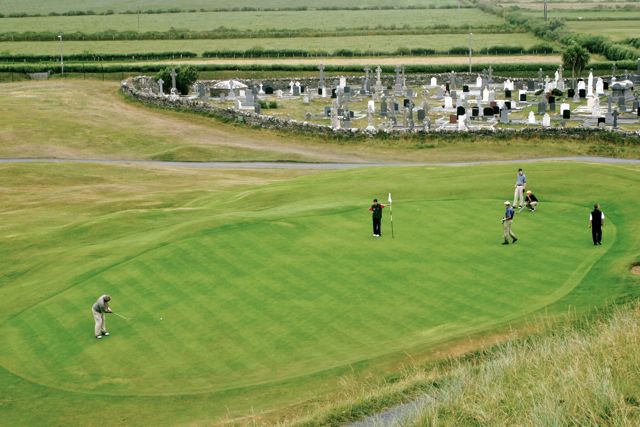
Ballybunion Graveyard & Green

Ballybunion was one of the Needle's favorite haunts. (John Garrity)

From the Post-Gazette: Frank passionately loved to play golf and played at nearly every top 100 golf course in the world, as well as many others. His favorites included Cypress Point, Pebble Beach, Ballybunion and his home course, Allegheny Country Club.

We all know name-dropping golfers who love to talk about the great courses of the world that they played. No matter what exotic course you say you teed it up at and loved, they’ll do you one better. Unless you’ve played Augusta National or Pine Valley, that is. Those are the ultimate toppers.

It was important to Archie, as he was dying, to let us know he’d checked off most of the top-100 course list. You’ve got to be serious to do that, plus have serious contacts just to get on some of those super-private tracks. Not to mention serious dough. But Archie isn’t one of those obnoxious name-droppers. He could have listed 20 more impressive clubs he had played, but he didn’t. He simply told us about his top-100 feat so we’d know how much golf meant to him, how seriously he took it. It also says something about the pride he had for his beloved Allegheny Country Club that he mentioned it in the same sentence with Cypress and Pebble and the ‘Bunion. It’s a loyal, true blue member who proudly waves the ACC flag even in his final days.

More from the Post-Gazette: His handicap peaked at 8. His exceptional play under pressure in tournaments labeled him, jokingly, as a sandbagger. Those who knew him well knew he never cheated at golf.

A handicap is a vanity. It’s a caste system for golf. It’s funny how handicaps inspire fudging at both ends of the scale. There are ego-trippers who claim to be 6-handicappers but can’t break 90 and players who can shoot in the mid-70s but keep their handicap in the low teens so they can win the bets and the events—yes, the sandbaggers.

Archie wanted us to know that at some point he’d gotten his handicap into single digits. That is the Holy Grail for amateur hackers. If you’ve got a single digit handicap at a private club, you’re a player. Note that Archie didn’t claim to still be an 8. But he wanted us to know that he could play the game at a very respectable level at one point in his life.

He also addressed the downside of the handicap system. When you play better than you’re supposed to play, better than your handicap says you’re supposed to, no one ever congratulates you, no one gives you credit. No one says, “Good for you for finally putting 18 good holes together. Way to finally play to your potential ” Nope. If you shoot 74 and you’re an 8 and your net 66 blows everyone else away, you’re just another sandbagger. Damned if you do, damned if you don’t.

This was Archie’s way of burying that unfair label. There are some amateurs—and I’ll bet Archie was one of them—who have a knack for rising to the occasion. He was probably a good putter—you have to be to get as low as 8.  I imagine Archie as the guy who always holed the putt on the 9th or 18th green when money was on the line. I picture him as clutch, the kind of guy you loved as a partner and hated as an opponent. Don’t drop the S-word on him just because he didn’t choke when the rest of would have. The man could play a little bit. Archie wants you to know that.

A hole-in-one eluded him for nearly his entire career. However, on Oct. 3, 2009, he scored a hole-in-one with a 5-iron at Allegheny’s eighth hole.

That’s another thing about golfers. There are certain things you do. Kind of a Bucket List. You’ve got to play Pebble Beach, the Old Course at St. Andrews, and a few other classic layouts before you die. And you’ve got to make a hole-in-one. It’s just one lucky shot out of thousands, but you’ve got to get one. It’s a pride thing. It is something golfers inevitably ask each other: “So, have you made an ace?” They leave off the “yet,” but it’s implied. As in, you’re not a real member of the club until you score a hole-in-one. It’s also an implied invitation to ask them about theirs… please.

Archie got his ace, all right. Just barely in time.

One year later (after the ace), Frank was diagnosed with terminal, inoperable, metastasized pancreatic cancer. He promised friends and family that he would “fight to my last breath” to beat the disease.

We know now that Archie lost that match. He was 67. He was “charismatic, charming, clowning and joking,” his obit said, and he earned his nickname, The Needle, “because of his pointed teasing with friends.” He was a former president and CEO of PPG’s Automotive Glass and Service.

His obit said that he had another nickname, “the General,” given to him by nurses at the hospital where he was born because he weighed nearly ten pounds and was much larger than the other children. “The comparison would foreshadow the remainder of his life,” the obit said. You can forgive Archie that vanity because he’d already lived the life and proved he was a business leader—a general.

Archie also wanted you to know that he was voted high school class president and later graduated with honors from Villanova University, where he was classmates with Jim Croce, the late singer-songwriter, and  played cards with him.

I’m glad Archie included golf in his obituary. It told me a lot about him. I didn’t know Archie personally, but I know golfers just like him. So do you—the successful businessman who exudes confidence at all times and is always trying to win the game, whether it’s a double-press bet or scoring a better tee time or telling a funnier story. You drop a name in the men’s grill, he drops a bigger one. It’s part of the he-who-dies-with-the-most-toys-wins mentality, except in this case it’s a he-who-plays-the-most-golf-courses-wins game. Guys like him make golf clubs fun. They make you want to hang out at the grill room and shoot the breeze—not that you’d ever actually admit that to him, naturally. That would be another win for him.

No, I never met Archie—The Needle—but it is obvious that golf had a strong grip on him. He accomplished a lot in his illustrious life. And, it seems to me, he was a real golfer. I hope—I believe—that Archie would consider that high praise, indeed.

Top 50 on TV: Nothing this week, but Pinehurst No. 2 (No. 51 on the Top 50) reopened  Monday after a thorough makeover by Ben Crenshaw and Bill Coore. The Donald Ross-designed course, which will host the 2014 U.S. and U.S. Women’s Open Championships, had 32 acres of grass and roughly 700 sprinkler heads removed. “My mouth literally falls open when I see the incredible work that they’ve done,” said USGA executive director Mike Davis, explaining why he was forced to play his round blindfolded.

4 Comments

Filed under golf

Carolina Courses Advance in Ranking

To Our Readers: Mr. Garrity, via burner phone, says that he is making final edits on his upcoming e-book, Tour Tempo 2: The Short Game and Beyond. “Recall the IT staff and renew trash pickup,” he said, followed by some language I couldn’t decipher due to loud conversation and the rattling of silverware at his end. He refused to divulge his whereabouts, but he offered a hint: “The Hague.”

The skeleton crew here at Catch Basin suspects that “The Old Man” (as we are paid to affectionately call him), is actually on a North Carolina golf holiday. We deduce that from the sudden advancement (from No. 51 to No. 18) of Mid Pines Inn & Golf Club of Southern Pines, N.C. and the appearance, at No. 50, of the Country Club of North Carolina Dogwood Course of Pinehurst, N.C. Inasmuch as the IT staff has been on unpaid leave (and since Mr. Garrity is traveling with the Bomar Brain), the updated rankings have to be The Old Man’s work. Also, we found a filled-out entry form for the Golf Writers annual golf tournament on his desk. (He listed his handicap as 10. LOL)

“Big things are in the works,” he shouted before hanging up.

While we wait for further orders, we’re dusting the computer room tarps and checking the mousetraps. We’ll keep you informed.

Thank you for your understanding,

Ethan Mobely, v.p. customer relations/outsourcing

Top 50 on TV: The Masters will be held, once again, at the fourth-ranked Augusta National Golf Club and the 47th-ranked Augusta National Practice Range.


1 Comment

Filed under golf

A Memo from Catch Basin

To Our Readers: Mr. Garrity has asked me to explain the recent paucity of posts on this site. “Tell my loyal fans to be patient,” he said, using a burner phone from an undisclosed site. “I’ll be back up to speed as soon as I finish the draft of TT2. In the meantime, send the Kansas City staff home and tell them to wait for further instructions.” He then muttered something that sounded like, “Nobody’s clawing their way into the middle class on my dime,” but he hung up before I could say anything.

Chantilly Aqua Range

The blooming azaleas of Augusta National are harbingers of spring and the Masters. (John Garrity)

TT2, by the way, is shorthand for Tour Tempo 2: The Short Game and Beyond, the long-awaited sequel to Tour Tempo: Golf’s Last Secret Finally Revealed, now in its 11th printing. We here at Top 50 headquarters assume that Mr. Garrity is holed up somewhere with John Novosel, his Tour Tempo co-author. The new book will be released later this spring on an array of electronic platforms.

In the meantime, Mr. Garrity has secured an agreement from the top 200 courses that they will make no improvements and countenance no deterioration until he returns. That way, the rankings will not be affected.

“If you can find a generic golf course photo, post it,” he said in the call. “Slap a caption on it. Something to do with Augusta National would be good, the Masters is coming up.”

Thank you for your understanding.

Ethan Mobely, v.p. customer relations/outsourcing

1 Comment

Filed under Uncategorized

Top 50 Has Stones to Challenge Malcolm Gladwell on Rankings

It’s been a while since we answered anonymous voice-mail questions, so here goes.

When can we expect your Top 50 list of Russian courses?

How about when Russia has fifty courses? Or forty. Or thirty. Or ten.

Sorry, I meant China.

The Chinese Top 50 was ready for posting in January, but the staff here at Catch Basin put it on hold pending investigation of our Yunnan Province course-rating team. The Yunnan division raised eyebrows when it touted a new 54-hole country club outside Kunming, the provincial capital. Three courses, allegedly designed by Schmidt-Curley Design of Scottsdale, Az., were supposedly threaded through a primordial landscape of karst peaks, pines and lakes. Playing as long as 7,565 yards, the Leaders Peak course was reported to have no bunkers (implausible) and an island green surrounded by rock instead of water (an impossibility). One of the architects was quoted as saying, “We wanted the stone to be the show.”

12th Hole at Stone Forest, China

Stone Forest: China's answer to Rocky Road ice cream?

Unfortunately, that quote was translated into Mandarin and back into English, so it came to us as “We got stoned at a show.” Horrified, we promptly fired our Yunnan course raters and hired a second-rater from Hong Kong, who now informs us that the original report was accurate in its particulars, if sloppy in its expression. The new golf complex, Stone Forest International Country Club, recently opened for play, and it does, indeed, provide a rocky experience for golfers of all abilities — all within a stone’s throw of Kunming, a city of nearly 6 million at the northern edge of Dian Lake.

Anyway, we’re ready to release our Chinese Top 50 — once our second-rater decides which of the three Stone Forest courses is the best.

Malcolm Gladwell, in a recent New Yorker, makes a devastating critique of U.S. News & World Report’s “Best Colleges” guide and, by extension, all service-journalism rankings. Do you think your pseudo-scientific golf course list is any better than the Consumer Reports and Car and Driver ratings that he demolishes?

Funny you should ask. I, myself, have debunked all three of those sloppy, self-serving lists, and I did so when Gladwell, as a barefoot boy in Hampshire, was still learning to use a curling iron. Three decades ago, for instance, I blew gaping holes in a “Most Livable Cities” survey that had Honolulu ranked 47th among American metropolises, 27 rungs lower than [drum roll} … Warren, Ohio! To correct their error, I recommended that they simply add the category, “Public and Private Garage and Parking Lot Landscaping.” I assume they took my advice, because the following year’s rankings had Honolulu somewhere in the top ten, while Warren was no longer recognized as an American city.

But to answer your question, my Top 50 has nothing in common with the flawed surveys in Gladwell’s article. That’s because it is unassailably “my” Top 50 — not yours, not GOLF Magazine’s and certainly not Gladwell’s.

I hear that Pinehurst No. 2 is reopening after a renovation by the Crenshaw-Coore design team. Will their changes boost the greatest of all Donald Ross courses into the Top 50?

I thought No. 2 was in my Top 50, but the boys in the computer room tell me that it dropped to 111th when I penalized it 400 points for having mats on the driving range. (Sorry, Pinehurst.) I’m a big fan of Crenshaw-Coore’s work, so I wouldn’t be surprised if No. 2 moves up dramatically before it hosts the 2014 men’s and women’s U.S. Opens. I definitely like the natural “dunes look” of the rebuilt bunkers. I just wish they had thrown in a few of Ross’s old “chocolate drop” mounds; that was a swell way of concealing construction debris without having to pay someone to truck it off to the dump.

Top 50 on TV: Nothing this week, but SI.com features a “Behind the Mic” video of Sir Nick Faldo forecasting this year’s Masters, “where the real drama starts.” Faldo correctly points out that intermediate and short-iron play will be the key to winning at Augusta National, along with putting (‘blistering-quick greens”) and driving (“very important”). Rut-iron play, in other words, will not be a factor.

1 Comment

Filed under golf

The Secret’s Out: “This Old Course” Returns to SI Golf Plus

It’s no longer a secret. The first installment of This Old Course 2011 has just appeared in the February 21 edition of Sports Illustrated Golf Plus, and the course getting a world-class makeover is [drum roll] …. top-ranked Askernish Old!

“This Old Course,” if you need reminding, is the award-winning, decennial series that gives readers a builder’s-eye view of a complete golf course renovation, from the first member’s complaint that the greens are too bumpy to the last grudgingly-signed check for excavator rental.* The 2001 series focused on Bobby Weed’s total redesign of the University of Florida Golf Course, an original Donald Ross layout. Number 421 in the Top 50 before Weed’s do-over, UF’s course is now ranked 39th — possibly due to SI’s 16 articles on the project (which is roughly double the attention that TIME devoted to last year’s mega-series on Detroit’s urban crisis).**

*Full disclosure: I am the author of the series.

**I was also the author of the 2001 series.

The return of This Old Course has been met with the expected acclaim:

Turf cutting at Askernish Old

The work has begun at top-ranked Askernish Old. (John Garrity)

Is it ten years already? It must be time to have the house repainted.” — SI’s Gary Van Sickle

“The 2001 series was better.” Course designer Bobby Weed

‘“Askernish Old’ is the name used by a number of golf writers to describe the 1891 Old Tom Morris designed golf course on remote South Uist, an island in Scotland’s Outer Hebrides that was quite literally ‘lost in the sands of time’ and rediscovered in 2005. It has since been restored and as far as I know is currently the only course on the island … unlike St. Andrews you will find no ‘Askernish New.’” — Shivas Irons Society president Steve Cohen

There are subtle differences between the two series. The Askernish coverage will be shorter — five articles in all, terminating in late June. The course work is also scaled down. In fact, Old Tom’s ghost course will look pretty much the same in July as it did a month ago, when work started. “We like to cover our tracks,” explains Eric Iverson, the on-site man for Tom Doak’s Renaissance Golf Design. “We try to make it look like we’ve never been there.”

That’s a good philosophy to have, it seems to me, when you’re working on the world’s top course.

3 Comments

Filed under golf

Price? It’s No Indicator of Quality Golf

“I know your rankings are baloney,” writes a reverse-mortgage broker from Decatur, Ga. “How do I know? Because you’ve got so-called “top fifty” courses that I can play for less than fifty dollars. You know as well as I do that great golf is expensive. As my dad used to tell me, ‘If you can afford to play it, it’s not worth playing.’”

Reading Decatur’s words, I have to chuckle. The Cal Sci algorithm that we use to pick the Top 50 includes practically every variable that might go into a course ranking system, including admittedly off-beat criteria such as flag-material thread count and average-wind-speed-to-ambient-grade ratio. But we have never — I repeat, never — fed the price of a round into our computers.

Think about it. If cost were proportional to quality, you wouldn’t need a course rating. You’d simply Google “most expensive golf” and up would pop your number one course: Shadow Creek Golf Course of Las Vegas, Nevada. ($500 per round.) Right behind Shadow Creek, according to copycat web sites, are Pebble Beach Golf Links ($475) and Old Head Golf Links of Kinsale, Ireland ($400).

17th Green at Pebble Beach

Pebble Beach: Always a delight, but never a bargain. (John Garrity)

Change the search to “most expensive golf clubs” and you get a gaggle of neighboring clubs on Long Island, N.Y., including four-time U.S. Open venue Shinnecock Hills GC, the National Golf Links of America, Atlantic GC, and The Bridge, all of which cost between a half-million and $750,000 to join. (And only if you’re invited!) The ten founding members of Sebonack GC, meanwhile, forked over $1.5 million each to play in the dunes along Great Peconic Bay. Which tells you that your average Hamptons golfer can treat you to a round at Shadow Creek with change found under his sofa cushions.

Of those eight courses, you will note, only Pebble Beach is in my Top 50. That’s because I recognize the absurdity of evaluating a course by its price tag. First of all, green fees can and do change, independent of course conditions. When I first played the  16th-ranked Old Course at St. Andrews, I paid something like 22 British pounds. Today, I’d have to pay a high-season rate of 130 pounds. Is the Old Course 5.9 times better than it was in 1990? Of course not!*

*It’s only 1.07 times better, and that’s due to improved parking around the Links Clubhouse, which opened in 1995.

A second reason to discount price is that it empowers Donald Trump.

A third reason …. but do I have to go on?

My old friend Jaime Diaz, the best print analyst in golf today, supports my views in the current Golf World. In a column headlined “Bigger Didn’t Make Golf Better; Some Tips on Saving the Game,” Jaime lands a few good jabs on the jaw of golf-industry bloat, including the cogent point that modern courses have been stretched to absurd lengths, making the game far too difficult for the average player. His solution: shorten ‘em.

“Longer term,” he goes on, “the greatest opportunity to turn the game around lies in the way people learn it ….”

“Over the years I’ve been increasingly struck by how many of the most accomplished and fulfilled golfers started out playing young and on the cheap, usually at a ragtag course where they could go round and round. More often than not, they learned technique by copying better players, with the final process one of simple and often zone-inducing trial and error. As Michael Hebron, a PGA Master Professional, likes to say, ‘You play to learn, not learn to play.'”

Askernish's "Old Tom's Pulpit" green

Askernish: Full membership for 125 British Pounds per year!

Yes! Now, flick your eyes to the sidebar on the right. You’ll see that the top two spots in the Top 50 are held by Askernish Old and Carne, two peerless links courses whose combined construction costs wouldn’t match what The Donald will spend on clubhouse art for his overblown Trump International Golf Links in Aberdeenshire. Neither Askernish nor Carne have valet parking, bag boys or teaching pros. Neither has a full-service practice range. Or cart paths. Or ball washers. What they have in abundance are spectacular dunes, awesome views, unforgettable holes, and summer days that go on and on and on.

Yes, Askernish and Carne would drop in the ranking if our algorithm gave points for sky-high green fees. But it doesn’t. It gives points for teenagers deciding to skip dinner to squeeze in another 18 before dark.

Tell us we’re wrong.

Top 50 on TV: Uh …. forget what you just read. Two of our priciest courses are on display this weekend at the AT&T Pebble Beach National Pro-Am — the luxe Pebble Beach Golf Links (No. 9) and the very exclusive Monterey Peninsula Country Club (No. 46). All we can say in our defense is that we’ve never spent a penny at either one of them. (It’s good to be a golf writer!)

1 Comment

Filed under golf

Merion Tops Van Sickle Bucket List

SI senior writer Gary Van Sickle took an apologetic tone in a recent e-mail. “Forgot to give you my must-play list,” he wrote. Then he shared his list. Then he apologized again. “I’m sure I left out some big course I haven’t played yet, but this was right off the top of my head and, as you know, there isn’t much left up there.”

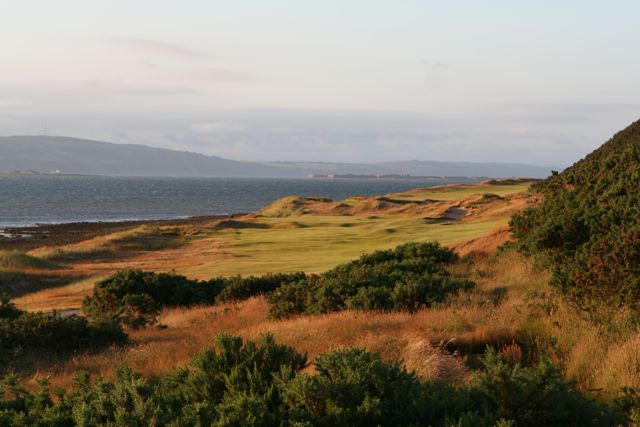
Castle Stuart 10th Tee

Castle Stuart: Come July, Eurotour will pay the piper.

He continued: “Colonial? I’ve walked it so many times, but I’m not sure if I’ve actually played it. There’s still eight states I haven’t played golf in, but I’m working on it. Amazingly, Kansas is one of them. Also the Dakotas and most of the Pacific northwest, except Washington.”

Gary drew up his list of “great courses I have yet to play” in response to my own bucket list of must-play tracks, which was, in turn, inspired by “Travelin’ Joe” Passov’s wish list on Golf.com. Gary, like Joe, has played more than a thousand golf courses and, like me, he prefers to change his shoes in the parking lot. That may explain why Gary hasn’t gotten invitations from the most exclusive clubs on his list.

Anyway, here’s Gary’s bucket list:

1. East Course, Merion Golf Club, Ardmore, Pa.  (“Covered my first U.S. Open there. David Graham beat George Burns.)

2. Bandon Dunes Golf Resort, Bandon, Ore. (“Haven’t been there yet.”)

3. Bandon Dunes Golf Resort, Bandon, Ore. (“The second course. Or is it the third?”)

4. Bandon Dunes Golf Resort, Bandon, Ore. (“Isn’t there one they sing about in kindergarten?”)

5. Sand Hills Golf Club, Mullen, Neb. (“Haven’t been there either.”)

6. Seminole Golf Club, Juno Beach, Fla. (“If Bob Ford is their pro in the winter, it’s got to be a good club. Hard to believe a course in Florida could be anything special, though. It’s freakin’ Florida.”)

7. National Golf Links of America, Southampton, N.Y.. (“Who doesn’t love windmills? They’re fantastic in miniature golf.”

8. Fishers Island Club, Fishers Island, N.Y. (“Not even sure where it is, but everybody raves about it. I suspect it’s like Tickle Me Elmo. Fantastic when nobody can get one. When the shelves are full of them, it’s just another toy.”)

9. Philadelphia Cricket Club, Philadelphia, Pa. (“Bamberger is a member there. Screw him.”)

10. The Camargo Club, Cincinnati, Ohio. (“Reminds me of my favorite knock-knock joke. Who’s there? ‘Argo.’ Argo who? ‘Arrr, go f— yourself.’”

“That’s my American list,” Gary wrote. “I could start talking about all the great courses I’ve missed in Scotland and Ireland, but there’s too many, and it’s just too sad to think about.” And finally, after thinking about it: “Castle Stuart!”

I have played only one of the courses on Gary’s list — Seminole — but four of his wannaplays are in my Top 50. This proves that courses can’t buy or bribe their way into my rankings.* It’s also a good test of Travelin’ Joe’s theory that a golf writer can shorten his bucket list by publishing a Ten-Courses-I-Need-to-Play column. (An invitation to  play Prairie Dunes has already fallen into Joe’s hopper. Can Cape Kidnappers be far behind?)

*Although I’m always willing to parse the Top 50 over a sandwich and 7up at the halfway house of any course in GOLF Magazine’s Top 100.

I, meanwhile, have heard nothing from Indian Army 9-Hole Golf Course (Ladakh) or any of the other courses on my own wish list, posted a couple of weeks ago. Is it too soon to write my Ten-Most-Overrated-Golf-Courses column?

Top 50 on TV: Nothing this week, but the European Tour has confirmed that Castle Stuart Golf Links of Inverness, Scotland, will the new venue for the Scottish Open. The Eurotour’s decision was almost certainly driven by two-year-old Castle Stuart’s Top-10 ranking in this space. In appreciation, the technical staff at Catch Basin has boosted Castle Stuart two rungs to No. 7, replacing Pebble Beach Golf Links as the world’s best cliffside course. The Cal Sci Algorithm will be jiggered to reflect the change.

1 Comment

Filed under golf